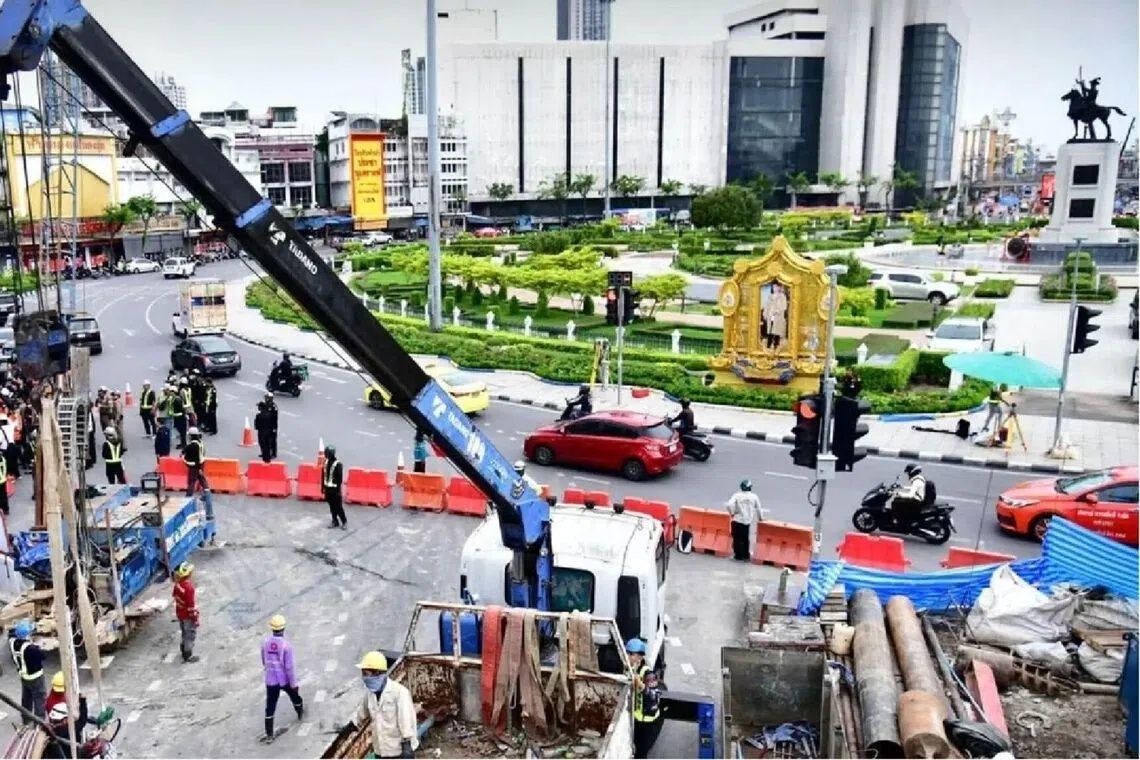
Authorities in Bangkok have initiated a major evacuation operation affecting about 60 residents from three commercial buildings situated within 30 metres of a ground subsidence incident near Wongwian Yai station. The incident emerged from water leakage inside a drainage sump at the deepest section of the southern Purple Line construction tunnel, allowing soil to progressively flow into the underground structure and triggering visible subsidence of the road surface above. The affected area has triggered heightened concerns about the structural integrity of neighbouring properties, prompting swift intervention by the Bangkok Metropolitan Administration and project contractors.
Governor Chadchart Sittipunt personally visited the subsidence site on July 9 alongside deputy governor Wisanu Subsompon and deputy permanent secretary Kanokwan Iamlim to assess the situation. Officials indicated that while water levels and the rate of ground movement have begun stabilising, continuous round-the-clock monitoring remains essential to detect any renewed deterioration. The evacuation decision reflects the precautionary approach adopted by Bangkok authorities when confronted with infrastructure emergencies that could endanger public safety, even as preliminary indicators suggest the situation has not sharply worsened.
The displaced residents have been relocated to temporary accommodation arrangements, including hotel facilities, with expectations that they will remain away from their residential and commercial premises for approximately one week. The Mass Rapid Transit Authority of Thailand's contractor has assumed financial responsibility for covering accommodation expenses, compensation payments, and related costs incurred by affected residents. Before occupants are permitted to return or any restrictions are lifted, engineers must conduct comprehensive stability assessments of both the buildings and the broader surrounding infrastructure network.
To enhance real-time detection of any further structural movement that could signal renewed ground instability, the Department of Disaster Prevention and Mitigation deployed two Rescue Guardian monitoring units on structures positioned close to the damaged road. These sophisticated instruments continuously measure building tilting and structural displacement, automatically transmitting data to a central monitoring system that triggers immediate alerts if abnormal movement patterns emerge. The sensors were positioned within approximately 30 metres of visible cracks identified in the road surface, ensuring comprehensive coverage of the highest-risk zone.
Engineers from Thailand's national Urban Search and Rescue team joined the inspection effort to thoroughly evaluate neighbouring structures and validate that response measures conform to established engineering standards and public safety protocols. The Department of Disaster Prevention and Mitigation mobilised generators, specialised lighting equipment, and other technical machinery to facilitate continuous overnight monitoring and repair operations. Rescue foundations and volunteer organisations were placed on standby alert, prepared to provide emergency medical assistance or facilitate patient transfers should circumstances deteriorate unexpectedly.
A forward command centre has been established immediately adjacent to the subsidence point to coordinate operational activities among multiple agencies including the BMA, the MRTA, the construction contractor, district authorities, police units, and various emergency response teams. The immediate technical objective focuses on sealing the water leak and preventing additional soil from being extracted into the underground tunnel. Continuous instrumental monitoring tracks road surface conditions, soil movement rates, water leakage volume, and the structural condition of neighbouring buildings.
The problematic tunnel section forms part of the same southern Purple Line construction alignment that experienced a previous road collapse incident near Vajira Hospital, though the two projects are being executed by different contractors. This history underscores recurring risks associated with Bangkok's ambitious mass transit expansion programme and the complex geological and hydrological challenges that deep tunnel construction presents in the city's dense urban environment. The recurrence of subsidence problems on the same line raises questions about whether consistent engineering protocols and site-specific geological assessments are being uniformly applied across the project.
Authorities have completely closed all outbound lanes of Prajadhipok Road between Ban Khaek intersection and the King Taksin the Great Monument at Wongwian Yai, affecting a stretch of approximately 200 metres. This closure decision reflects efforts to minimise traffic vibration that could further destabilise surrounding soil or compromise the structural condition of nearby buildings. Traffic management measures include converting two inbound lanes for temporary outbound vehicle use. Motorists arriving from Memorial Bridge or Phra Pok Klao Bridge have been directed to turn at Ban Khaek intersection and utilise alternative routes via Itsaraphap, Lat Ya, or Somdet Chao Phraya roads.
The closure creates significant challenges for an area already recognised as a major traffic bottleneck, particularly given the concentration of large educational institutions in the vicinity, including Suankularb Wittayalai School and Suksanari School. Governor Chadchart has indicated that Bangkok may implement traffic mitigation measures previously deployed following the subsidence incident near Vajira Hospital, potentially involving expanded school shuttle services designed to reduce the volume of private vehicles accessing the area during peak hours. Such measures would represent a coordinated effort between transport authorities and educational institutions to minimise community disruption during the road closure period.
Official sources have stated that traffic restrictions will be progressively eased only after engineers formally confirm that all buildings, the roadway, and surrounding infrastructure meet established safety standards. Additional traffic management arrangements will be announced once officials determine the anticipated duration of the closure. The pace of recovery depends substantially on the success of repair operations aimed at stopping water leakage and stabilising the subsiding ground, processes that typically require several weeks of careful engineering work and continuous monitoring.
For Malaysian readers and Southeast Asian observers, this incident illustrates the substantial technical challenges and financial costs inherent in constructing deep underground mass transit systems in tropical urban environments. Bangkok's ongoing Purple Line expansion, while essential for addressing severe traffic congestion, has repeatedly demonstrated the vulnerability of such projects to subsurface complications. Similar planned or under-construction metro systems across Southeast Asia, including Malaysia's ongoing MRT network expansion, face comparable geological and hydrological risks that demand rigorous engineering oversight, transparent project management, and robust contingency planning to protect public safety and minimise community disruption.

