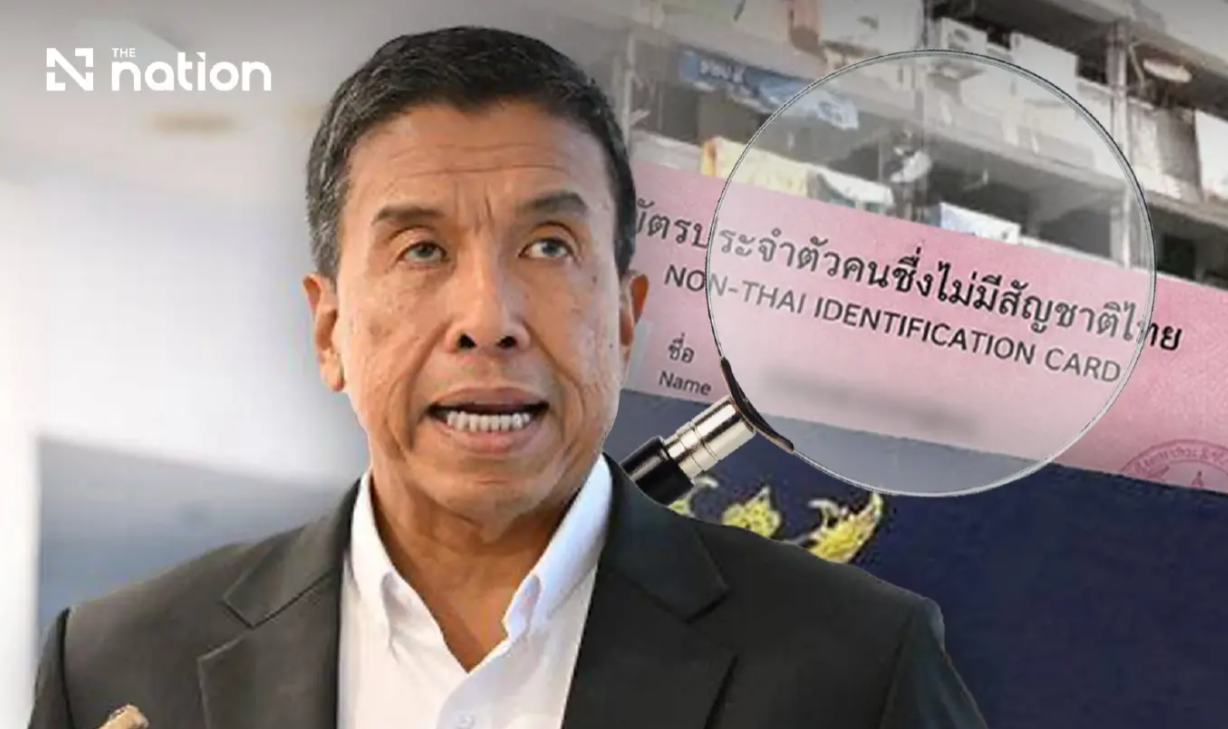
Bangkok Governor Chadchart Sittipunt has launched a sweeping decade-long investigation into household-registration records across the Thai capital's 50 district offices, responding to emerging evidence of systematic fraud involving pink cards—the identity documentation issued to non-Thai nationals residing in Thailand. The auditing exercise will scrutinise records stretching back to 2017, examining whether individuals without Thai citizenship were unlawfully inserted into household registrations to facilitate fraudulent pink-card applications that would otherwise be ineligible.
The investigation exposes significant vulnerabilities embedded within Thailand's civil-registration architecture, weaknesses that enterprising fraudsters appear to have exploited with considerable sophistication. At the heart of these schemes lies a concerning pattern: non-Thai nationals found pathways to establish themselves within the formal household-registration system through deceptive means, then leveraged this official status to obtain pink cards that should never have been granted. Bangkok's authorities now face the daunting task of unpicking multiple years of potentially compromised administrative records to identify where legitimate registrations end and fraudulent ones begin.
The most striking manifestation of the fraud emerged in Din Daeng district, where investigators discovered a single residential property measuring approximately 40 square metres—barely larger than a modest apartment—with between 40 and 45 individuals listed as household members. This dramatic clustering of names at one address proved impossible to reconcile with basic residential capacity, triggering closer examination. Subsequent reviews of Din Daeng's 2024 registrations alone uncovered more than 2,000 suspicious address transfers, suggesting the problem extends far beyond isolated incidents and points instead toward organised, systematic manipulation of the registration system.
Dissecting the mechanics of these schemes reveals considerable ingenuity in circumventing safeguards. One approach exploited birth certificates issued in Thailand to children born to foreign parents who subsequently relocated abroad. Despite the children's departure, their certificates remained on file in Thailand—and were then leveraged as anchors for transferring unrelated individuals into household registrations under false identities. Other variations involved creating phantom relationships entirely, fabricating parent-child ties or reassigning names from centralised registers into ordinary household files, all designed to create the paperwork foundation necessary for pink-card applications. These methods suggest involvement by people with intimate knowledge of bureaucratic procedures, whether rogue officials or external brokers with insider connections.
The administrative response has already commenced, with four Bangkok Metropolitan Administration employees temporarily suspended pending disciplinary hearings. This action, officials stressed, does not constitute proof of guilt but rather reflects the seriousness with which authorities are treating preliminary findings. The investigation remains very much in motion, with police involvement deemed essential to uncover the financial dimensions of the suspected scheme. Bangkok's administrative apparatus lacks independent authority to compel external parties—particularly suspected brokers operating in the shadows—to disclose financial records or transactions, making police investigative powers crucial to tracing money flows and establishing whether payments facilitated the fraud.
Governor Chadchart has instructed each of Bangkok's district offices to submit preliminary reports by the deadline established for late August, beginning the systematic extraction of potentially incriminating evidence from five years of accumulated records. The investigation committee being established will examine not merely the registrations themselves but also the conduct of personnel involved in processing them, with particular attention to determining whether any chain of approvals was deliberately bypassed or corrupted. Chadchart explicitly committed to pursuing the inquiry wherever evidence leads, including into the ranks of retired senior officials or executives, suggesting investigators are prepared to contest powerful institutional interests if culpability emerges.
Expanding the probe beyond Din Daeng, the governor cautioned that preliminary estimates suggesting approximately 3,000 questionable registrations remain unconfirmed. These cases, he explained, may be dispersed across multiple properties rather than concentrated in single locations, making systematic detection considerably more challenging. Initial screening will focus on identifying homes with at least 15 registered residents—a threshold that, while already extraordinary for typical Thai households, will subsequently be lowered to enable broader random sampling of individual properties. This graduated approach reflects recognition that not all unusual concentrations necessarily indicate fraud; some may have legitimate explanations, and the inquiry must distinguish between the two without inadvertently punishing lawful residents.
Beyond immediate investigation, the Bangkok Metropolitan Administration is engineering structural reforms intended to prevent recurrence of similar schemes. Approval authority for registrations will be dispersed among district directors and section heads rather than concentrated in individual officers, thereby institutionalising checks and balances that reduce opportunities for unilateral abuse. Officials assigned to sensitive registration positions face potential periodic rotation, disrupting the entrenched relationships and extended tenure that can enable institutional corruption to flourish unchecked. These procedural adjustments acknowledge a fundamental truth: comprehensive solutions to administrative fraud require not merely investigation of past wrongdoing but also redesign of systems that permitted vulnerability in the first place.
The implications of this disclosure reverberate beyond Thailand's borders into Southeast Asia's broader immigration and documentation landscape. Regional neighbours, including Malaysia, maintain their own systems for registering foreign residents and issuing identity credentials, systems potentially vulnerable to analogous manipulation. The Bangkok case demonstrates how sophisticated actors can weaponise bureaucratic complexity and insider knowledge to undermine the integrity of documentation systems. For Malaysian policymakers and administrators, the investigation offers a cautionary lesson regarding the necessity of robust internal controls, regular audits of sensitive registration functions, and cross-institutional coordination to prevent analogous schemes from taking root within Malaysian registries.
Chadchart confirmed that expanded anti-corruption policies will place heightened emphasis on administrative and civil-registration functions, signalling a broader institutional reckoning with governance failures. Working procedures will be reviewed to enhance transparency while ensuring legitimate applicants face no unfair prejudice from the investigation. This balancing act—simultaneously pursuing wrongdoing while protecting innocent parties—represents one of the investigation's fundamental challenges. Success requires distinguishing between those knowingly participating in fraud and those whose registrations may appear irregular through no fault of their own, a distinction that demands careful, methodical examination of each case rather than blunt institutional responses.
The unfolding investigation in Bangkok represents a significant test of Thailand's capacity to confront systematic administrative corruption. The discovery that non-Thai nationals could exploit civil-registration vulnerabilities to obtain identity documentation they should not legally qualify for undermines confidence in foundational systems meant to ensure order within state machinery. As the audit progresses and findings crystallise, the investigation will reveal not merely the scope of the fraud but also the depth of institutional deficiency that permitted it to flourish for an extended period across multiple district administrations.

