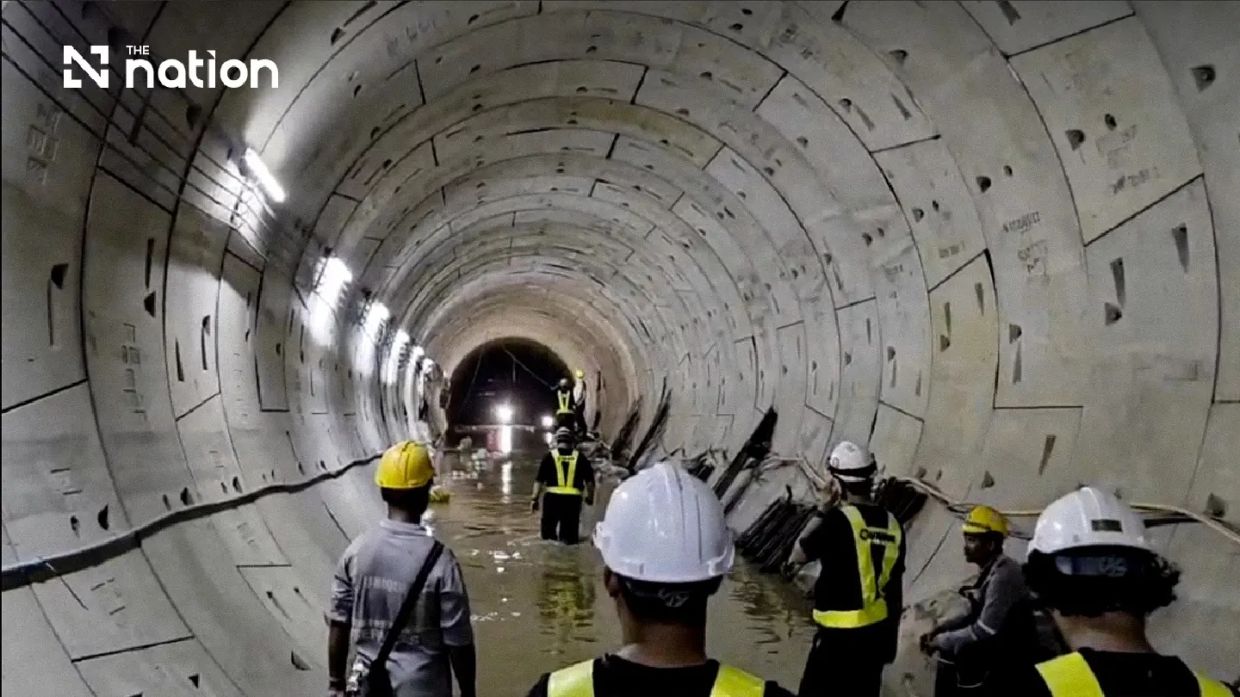
Water infiltrated an underground construction shaft beneath Bangkok's southern Purple Line extension following intense rainfall on July 8, triggering an emergency safety response from Thailand's transport authorities and prompting Prime Minister Anutin Charnvirakul to visit the Wongwian Yai worksite shortly after midnight. The leak occurred within the tunnel section of the Tao Poon–Rat Burana, or Kanchanaphisek Ring Road, segment of the rail project, where water levels rose significantly throughout the day as precipitation accumulated. The incident underscores the vulnerability of massive underground infrastructure projects to Bangkok's unpredictable monsoon conditions and raises fresh concerns about construction management at a time when the capital's transit system remains under intense scrutiny.
The immediate response demonstrates how seriously Thailand's government views structural failures in transport infrastructure. Deputy Prime Minister and Transport Minister Phiphat Ratchakitprakarn, along with fellow deputy transport ministers Siripong Angsakulkiat, Phattharaphong Phatraprasit, and Sanphet Boonyamanee, descended on the site before the Prime Minister's arrival. Deputy Interior Minister Worasit Liangprasit also attended, alongside Gardphajon Udomdhammabhakdi of the Mass Rapid Transit Authority of Thailand (MRTA) and Prasong Suviwattanachai, the executive chairman of construction firm Unique Engineering and Construction Public Company Limited (UNIQ), which is handling the contract worth 14.982 billion baht.
The affected area forms part of Contract 4 of the Purple Line's southern extension, specifically the Saphan Phut–Dao Khanong section stretching from the main northern line towards outer Bangkok. Current construction operations involve extracting tunnel material and building retaining walls—work that becomes hazardous when water enters the excavated space, potentially compromising structural integrity and worker safety. The project's overall complexity intensifies when factoring in the dense urban environment surrounding the construction zone, where nearby buildings and road networks depend on stable ground conditions.
Initial assessments by Deputy Transport Minister Phattharaphong indicated that the situation remained manageable, though he ordered comprehensive technical investigations to identify the leak's precise origin and mechanism. The MRTA and UNIQ received explicit instructions to implement corrective measures swiftly, prevent damage to tunnel structures, protect public safety, and maintain the construction schedule. Regular progress reports to the Transport Ministry became mandatory, with all work required to adhere strictly to engineering and safety protocols—language suggesting earlier concerns about project oversight standards.
The Prime Minister's characterization of the incident as fundamentally different from the catastrophic Vajira Hospital tunnel collapse—which occurred in late September 2025 and involved complete structural failure with surface subsidence—aimed to reassure both the public and investors that authorities had detected and contained this problem early. Anutin emphasized that officials observed the leak from its onset and immediately mobilized resources to seal breaches while monitoring water levels, demonstrating proactive management rather than reactive crisis control. The distinction matters considerably for public confidence in the Purple Line project, which has faced mounting skepticism following earlier disasters.
Water management became the critical variable in the hours following the leak's discovery. Engineering teams deployed equipment to track ground movement in adjacent structures, identifying any warning signs of subsidence or structural stress. As of the Prime Minister's midnight visit, monitoring systems had detected no abnormal behaviour, though the area would remain under constant surveillance. The MRTA's installation of movement-tracking apparatus reflects lessons learned from previous failures, where early warning systems might have provided crucial evacuation time and prevented injuries.
Anutin's late-night appearance at the construction site, which some observers characterized as politically motivated, actually reflected the administration's determination to prevent another high-profile infrastructure failure that could damage public trust further. The Prime Minister's explanation that he simply announced his intention to visit through a group message downplays the symbolic weight of such involvement, yet it highlights how infrastructure disasters in Thailand's capital attract immediate executive attention. The Vajira Hospital collapse had served as a difficult but instructive lesson about the necessity for rapid response, adequate public communication, and sustained operational oversight.
The context of Bangkok's ongoing Purple Line expansion remains significant for regional observers, particularly Malaysian stakeholders following Thai infrastructure development. The project represents a substantial investment in the Thai capital's public transport capacity, designed to relieve congestion and integrate peripheral areas into the metro network. However, the series of construction incidents has raised questions about contractor competence, regulatory enforcement, and the adequacy of geological surveys in a city built on alluvial plains with complex subsurface conditions. UNIQ's performance on this contract will likely influence future project awards throughout Southeast Asia's expanding metro networks.
Rainfalls of the intensity experienced on July 8 occur regularly during Bangkok's monsoon season, typically from May through October. Construction firms undertaking major underground work must anticipate such events and implement comprehensive water management systems, including adequate drainage, pumping capacity, and contingency protocols. The Purple Line project's vulnerability to relatively predictable weather patterns suggests that either drainage design proved inadequate or that site-specific conditions posed unforeseen challenges. Either scenario raises questions about pre-construction investigations and adaptive management during the execution phase.
Malaysian audiences should observe the Purple Line situation closely, as Southeast Asia shares similar climatic challenges and urban development pressures. Several Malaysian cities are pursuing their own rapid transit expansions, including extensions to Kuala Lumpur's MRT and LRT networks, as well as entirely new metro systems in other urban centres. The engineering lessons—both positive and negative—from Bangkok's experiences provide valuable reference points for Malaysian planners and contractors. Adequate investment in geological surveys, robust contingency planning for monsoon conditions, and transparent reporting of construction incidents represent best practices that benefit the entire region's infrastructure development.
The MRTA's commitment to accelerated repairs and restoration of normal conditions signalled that authorities intended to minimize disruption to surrounding areas while completing corrective work. The infrastructure project remains on track, barring any discoveries of more extensive structural compromise during detailed investigations. However, the leak incident reinforces the reality that underground transit projects in tropical megacities demand exceptional planning, continuous monitoring, and genuine preparedness for environmental stresses that can emerge despite thorough design processes.
Moving forward, the incident's resolution will substantially influence public perception of the Purple Line's safety and the government's competence in managing complex infrastructure. Thailand's transport sector cannot afford further major failures, as successive incidents erode public confidence in both private contractors and public agencies responsible for oversight. The coordination demonstrated at Wongwian Yai on July 8—bringing together ministers, regulatory authorities, and construction professionals—suggests that institutional memory from earlier disasters has embedded itself within Thailand's transport administration. Whether such coordination translates into fundamentally improved construction practices and standards remains the central question for Southeast Asia's rapidly expanding urban rail networks.

