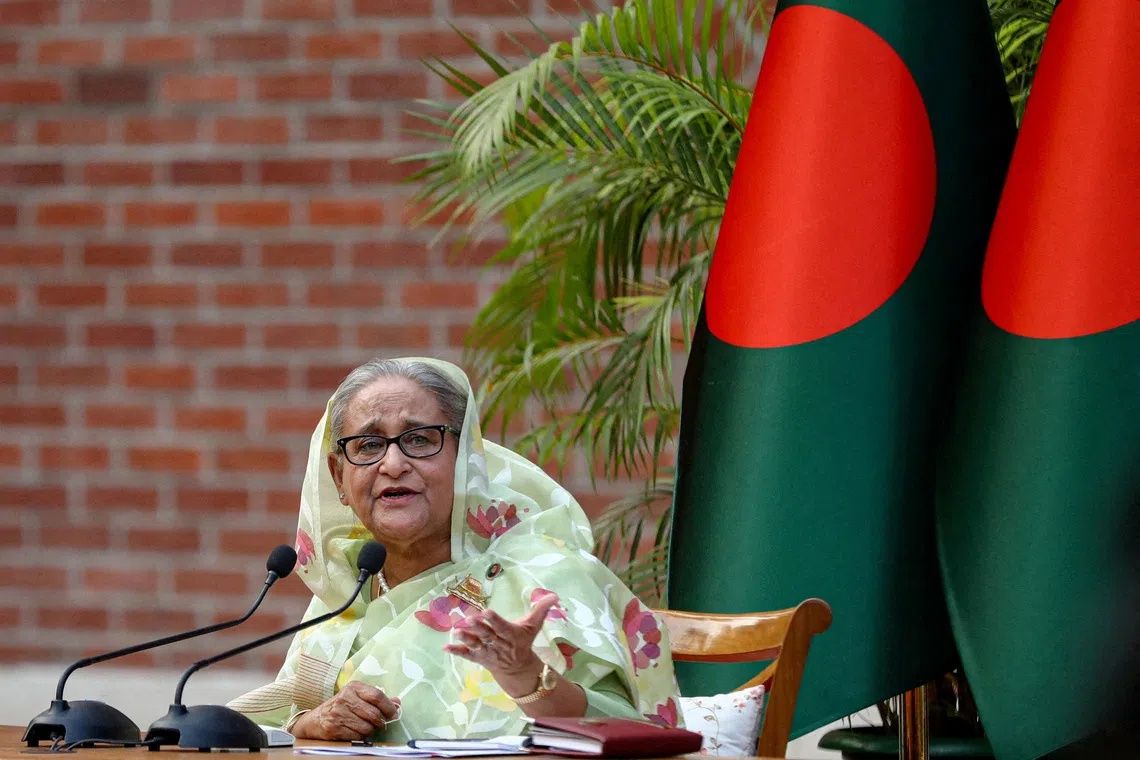
Bangladesh's government has formally requested that India spell out its position regarding exiled former prime minister Sheikh Hasina's planned virtual address scheduled for New Delhi on August 5, cautioning that permitting such political engagement by a fugitive could jeopardise the recent warming of ties between the two South Asian neighbours. The development marks Dhaka's first official statement addressing Hasina's appearance at an event organised by the Foreign Correspondents' Club of South Asia, which will commemorate two years since the student-led uprising that dismantled her administration in August 2024.
Shama Obaed Islam, Bangladesh's State Minister for Foreign Affairs, articulated the government's unease during a media briefing on Monday, emphasising that Dhaka has invested considerable diplomatic effort in rebuilding relations with New Delhi. She underscored that Bangladesh remains committed to a constructive partnership with India but expects New Delhi to reciprocate by preventing its territory from becoming a staging ground for political activities by individuals facing serious criminal allegations. The minister's carefully calibrated language reflected the delicate balance Dhaka must strike—maintaining strategic ties with New Delhi while simultaneously pursuing accountability for those held responsible for the violence that toppled Hasina's government.
The context surrounding this diplomatic contention is significant for understanding regional dynamics. Hasina fled to India in August 2024 following weeks of violent unrest that resulted in substantial loss of life, with United Nations estimates suggesting the security crackdown claimed as many as 1,400 lives. Since her departure, the Bangladeshi interim government that took office after February's election has initiated extradition proceedings against the former leader, who now resides in India. In a striking development, Bangladesh's courts sentenced Hasina to death in 2025 on crimes against humanity charges related to the 2024 crackdown, though the exiled leader has dismissed these proceedings as legally flawed and politically motivated.
Hasina's defiance adds another layer to this diplomatic puzzle. In a recent interview with Reuters, the 78-year-old former prime minister indicated her intention to return to Bangladesh as early as December, notwithstanding the death sentence and multiple pending cases against her. This statement signals either confidence in her political rehabilitation or a willingness to challenge the current authorities—interpretations that colour how both Dhaka and New Delhi view her continued activism from Indian soil. The planned August 5 address, which will reportedly include contributions from her son Sajeeb Wazed Joy and other participants, appears designed to maintain her political profile and narrative as the second anniversary of her government's collapse approaches.
Islam made clear that Bangladesh has previously communicated its concerns to Indian counterparts at multiple diplomatic levels, highlighting that Hasina and other Awami League figures have utilised Indian territory to issue political statements. She stressed that Dhaka opposes this conduct and has reminded India that it had previously signalled its own reservations about fugitive individuals using its soil for political organising. The minister's remarks contained a diplomatic warning: if India did not voluntarily address the matter through its own policy framework, Bangladesh would formally escalate the issue through established diplomatic channels. This measured escalation suggests that while Dhaka views the matter seriously, both governments retain room for face-saving compromise.
The timing of this dispute carries particular significance given the trajectory of India-Bangladesh relations since Hasina's departure. The bilateral relationship has experienced considerable strain over the past eight months, reflecting deeper questions about minority rights, rule of law, and the legitimacy of the transition process that brought the interim government to power. However, both New Delhi and Dhaka have recently signalled renewed commitment to cooperation, suggesting a mutual recognition that continued friction serves neither country's strategic interests. The current government under Tarique Rahman appears more amenable to constructive engagement with India than many initially anticipated, opening possibilities for relationship normalisation.
Yet Hasina's continued activism complicates this rapprochement. India's unwillingness or inability to constrain her political engagement from Indian territory risks sending contradictory signals about New Delhi's priorities. Should India permit the August 5 address without addressing Bangladeshi concerns, it could suggest that New Delhi values maintaining Hasina's goodwill over solidifying ties with the current Bangladeshi administration. Conversely, restricting Hasina's speech could be perceived as India abandoning principles of free expression or yielding to pressure from Dhaka, potentially damaging New Delhi's relationship with the Awami League and its international standing as a haven for political exiles.
The Foreign Correspondents' Club of South Asia's decision to host this event underscores another dimension—the role of civil society and international media in this dispute. By inviting Hasina to address international journalists, the club has elevated what might otherwise have remained a lower-profile activity into a high-stakes diplomatic incident. The club's lack of immediate response to Bangladeshi government concerns suggests either deliberation about how to navigate the political dimensions or adherence to principles of editorial independence that preclude government interference with journalistic platforms.
For Malaysia and broader Southeast Asia, this episode illuminates the persistent challenges confronting the region regarding asylum, extradition, and the balance between hospitality toward political exiles and respect for neighbouring states' judicial processes. The India-Bangladesh dynamic parallels tensions that other Southeast Asian nations occasionally face when hosting individuals fleeing political upheaval in neighbouring countries. How New Delhi ultimately responds will likely establish precedent for how asylum-granting states manage such situations, with implications for regional stability and cooperation frameworks.
India's foreign ministry had not issued any public statement as of reporting time, suggesting deliberate hesitation before taking an explicit position. This silence may constitute its own form of signalling—indicating that New Delhi wishes to avoid escalating the matter while simultaneously declining to validate Bangladesh's concerns. The coming weeks will prove instructive in determining whether diplomatic channels can resolve this friction or whether the August 5 address proceeds without modification, testing the genuine depth of the improving India-Bangladesh relationship.

