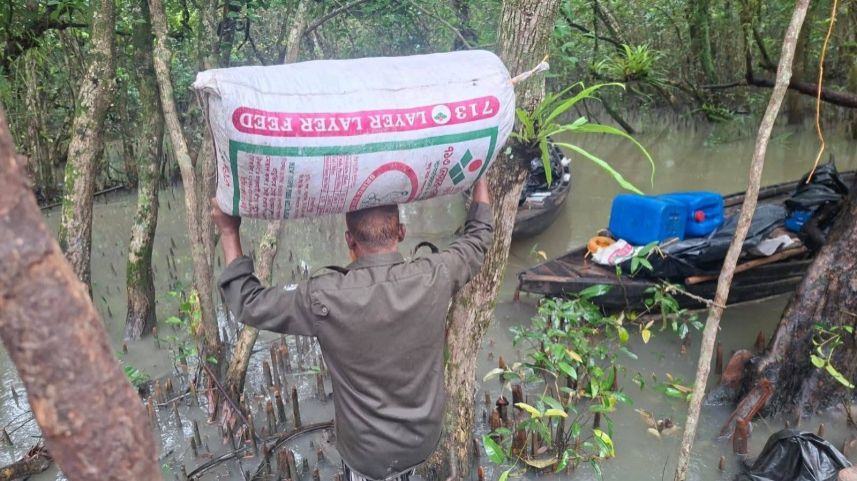
Bangladeshi forest rangers have dismantled a network of clandestine shrimp processing operations hidden within the Sundarbans, the world's largest mangrove forest spanning the Bangladesh-India border. The coordinated 12-hour raid on July 30 by the Chandpai Range authorities targeted the ecologically sensitive Charaputia area, resulting in the destruction of three illegal camps and the confiscation of poison-tainted produce destined for consumer markets. The discovery has exposed a troubling nexus between environmental degradation and food safety risks that extends beyond the immediate zone of operations, with officials now investigating a broader network of suppliers and distributors.
The Forest Department operation, led by Divisional Forest Officer Rezaul Karim Chowdhury, focused on three illicit processing sites positioned strategically at the mouths of Kaga Khal, Indurkani Khal, and Chhoto Hormal Khal within the East Forest Division. When enforcement teams arrived at dawn, personnel at the first two locations had already evacuated, suggesting operational awareness of pending action. However, the third camp provided overwhelming evidence of active large-scale processing, with officials recovering approximately five maunds of fresh shrimp spread across drying racks, two completed sacks of processed product ready for distribution, two litres of liquid chemicals identified as suspected poison, multiple fishing vessels, specialized equipment, and stockpiled provisions. The pungent chemical odour emanating from the fresh shrimp was so pronounced that authorities opted to incinerate the entire catch on-site rather than risk contamination through transport to storage facilities.
The severity of the environmental threat became apparent when forest officials seized a separate boat carrying 95 crab traps during the same operation, with occupants fleeing into the dense mangrove to evade capture. The incident underscores how illegal harvesting operations have evolved beyond traditional poaching to encompass sophisticated processing infrastructure that transforms raw aquatic products through chemically intensive methods. Chowdhury pledged continued enforcement action, stating that regulatory authorities would intensify raids to suppress unlicensed activity within the protected forest reserve. Authorities have initiated formal case proceedings, signalling a commitment to prosecuting those responsible for operating what appears to be an organized enterprise rather than isolated incidents.
Environmental advocates have seized upon the raid as validation of long-standing warnings about systematic poisoning of the Sundarbans' aquatic environment. Noor Alam, coordinator of Sundarban Rokkhay Amra, an environmental monitoring collective, characterized the discovery as symptomatic of a deeper crisis. He emphasized that chemical contamination penetrates the entire food web, from microscopic organisms through fish populations to larger predators, while simultaneously degrading water quality and triggering cascading ecological collapse. The activist stressed that enforcement-focused interventions, while necessary, cannot succeed without fundamental strengthening of monitoring and regulatory capacity across the sprawling 9,000-square-kilometre forest reserve.
The implications for consumer health have become increasingly tangible as poisoned dried shrimp infiltrates neighbourhood markets across rural Bangladesh. Residents of Kachua upazila and surrounding areas reported a recent proliferation of dried shrimp availability at local bazaars, particularly at Badal Bazar, despite historically limited local supply of this commodity. Mehadi Hasan Khan, a student observer, highlighted the asymmetry of information between sellers and buyers: while vendors may profit from the lower production costs associated with rapid chemical processing, purchasing households possess no reliable mechanism for detecting contamination or verifying supply-chain legitimacy. This market failure creates cascading health risks among vulnerable populations already experiencing nutritional pressures and limited access to food safety verification systems.
The Sundarbans occupy a precarious position within Bangladesh's environmental landscape and the global conservation hierarchy. As a UNESCO World Heritage Site of extraordinary biological significance, the forest supports Bengal tigers, estuarine crocodiles, river dolphins, and countless bird species found nowhere else. Yet the reserve faces simultaneous assault from multiple vectors: large-scale timber smuggling operations; intensive hunting of protected wildlife for illegal trade; unregulated fishing by commercial operators; advancing saltwater intrusion driven by sea-level rise; and habitat degradation from agricultural encroachment. The emergence of chemically dependent shrimp processing represents a novel threat that compounds existing pressures by introducing toxins directly into the aquatic foundation of the ecosystem.
For Malaysian readers and Southeast Asian observers, this case illuminates regulatory challenges that plague the region's common natural resources. The Sundarbans situation mirrors contemporary pressures on Southeast Asia's mangrove and coastal ecosystems, from the Mekong Delta through Malaysian Peninsular and Sabah waters to Indonesian maritime zones. The poisoned shrimp network demonstrates how global commodity demand for affordable seafood products incentivizes cost-cutting practices that externalize environmental damage onto public resources. Bangladesh's response, though limited in scope, offers lessons about the necessity of coordinated enforcement, inter-agency intelligence sharing, and simultaneous action against multiple points in the supply chain.
The broader structural challenge reflects how economic desperation and limited livelihood alternatives drive marginalized communities toward illegal resource extraction. Workers processing shrimp in forest camps operate at the periphery of the formal economy, often lacking alternative employment and vulnerable to exploitation by organised traders. Addressing the network therefore requires not merely dismantling camps but developing legitimate economic pathways in forest-adjacent communities. Bangladesh's Forest Department has indicated awareness of this dimension, though concrete livelihood programmes remain underdeveloped compared to enforcement capacity.
The discovery also raises uncomfortable questions about supply-chain transparency in South Asian seafood markets. Dried shrimp features prominently in regional cuisines and food manufacturing, yet traceability from processing site to consumer remains virtually nonexistent in many contexts. Without certification systems, third-party verification, or enforcement of processing standards, consumers throughout the region face persistent risks of purchasing contaminated products. Thailand and Vietnam, the region's leading shrimp exporters, maintain more developed regulatory frameworks, but informal domestic and cross-border trade escapes oversight.
Prospective remediation will require sustained political commitment. Authorities acknowledge that a single 12-hour raid, regardless of the tonnage destroyed, cannot eliminate entrenched networks without comprehensive follow-up. Forest officials must simultaneously strengthen presence in remote processing zones, intercept product movement toward urban markets, and identify and prosecute financiers and organisers rather than apprehending only field workers. Intelligence gathering regarding processor locations demands cooperation from local communities who may themselves depend economically on the trade, creating incentive misalignments that enforcement strategies must navigate.
The environmental consequences may persist for years regardless of operational success. Chemical residues accumulate in sediments and organisms, disrupting reproductive cycles and triggering long-term population declines even after source activities cease. The Sundarbans' recovery from the current contamination episode will depend on whether enforcement intensity can be sustained and whether alternative livelihoods can be realised quickly enough to eliminate the economic incentives driving chemical processing. For now, the raid represents a tactical victory within an ongoing strategic struggle to preserve one of Asia's most vital and vulnerable ecosystems from degradation driven by invisible chemical threats and market-driven exploitation.

