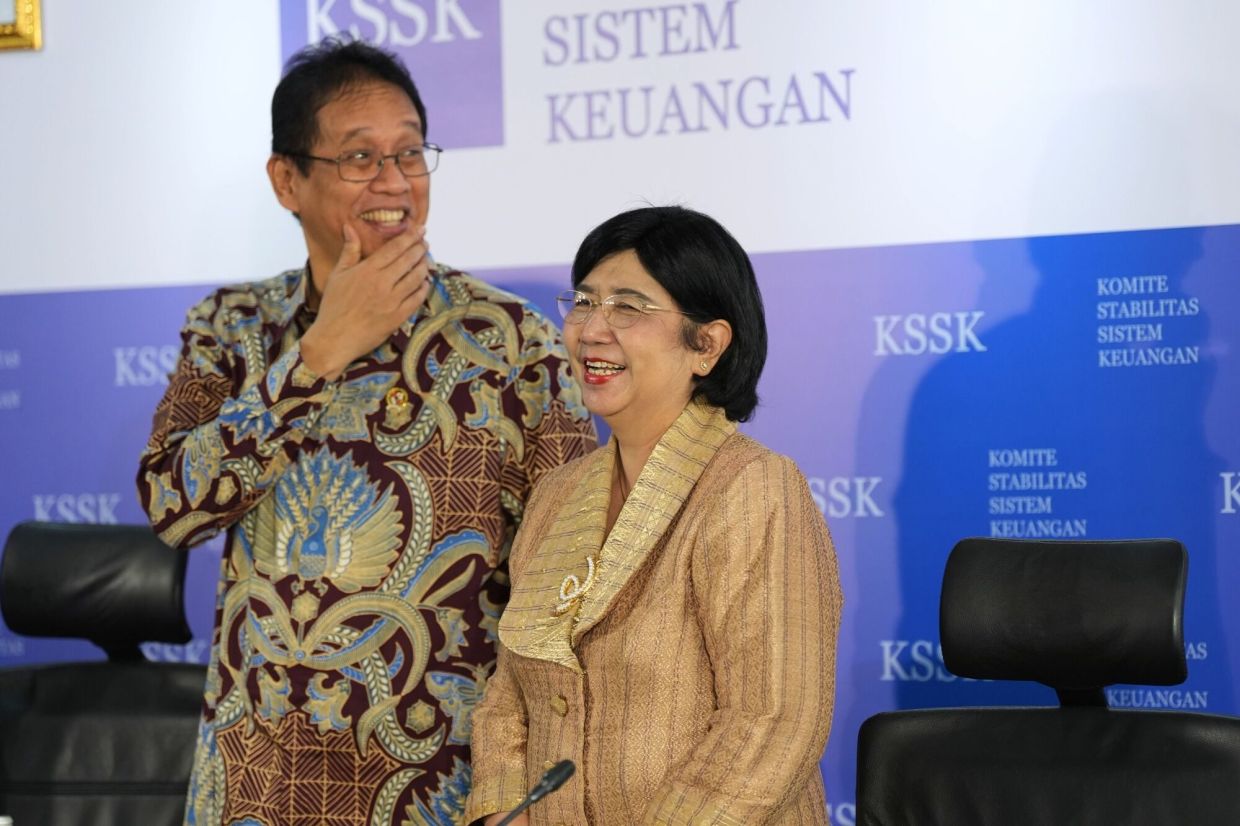
Destry Damayanti's appointment as Indonesia's acting central bank governor has set in motion a critical leadership transition that will define the trajectory of Southeast Asia's largest economy in the coming years. Barely two weeks into her role, the former deputy governor has already signalled a notably different approach to executive relations than her predecessor, meeting with Finance Minister Purbaya Yudhi Sadewa before even visiting President Prabowo Subianto at the presidential palace. This deliberate sequencing of appointments carries unmistakable symbolism: Destry is positioning herself as an architect of closer coordination between monetary and fiscal authorities, a departure from the more distant posture maintained by her predecessor Perry Warjiyo.
The visible warmth between Destry and Purbaya, displayed prominently during joint press briefings and handshakes, contrasts sharply with the formal protocols that characterised Warjiyo's tenure. During Warjiyo's five-year leadership, substantive one-on-one meetings with the finance ministry were notably sparse, with the most recently publicised bilateral engagement occurring only in September 2025 at the central bank's offices. This pattern reflected the traditional boundary-setting that central banks employ to insulate themselves from political pressure, but it also sometimes created friction with a government eager to align monetary and fiscal stimulus. Prabowo's selection of Destry, who served as Warjiyo's deputy since 2019, appears calculated to achieve a middle ground: a technically competent policymaker who understands the central bank's institutional role yet remains more receptive to the administration's development priorities.
Prabowo's growth ambitions form the backdrop to this leadership shift. The president has articulated a target to accelerate economic expansion to 8 percent by 2029, a goal that requires coordinated policy stimulus and investor confidence. To achieve this, the administration has already deployed populist measures including free school meals and expanded state intervention in commodity sectors—initiatives that have unsettled international market participants. The rupiah has depreciated approximately 6 percent against the dollar during 2025, making it Asia's worst-performing currency, whilst both Fitch and Moody's have placed Indonesia's sovereign credit rating on negative watch citing policy uncertainty. Into this turbulent environment steps Destry, charged with demonstrating that a friendlier disposition toward government can coexist with credible monetary management.
During preliminary trading after her nomination was announced, market participants offered a cautious endorsement. The rupiah strengthened to its highest level in a month and outperformed most regional Asian currencies, suggesting that investors perceive her appointment as stabilising relative to alternative scenarios. Economists at major financial institutions have struck similarly measured tones of approval. Helmi Arman, an analyst covering the region for Citigroup, noted that the market expects improved communication between the central bank and government going forward, though he cautioned that the broader environment for institutional credibility remains unsettled and contingent on policymaking trajectories. Her nomination still requires parliamentary approval, introducing an element of procedural uncertainty that could extend the transition period.
Destry arrives at Bank Indonesia with credentials that satisfy both technical and political constituencies. She holds an undergraduate degree in economics from the University of Indonesia and a master's degree in regional science from Cornell University, demonstrating training grounded in rigorous economic methodology. Before joining the central bank, she served as chief economist at PT Bank Mandiri, one of the nation's largest financial institutions, and held a commissioner position at the Indonesia Deposit Insurance Corp., an agency previously directed by Finance Minister Purbaya himself. This shared institutional history creates a foundation of professional familiarity that could facilitate productive dialogue, though it also raises questions among purists about whether such personal connections might unconsciously influence monetary decisions.
The investor and analyst community knows her well, having engaged regularly with her on central bank policy matters throughout her tenure as deputy governor. This existing rapport suggests she will maintain BI's tradition of transparent communication with financial markets, an essential element for maintaining currency stability. Nevertheless, her challenge will be translating this relationship-building capacity into actual policy autonomy when government and central bank objectives diverge. International experience demonstrates that central banks embedded in systems with powerful executives face recurring temptations to subordinate rate decisions to fiscal priorities, a dynamic that eventually undermines currency credibility and inflation control.
The technical environment confronting her demands sophisticated management across multiple fronts. Under Warjiyo's watch, Bank Indonesia has deployed a diverse toolkit to navigate competing objectives: interest rate increases totalling 300 basis points since May 2025, direct foreign exchange market interventions to support the rupiah, and non-rate instruments including liquidity management to sustain credit growth and economic activity. This multi-pronged approach reflects the genuine complexity of Indonesia's position as a developing economy exposed to volatile global capital flows whilst facing domestic inflation pressures and currency depreciation. Destry will inherit this framework but must decide whether to intensify or moderate its application as circumstances evolve.
Irman Faiz, chief economist at PT Bank Danamon, crystallises the central governance question: "Coordination is necessary, but policy subordination is not." This formulation captures the essential tension. Nobody disputes that monetary and fiscal authorities should communicate regularly and align their communications to avoid contradictory signals. Indonesia's track record includes periods of damaging incoherence between the central bank and finance ministry that contributed to currency instability. Yet there exists a critical distinction between cooperation and capitulation. When a central bank systematically subordinates its interest-rate decisions to government growth objectives, it inevitably loses the inflation-fighting credibility that supports currency stability, ultimately undermining the very growth it sought to facilitate.
Global financial conditions present additional headwinds that will test Destry's mettle. Rising interest rates in advanced economies, particularly the United States, continue to exert depreciation pressure on emerging-market currencies including the rupiah. Simultaneously, the strength of the dollar reflects broader economic dynamics beyond Indonesia's control. Against this backdrop, maintaining domestic inflation within reasonable bounds becomes critical to supporting currency stability, yet Prabowo's fiscal expansion and commodity price controls complicate this task considerably. Destry must navigate between the demands for growth stimulus and the imperatives of price stability, knowing that financial markets will scrutinise every decision for signs of institutional capture.
Fakhrul Fulvian, chief economist at PT Trimegah Sekuritas Indonesia, articulates an ambitious vision extending beyond the mere preservation of recent achievements. He argues that BI's next phase should translate the stability achieved under Warjiyo into more constructive outcomes: normalised yield curves, strengthened monetary transmission to the real economy, renewed private-sector investment confidence, and healthier overall liquidity conditions. This agenda suggests that Destry's leadership should not be content with defending the status quo but should leverage the improved government relations to actualise structural reforms within the financial system. Such an approach could partially reconcile growth objectives with institutional integrity by expanding the economy's genuine productive capacity rather than relying exclusively on stimulus.
The implications extend beyond Indonesia's borders, resonating throughout Southeast Asia and influencing broader emerging-market dynamics. Indonesia's monetary policy evolution sets benchmarks that influence investor perceptions of central bank independence across the region. Malaysia, Thailand, the Philippines, and Vietnam all monitor developments at BI closely, knowing that evidence of systematic political influence could trigger broader investor caution toward the entire region's currencies and bonds. Conversely, a demonstration that a new generation of central bankers can balance legitimate government coordination with institutional autonomy might establish a positive precedent for developing economies navigating the perpetual tension between elected officials' growth imperatives and technocrats' stability mandates.
Destry's parliamentary confirmation remains pending, though opposition appears unlikely given Prabowo's dominant coalition. Once formally appointed, she will occupy one of Asia's most consequential central banking positions, commanding a monetary system anchoring an economy of nearly 280 million people and representing a critical juncture in Indonesia's economic trajectory. Her early signals of willingness to engage cooperatively with the finance ministry have reassured markets accustomed to Warjiyo's more austere institutional posture. Yet reassurance must ultimately translate into sustained credibility through action. The true test will arrive when government and central bank priorities collide—when fiscal demands for monetary accommodation confront inflation pressures or currency instability. How Destry navigates that inevitable moment will determine whether her tenure represents authentic institutional evolution or gradual institutional capture disguised by improved collegial relations.

