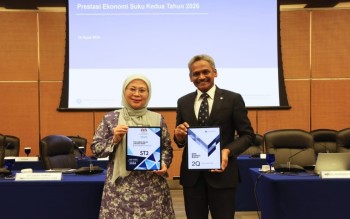
Bank Negara Malaysia (BNM) has signalled confidence in Malaysia's economic trajectory by maintaining its 2026 gross domestic product growth forecast at 5.0 per cent, with no adjustments deemed necessary at the current juncture. Governor Datuk Seri Abdul Rasheed Ghaffour delivered this message following the announcement of Malaysia's second-quarter GDP figures, which exceeded earlier projections and reinforced the central bank's optimistic stance on the trajectory ahead. The governor's remarks suggest that the policy framework remains well-calibrated to support sustained expansion, though officials continue to monitor external risks that could alter the growth narrative as the year progresses.
The economy's performance in the second quarter of 2026 provided tangible evidence supporting the central bank's confidence. Malaysia's economy expanded by 6.0 per cent during this period, eclipsing the Department of Statistics Malaysia's preliminary estimate of 5.8 per cent. This outperformance reflected stronger momentum than initially anticipated, driven by a convergence of favourable domestic and international conditions. The governor highlighted that Malaysia has consistently delivered growth above expectations throughout the first three quarters of 2026, a pattern that underscores the resilience embedded within the broader economy and the effectiveness of policy support mechanisms currently in place.
Domestic demand has emerged as the primary engine propelling Malaysia's economic expansion, with household consumption demonstrating particular strength. Household consumption growth reached 4.8 per cent in the second quarter, a healthy expansion that reflects the purchasing power of Malaysian consumers and their willingness to spend despite economic uncertainties. The governor identified multiple reinforcing factors sustaining this consumption momentum. Income growth among households has provided the foundation for increased spending, whilst accumulated savings from previous periods offer a buffer that households can deploy when confidence remains elevated. Government policy support—through welfare programmes, tax measures, and targeted fiscal initiatives—has complemented the organic growth in incomes, whilst household borrowing has played only a marginal role in driving consumption patterns, indicating that expansion is underpinned by underlying income rather than unsustainable credit dynamics.
The external sector has provided substantial support to Malaysia's overall economic performance, particularly during the preceding quarter. Export-led growth has manifested across a diversified basket of products and services, defying simplistic narratives of overdependence on any single sector. The electrical and electronics (E&E) industry, traditionally a cornerstone of Malaysia's export portfolio, has maintained its contribution to growth, yet equally important has been the expansion of non-E&E exports, which demonstrates improving diversification within the tradable goods sector. This diversification carries strategic significance for Malaysian policymakers, as it reduces vulnerability to sector-specific shocks and price volatility that characterised earlier periods of heavy dependence on particular commodity or manufacturing clusters.
Beyond conventional merchandise exports, the information and communications technology services sector has emerged as an increasingly dynamic contributor to economic activity. This shift reflects Malaysia's gradual transition towards higher-value services and digital economy participation, an evolution that carries implications for employment composition and skill requirements across the labour market. The governor's emphasis on this sector's growing importance signals recognition that Malaysia's future growth will depend partly on successfully capturing opportunities within the knowledge-intensive global economy, where technological innovation and digital capabilities determine competitive advantage. Investment activity has also remained a component of the growth mix, supporting the creation of productive capacity that underpins future output expansion.
However, the governor acknowledged that the path forward is not without impediments. Global economic uncertainties and geopolitical conflicts present material downside risks to Malaysia's growth trajectory. These external headwinds could potentially constrain export demand, particularly if major trading partners experience economic slowdown or if supply chain disruptions intensify. The complexity of today's geopolitical environment means that seemingly distant conflicts can have tangible effects on Malaysian exporters through commodity price movements, logistics disruptions, or shifts in investor sentiment. Such risks are sufficiently material that the central bank has factored them into its forward-looking assessment, even whilst maintaining its headline forecast at the 5.0 per cent level.
One emerging environmental challenge that merits closer attention is the potential economic impact of El Niño phenomena. The governor cautioned that whilst the El Niño effect would likely manifest gradually and remain concentrated within the agricultural sector, businesses and households ought to begin preparing for potential adverse scenarios. Agriculture remains important to rural livelihoods in Malaysia and contributes to food security, making any significant El Niño-induced disruption a matter of policy concern. Drought conditions triggered by El Niño could constrain agricultural output, potentially driving food price inflation and affecting rural incomes. The governor's call for preparedness reflects a forward-looking risk management approach, urging stakeholders to implement adaptive measures before conditions deteriorate rather than responding retroactively to shocks.
The governor clarified that any formal revision to growth forecasts would normally materialise during the annual Budget announcement, a procedural practice that allows the government and central bank to incorporate fresh data and reassess economic fundamentals in a coordinated fashion. This disciplined forecasting framework prevents frequent revisions that might undermine credibility or create policy volatility. The decision to hold the 5.0 per cent forecast steady reflects confidence that underlying growth drivers remain intact, notwithstanding the acknowledged external risks. The persistence of growth factors across consumption, investment, exports, tourism, and diversifying services sectors provides a foundation resilient enough to support the targeted growth rate through the remainder of 2026.
For Malaysian observers and policymakers, Bank Negara's updated assessment carries several implications. First, it suggests that the domestic economy possesses sufficient inherent strength to weather moderate external shocks, a reassuring signal for businesses planning capital expenditure and hiring decisions. Second, the emphasis on domestic demand's centrality indicates that Malaysia's growth is not precariously dependent on external factors alone, reducing vulnerability to sudden shifts in global trade flows. Third, the identification of emerging opportunities within services and technology sectors points to potential future growth pathways that Malaysian policymakers and private sector participants should cultivate. Finally, the cautionary notes regarding geopolitical risks and environmental factors underscore the importance of maintaining policy flexibility and implementing adaptive strategies that can pivot quickly should conditions deteriorate unexpectedly.

