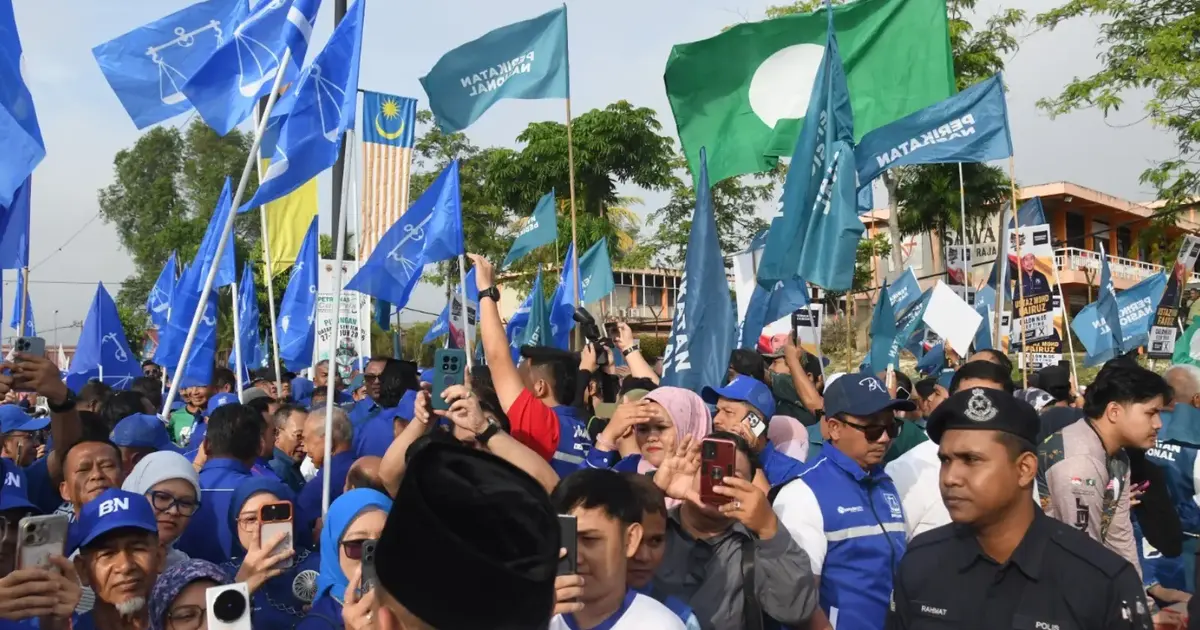
The prospect of Barisan Nasional stepping in as a replacement partner for PAS in Selangor faces significant structural challenges, according to political commentator Azmi Hassan, who argues the coalition lacks the organisational muscle and strategic positioning that Bersatu once provided to Perikatan Nasional during the previous state election cycle. This assessment raises uncomfortable questions about how PAS intends to expand its political footprint in Malaysia's wealthiest and most urbanised state without the specific advantages that the Mahathir-led party delivered.
Bersatu's contribution to PN's showing in Selangor during the recent electoral contest cannot be easily replicated by BN, Hassan suggests, because the configurations and party dynamics involved were distinctly different. When Bersatu competed as part of PN, it operated within a coalition structure that created specific synergies in contest and mobilisation. The party held particular appeal in certain constituencies and demographics that traditional BN machinery had lost touch with, particularly among younger voters and those fatigued with establishment politics.
Barisan Nasional, despite its historical dominance in Malaysian politics and its deep institutional roots, operates from a fundamentally different strategic position. The coalition encompasses UMNO, MCA, and MIC, each with their own electoral bases and organisational priorities. Unlike Bersatu's more fluid positioning and willingness to challenge the political centre, BN carries the baggage of decades of entrenched power structures and established political networks that function according to well-worn patterns.
The arithmetic of electoral politics in Selangor presents particular difficulties for any coalition seeking to dislodge the incumbent Pakatan Harapan government. Selangor's electorate is notoriously fragmented, with significant populations in urban centres that lean toward opposition politics, and suburban and semi-rural areas where traditional vote banks retain influence. Bersatu, during its PN phase, had managed to penetrate certain suburban constituencies by positioning itself as a force distinct from both the old establishment and the traditional opposition.
Hassan's analysis suggests that PAS, which commands strong support in certain Selangor constituencies particularly in the state's northern and eastern fringes, would require a coalition partner whose electoral appeal complements rather than competes with its own base. Bersatu had filled this role by offering access to constituencies in more urbanised and semi-urbanised areas that PAS alone struggled to penetrate. BN's presence in these same areas, by contrast, may create redundancy rather than complementarity.
The historical trajectory of political alliances in Malaysia demonstrates that successful coalition-building hinges not merely on nominal alignment but on each partner bringing distinct advantages to the table. When parties compete for the same constituencies or appeal to overlapping voter segments, internal tensions emerge over seat allocation and campaign resources. Bersatu's outsider status, combined with its specific appeal to anti-establishment voters who were not comfortable with either traditional BN or traditional PH, created a distinctive coalition dynamic that proved electorally effective in certain contexts.
BN's return to prominence following the 2022 elections has reinvigorated the coalition's institutional apparatus, but this revival has not necessarily translated into expanded electoral reach. The coalition essentially rebuilt the same machinery that governed Malaysia for decades, rather than developing new mechanisms to reach voters alienated by long years of establishment rule. For PAS, this raises the strategic question of whether BN's resources and organisational capacity can compensate for its lack of innovative appeal.
The practical implications of Hassan's assessment extend beyond Selangor. Political developments in Malaysia's most economically significant state typically reverberate across regional politics, influencing coalitional calculations and voting behaviour in adjacent states. Should PAS and BN prove unable to generate sufficient electoral momentum in Selangor despite their combined resources, the broader calculus of Malaysian politics could shift toward either deeper polarisation or unexpected realignments.
Furthermore, the success or failure of a PAS-BN partnership in Selangor would signal to other state-level opposition forces whether traditional institutional power and resources remain sufficient to challenge incumbent governments, or whether the Malaysian electorate has fundamentally shifted toward demanding new voices and organisational forms. Bersatu's particular appeal—as neither fully establishment nor fully anti-establishment—may have represented a transitional moment in Malaysian politics that cannot be easily recreated through alternative partnerships.
The analyst's perspective also highlights an often-overlooked dimension of Malaysian electoral competition: the importance of intangible factors such as perceived legitimacy, political freshness, and organisational culture. BN, despite considerable assets, carries perceptions shaped by its decades in power and the scandals that precipitated its 2018 electoral defeat. These perceptions, particularly among younger and more educated Selangor voters, present obstacles that mere financial resources or administrative machinery cannot easily overcome.
As PAS pursues its ambitions in Selangor, the party faces a fundamental challenge that extends beyond simple arithmetic. It must identify coalition partners capable of reaching constituencies and voter segments it cannot access independently, whilst simultaneously maintaining clarity about its own political identity and appeal. Without Bersatu's particular positioning, PAS's path to state-level power in Selangor appears significantly more constrained, raising questions about whether the next chapter of Malaysian state politics will see dramatic realignment or continued consolidation of existing power structures.

