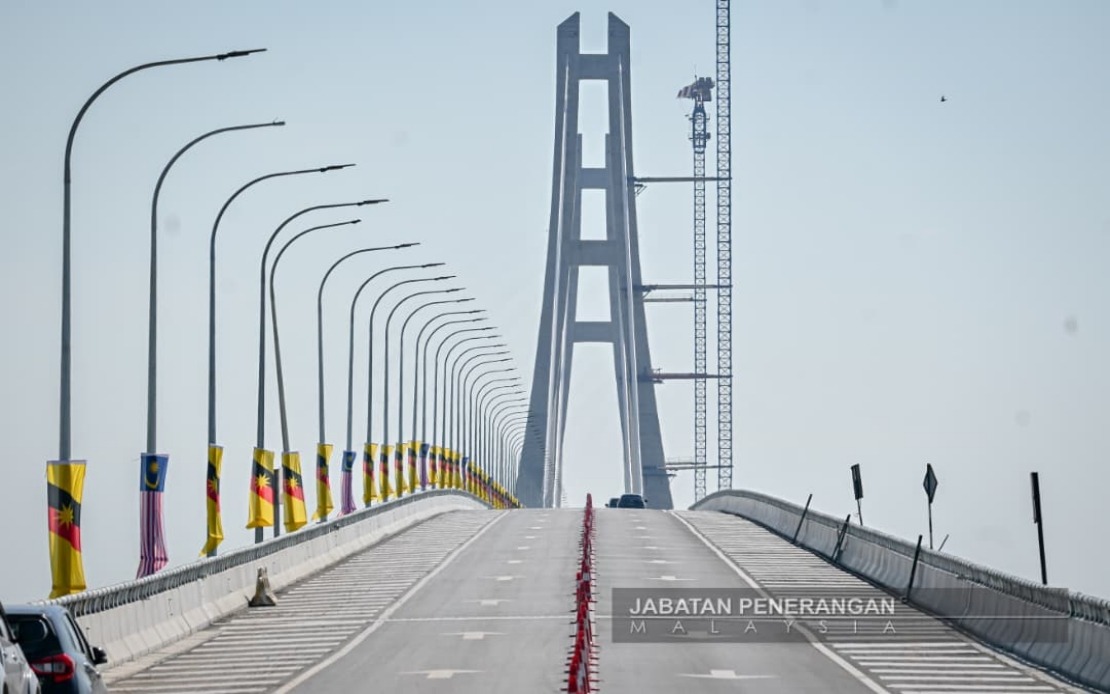
Sarawak Premier Tan Sri Abang Johari Tun Openg has marked the completion of the Batang Lupar 1 Bridge as a turning point in the state's infrastructure trajectory, signalling the beginning of accelerated economic development across the coastal corridor. The 4.844-kilometre bridge, constructed at a cost of RM848.75 million, now links the previously isolated districts of Sebuyau, Betong, Sri Aman and Samarahan—communities that have long grappled with the inefficiencies and dangers of river-based ferry transport.
The bridge represents far more than a mere transportation convenience. It functions as a strategic connector within the broader Sarawak Second Trunk Road (STRR) initiative, a comprehensive coastal development programme designed to modernise the state's transport infrastructure. By establishing direct land routes where ferries once operated, the project addresses decades of logistical constraints that have hindered economic activity in these districts. The construction itself was initiated in response to consistent pressure from local communities and their elected representatives, reflecting growing frustration with the limitations and safety risks inherent in ferry operations across the Batang Lupar River's mouth, where rough waters and strong winds have historically created dangerous conditions.
The ferry service that once connected Sebuyau and Triso frequently encountered disruptions due to adverse weather, with crossings sometimes taking more than an hour to complete. Beyond the inconvenience, these delays imposed real costs on businesses attempting to move agricultural produce and goods to larger markets. Abang Johari emphasised that the bridge eliminates these transportation bottlenecks while opening pathways for sustained investment in local agriculture and commerce across all four connected districts. The infrastructure now enables the seamless movement of people and products that development-focused economies require.
Sarawak Deputy Premier Datuk Amar Douglas Uggah Embas underscored the broader significance of this project within the state's integrated coastal vision. The bridge forms a crucial segment of the RM3.21 billion Sarawak Coastal Road network, with full completion scheduled for 2030. This phased approach demonstrates Sarawak's commitment to systematic infrastructure transformation rather than isolated projects. The complete network, once finished, will fundamentally reshape regional connectivity by reducing the distance between Kuching and Sibu from 396 kilometres to 252 kilometres—a reduction of approximately 144 kilometres that will shorten travel time considerably and enhance business logistics across the state's primary commercial corridor.
The strategic implications extend beyond convenience metrics. Shortened distances between major trading hubs reduce transport costs for businesses, making Sarawak's agricultural and manufactured goods more competitive in regional markets. Farmers in Betong and Sri Aman gain faster access to Kuching's distribution networks and consumer markets, potentially spurring agricultural diversification and expansion. The improved connectivity also enhances Sarawak's attractiveness as an investment destination, signalling government commitment to infrastructure that multinational and regional enterprises require for operations across the state.
For Malaysian observers, the project demonstrates how coastal states can leverage targeted infrastructure investment to unlock regional potential. The Batang Lupar 1 Bridge exemplifies the broader pattern across Southeast Asia whereby governments increasingly recognise that modern transport networks form the foundation for economic transformation. The project's cost of RM848.75 million represents substantial public investment that Sarawak has prioritised despite competing budgetary demands, reflecting confidence in the long-term economic returns that improved connectivity generates.
The bridge's official recognition by the Malaysia Book of Records as the longest bridge spanning a river in Malaysia adds symbolic value to the practical achievements. This designation, presented by MBOR representative Megat Faris Hussein Megat Muzaffar Shah, establishes the structure as an engineering landmark that reflects contemporary Malaysian technological capability. For Sarawak, the recognition reinforces the state's profile as a centre of infrastructure innovation and development ambition within the federation.
The elimination of ferry dependence carries psychological significance alongside economic implications. Communities that have historically felt marginalised or cut off from mainstream economic opportunities now possess direct road access to regional centres. This psychological shift—moving from isolation to connectivity—often catalyses business creation and investment decisions as entrepreneurs and residents perceive expanded possibilities. The bridge thus represents both a physical connection and a symbolic declaration that these coastal districts are integral to Sarawak's future prosperity.
The project also illustrates how infrastructure decisions reflect and shape demographic patterns. Improved transport connectivity tends to attract migrant workers, entrepreneurs, and service providers seeking opportunities in connected regions. Over time, the Batang Lupar 1 Bridge and its companion STRR projects may redistribution population and economic activity across Sarawak's coastal zone, potentially reducing concentration in Kuching while stimulating growth in secondary centres.
For Southeast Asian policymakers observing Sarawak's approach, the project demonstrates how states can coordinate multiple infrastructure initiatives toward unified development objectives. Rather than pursuing scattered projects, Sarawak has embedded the bridge within a comprehensive coastal road network vision. This integrated approach maximises the cumulative impact of individual investments by ensuring they function synergistically rather than in isolation.
The completion timeline extending to 2030 reflects realistic assessment of project complexity across Sarawak's geographically challenging terrain. This measured approach, communicated transparently by Deputy Premier Douglas Uggah, sets stakeholder expectations appropriately and demonstrates professional project management. Investors and communities can plan accordingly when governments articulate clear completion horizons supported by budgetary allocations.
Looking forward, the bridge's opening initiates a new phase in Sarawak's coastal development narrative. As the STRR programme advances toward full completion, the state positions itself to capture opportunities in agricultural trade, light manufacturing, and resource-based industries that improved transport networks enable. The four connected districts—Sebuyau, Betong, Sri Aman and Samarahan—now stand poised for economic expansion previously constrained by geographical isolation. The Batang Lupar 1 Bridge, despite its impressive engineering credentials, ultimately represents opportunity: the chance for communities and businesses to participate fully in modern economic networks that infrastructure connectivity provides.

