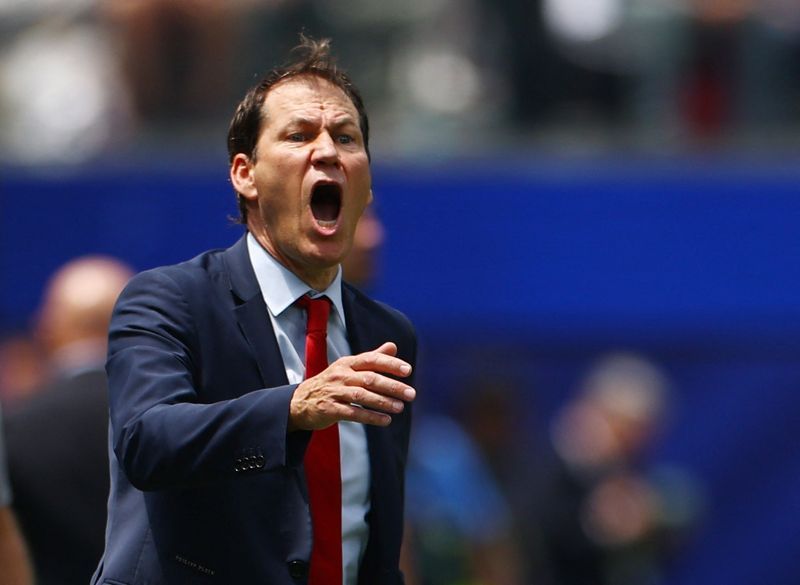
The future of Belgium coach Rudi Garcia has become increasingly uncertain following his controversial decision to substitute Thibaut Courtois during Friday's World Cup quarter-final clash against Spain in Atlanta, a match the Belgian side lost 2-1. The substitution of the goalkeeper, widely regarded as one of the world's finest, has ignited widespread criticism among Belgian football analysts and fuelled fresh questions about Garcia's tactical judgment and future with the national team.
Courtois indicated his willingness to continue despite experiencing a mild leg problem, yet Garcia made the call to withdraw him after 71 minutes, insisting that the goalkeeper did not meet his strict fitness threshold. Senne Lammens took over in goal but proved unable to keep Spain's attack at bay. When Pau Cubarsi struck a low ball towards goal, Lammens misjudged the situation, spilling the shot and allowing substitute Mikel Merino to finish clinically in the 86th minute for what proved to be the winning goal.
The decision has drawn scathing criticism from Belgian football circles, with prominent commentator Peter Vandenbempt voicing his incredulity on Belgian radio. Vandenbempt questioned the logic of removing the world's best goalkeeper from a knockout match because of alleged limitations in his long-range passing ability, describing the substitution as incomprehensible. He suggested that a player of Courtois' experience and self-awareness should be trusted to determine his own physical capabilities, rather than being subjected to such a rigid application of fitness protocols.
Garcia, however, has defended his approach with unwavering conviction, framing the decision as consistent with his stated philosophy throughout the tournament. He maintains that he has enforced a non-negotiable principle from the tournament's outset: only players operating at full physical capacity are permitted to participate. The coach explained that Belgium's attacking strategy specifically relied on Courtois' ability to launch long passes to attackers Charles De Ketelaere and Romelu Lukaku, and that he made the substitution partly to prevent further deterioration of Courtois' condition.
This incident will almost certainly feature prominently when Belgian football federation officials conduct their review of Garcia's tenure before the end of the month, when his contract formally expires. The 62-year-old Frenchman arrived at the start of 2025 with a mandate to revitalise the team following the widely criticised era under Domenico Tedesco, whose reign was characterised as both toxic and demoralising to the playing squad. Garcia was tasked with rebuilding trust and competitiveness following that difficult period.
Since his appointment, Garcia can point to several achievements in establishing his credentials. He successfully navigated Belgium's Nations League obligations by maintaining top-tier status, secured World Cup qualification, and steered the team to the quarter-final stage—all objectives that were checked off as completed. His record across 20 international matches reads 12 wins, six draws, and two defeats, statistics that suggest reasonable overall performance at the tactical level.
Yet the federation now faces a significant challenge in determining whether Garcia represents the right direction for the national team's development toward the 2028 European Championship. Beyond the Courtois substitution, concerns have mounted about his tactical selections, the timing and nature of his substitutions, and his broader management philosophy. The narrow defeat to Spain, while respectable given the circumstances, failed to bolster confidence in his strategic vision moving forward.
Belgium's path through this World Cup has been notably inconsistent, raising further questions about Garcia's squad management. The team required late flourishes to progress beyond the group stage, managing only draws against Egypt and Iran before defeating New Zealand to top their group. In the Round of 32 encounter with Senegal, Garcia withdrew several key players when Belgium trailed 2-0, a decision that preceded an improbable comeback—though whether his tactical intervention or Senegal's defensive lapses deserve primary credit remains genuinely debatable.
Garcia can nevertheless cite meaningful positives from his stewardship. Belgium delivered an emphatic 4-1 victory against co-hosts the United States, demonstrating attacking potency against quality opposition. He has also successfully integrated emerging talent into the squad, with players including Nathan Ngoy and Nicolas Raskin making significant contributions throughout the tournament and establishing themselves as fixtures for future campaigns.
The federation's decision regarding Garcia will shape Belgium's approach to the 2028 European Championship, with implications for player development, squad building strategy, and the overall trajectory of the national program. His rigid adherence to fitness principles, while defensible in isolation, must be weighed against his tactical flexibility, player development record, and ability to manage a squad containing experienced campaigners who merit considerable input into decisions affecting their participation. The balance between principled discipline and pragmatic adaptability will likely prove decisive in determining whether Garcia continues in the role.
For Malaysian readers and Southeast Asian football followers, this situation underscores the broader tensions within European football management, where the demands of elite-level competition increasingly clash with modern approaches to player welfare and autonomy. The debate reflects deeper questions about coaching authority, medical decision-making, and player empowerment that resonate across global football at all levels.

