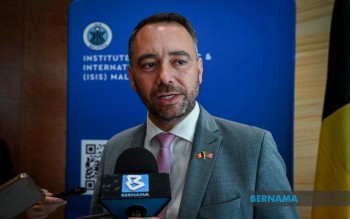
Belgium is positioning itself as a strategic partner for Malaysia's green energy ambitions, with its Deputy Prime Minister Maxime Prévot calling for expanded cooperation in offshore wind during a visit to Kuala Lumpur this week. Speaking on the sidelines of the 39th Asia-Pacific Roundtable, Prévot identified offshore energy as a cornerstone opportunity for bilateral collaboration, alongside semiconductors, logistics, clinical trials, biotechnology research and pharmaceuticals—sectors that reflect Belgium's growing presence in Southeast Asia's knowledge economy.
The Belgian diplomat's emphasis on offshore wind represents a significant opportunity for Malaysia, which has committed to increasing renewable energy capacity as part of its broader decarbonisation strategy. While Belgium possesses only 60 kilometres of coastline, it has developed substantial technical prowess in offshore wind generation, currently operating farms capable of delivering two gigawatts of electricity to its population. This accomplishment is particularly noteworthy given Belgium's geographic constraints, suggesting that technological solutions developed there could be adapted for Southeast Asian conditions. The country intends to expand this capacity to between six and seven gigawatts within the coming years—equivalent to the power output of five to seven nuclear plants—demonstrating the scalability and potential of offshore wind infrastructure.
For Malaysia, such expertise carries considerable weight. The nation sits at the intersection of crucial maritime trade routes and possesses extensive coastlines suitable for offshore energy projects. As Malaysia navigates its energy transition away from fossil fuels, acquiring foreign technical knowledge in renewable infrastructure has become increasingly important for achieving its climate commitments. The Belgian model provides a replicable template for countries seeking to rapidly scale renewable capacity without depending entirely on domestically developed technology.
PreVot's visit also carried broader regional significance through the European Union's announcement of substantial financial backing for Southeast Asian energy infrastructure. The EU and its member states plan to mobilise €10 billion under their Global Gateway Strategy specifically to support the ASEAN Power Grid and regional energy transition initiatives. This commitment reflects a strategic recalibration of European engagement with Southeast Asia, moving beyond traditional trade relationships toward infrastructure investment and technological partnerships that directly address climate imperatives.
The ASEAN Power Grid initiative represents an ambitious attempt to create regional electricity interconnectivity, allowing member states to share renewable energy resources and reduce dependence on carbon-intensive power generation. Malaysia stands to benefit significantly from such infrastructure development, as it could import clean energy from regional partners during periods of surplus production and export domestic renewable capacity when advantageous. The €10 billion commitment from Brussels suggests that the EU views ASEAN's energy transition not merely as a humanitarian concern but as a strategic investment in long-term regional stability and economic resilience.
PreVot's framing of the partnership emphasises sustainability and local benefit rather than extractive investment models. He specifically noted that European and ASEAN strategies, when aligned, could generate sustainable economic growth while reinforcing regional resilience. This language signals a shift from older development paradigms toward partnerships explicitly designed to create shared value and strengthen regional self-sufficiency. For Malaysian policymakers, such an approach offers a counterbalance to other significant investors in the region whose engagement has sometimes prioritised rapid resource extraction over long-term capacity building.
The bilateral economic relationship between Belgium and Malaysia already reflects growing integration. Total trade reached RM9.74 billion in 2025, with Malaysian exports comprising RM6.85 billion and Belgian imports accounting for RM2.89 billion. These figures indicate that Belgium represents a meaningful export market for Malaysian products while also serving as a source of specialised imports. The trade imbalance—favourable to Malaysia—suggests that the relationship is not purely extractive but reflects mutual commercial benefit.
Belgian investment presence in Malaysia has expanded considerably in recent years. As of 2025, 67 projects involving Belgian participation had received regulatory approval, representing combined investments worth RM5.1 billion and generating employment for approximately 4,605 workers. These figures demonstrate that Belgian companies view Malaysia as a substantial opportunity for capital deployment and operational expansion. The sectoral distribution of these investments—spanning energy, pharmaceuticals, biotechnology, and logistics—indicates that Belgian engagement focuses on higher-value activities requiring advanced technical capability rather than low-skill manufacturing.
PreVot's inaugural visit to Malaysia since assuming office in February 2025 suggests that Belgium's Foreign Ministry is prioritising Southeast Asian engagement. For a relatively small European nation, such high-level diplomatic attention to the region underscores the strategic importance Brussels attributes to deepening ties with ASEAN economies. The timing of this visit, coinciding with formal announcements of EU investment in regional energy infrastructure, indicates a coordinated diplomatic and economic strategy rather than ad-hoc bilateral relations.
The offshore wind partnership proposal carries particular relevance for Malaysia's maritime industries and technological workforce. Developing domestic capacity in offshore renewable energy infrastructure would create skilled employment opportunities, support the transition of port and maritime logistics sectors toward green technologies, and position Malaysia as a regional hub for offshore wind expertise. Such positioning could attract additional foreign investment from renewable energy companies seeking regional operational bases and maintenance facilities.
Looking forward, the Belgium-Malaysia energy partnership could serve as a template for deeper European engagement with Southeast Asia on climate transition issues. As global efforts to decarbonise accelerate, countries like Belgium that have already invested substantially in renewable infrastructure possess both technical expertise and practical experience valuable to developing economies undertaking similar transitions. The financial commitments announced through the Global Gateway Strategy suggest that the EU intends to translate this expertise advantage into sustained engagement with the region.
For Malaysia specifically, the convergence of Belgian technical expertise, EU financial support, and regional infrastructure initiatives through the ASEAN Power Grid creates a rare opportunity to advance clean energy capacity while accessing foreign investment and knowledge transfer. The challenge will lie in translating diplomatic gestures and investment announcements into concrete projects that deliver tangible improvements in renewable energy generation and regional grid reliability. Success would position Malaysia as a leader in Southeast Asian energy transition and strengthen its standing as a destination for future green technology investment.

