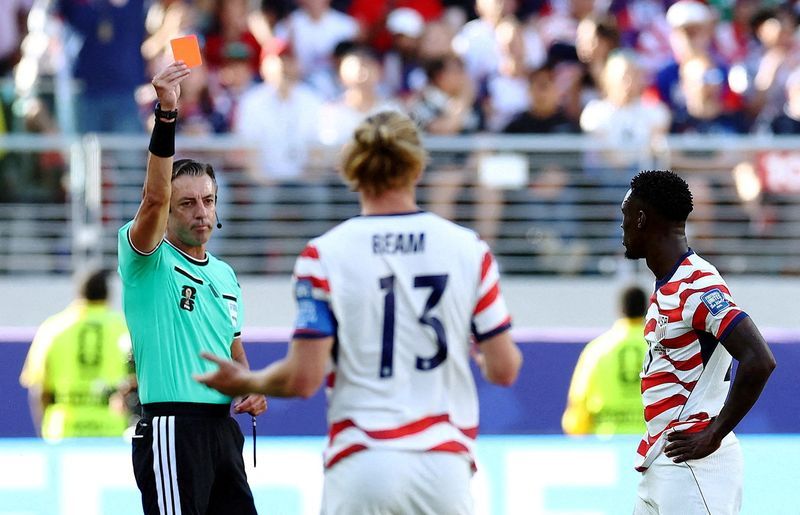
The relationship between political power and sporting governance has collided dramatically as Belgian officials and citizens voiced outrage over U.S. President Donald Trump's personal intervention with FIFA to overturn a disciplinary suspension affecting the American national team. The controversy erupted just days before Belgium's crucial last-16 World Cup encounter against the United States in Seattle on Monday, transforming what should have been a straightforward match into a flashpoint for broader questions about institutional independence and fairness in international football.
At the centre of the dispute stands the case of striker Folarin Balogun, who had received a red-card suspension that would have sidelined him from the American team's next fixture. Trump reportedly made a direct appeal to FIFA President Gianni Infantino requesting a review of the ban, a move that proved successful. FIFA subsequently suspended the punishment, clearing Balogun to feature in the knockout stage. The intervention represents an extraordinary breach of protocol in international football, where disciplinary matters are typically resolved through formal appeals processes rather than high-level political pressure.
Brussels residents responding to the decision expressed deep frustration at what they perceived as the weaponisation of political influence to circumvent sporting rules. Therese Kpooubie, a Belgian capital worker, articulated the core concern shared by many football enthusiasts across the nation. She questioned the fundamental logic underpinning the reversal, noting that red cards exist as consequences for serious infractions on the pitch. Her rhetorical challenge—asking whether the original referee had erred in issuing the card—highlighted how the FIFA decision appeared to retroactively invalidate established disciplinary judgments without a compelling sporting rationale.
Kpooubie's frustration extended to the broader implications of external political interference in football governance. She expressed alarm at the possibility that political connections rather than sporting merit might influence which players participate in matches, describing such a scenario as shameful. Her comments reflected a widely shared sentiment among Belgian football supporters who view the integrity of competition as dependent upon the consistent and impartial application of disciplinary codes, irrespective of a player's nationality or the political stature of their nation's leadership.
Other Brussels observers adopted a more pragmatic stance, suggesting that Belgium should channel frustration into enhanced performance on the pitch. Bastien Noel acknowledged the decision whilst arguing that the Red Devils—the traditional nickname for Belgium's national team—should treat the FIFA ruling as motivation rather than excuse. His perspective embodied a resilience common among sporting cultures, emphasizing that whilst external circumstances might prove unfair, ultimate vindication comes through victory achieved through superior play and determination.
Belgium's political leadership echoed the public's concerns at an official level. Deputy Prime Minister Maxime Prevot issued a formal statement expressing incredulity at the circumstances surrounding FIFA's reversal. Prevot's language—invoking violations of football's basic rules and institutional integrity—elevated the dispute beyond stadium discussions into formal diplomatic discourse. His statement suggested that if Trump's intervention directly caused the disciplinary decision, the outcome would constitute a fundamental breach of sporting ethics and governance principles that govern international football.
The American position focused on denying direct interference in FIFA's processes. Bill White, the U.S. Ambassador to Belgium, utilised social media to assert that President Trump had not intervened in FIFA's inner workings, claiming instead that Trump simply thanked the organisation after it had independently reached its decision. This characterisation sought to distinguish between post-hoc gratitude and direct interference, though sceptics questioned whether distinguishing between a president's personal request to FIFA leadership and interference represented a meaningful semantic distinction rather than substantive explanation.
The timing of Trump's intervention amplified concerns about its propriety. Coming immediately before a knockout stage match between the two nations, the decision created immediate suspicions regarding its motivation. Rather than allowing competitive outcomes to reflect team quality and tactical acumen, the suspension reversal raised questions about whether the match outcome might be influenced by administrative decisions made outside normal channels. Such concerns extend beyond this specific contest to broader implications about whether FIFA's disciplinary independence—theoretically protected through formal governance structures—can withstand pressure from powerful political actors.
Belgium supporters interpreted the situation as a test of their team's character and resolve. Some embraced it as an opportunity to demonstrate that the Red Devils could defeat a rival team irrespective of whether that opponent fielded additional personnel through FIFA decisions influenced by presidential pressure. This defiant framing transformed potential sporting disadvantage into psychological advantage, positioning Belgian victory not merely as athletic triumph but as vindication of fair competition principles that Trump's intervention had appeared to undermine.
The broader context matters considerably for Southeast Asian and international observers evaluating FIFA's governance trajectory. The incident raises uncomfortable questions about how multinational sporting organisations balance relationships with powerful nations against their stated commitment to impartial governance. When presidents can successfully lobby FIFA leadership to overturn disciplinary decisions, the notion that rules apply equally regardless of political influence becomes untenable. Such precedents potentially emboldened other national leaders to employ similar tactics, fragmenting international football governance.
Belgium's response reflected a football culture deeply invested in competitive integrity. Rather than accepting the decision passively, officials voiced principled objections whilst supporters prepared to channel grievance into pitch performance. The match itself would ultimately determine whether FIFA's controversial reversal affected the sporting outcome, though regardless of the result, Trump's intervention had already achieved a corrosive effect on the perceived neutrality of international football governance.
The Belgium-United States clash now carries weight far exceeding typical World Cup encounters. It has become a referendum on whether political power should influence sporting governance, whether FIFA's disciplinary processes possess genuine independence, and whether international football remains committed to competitive fairness or has become susceptible to high-level political manipulation. For Belgian officials and supporters, victory would vindicate their principles; for global football observers, the incident underscored worrying vulnerabilities in how international sport's governing bodies exercise authority.

