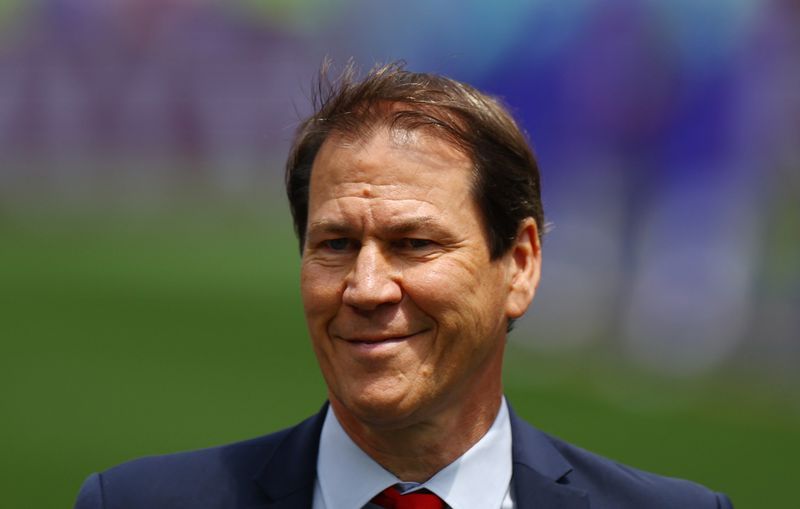
Rudi Garcia's tenure as Belgium's national football coach will conclude on July 31st following a mutual decision by both the French tactician and the Belgian football association not to extend his contract beyond its expiration date. The announcement came on Monday, marking the end of an 18-month engagement that proved contentious from start to finish, punctuated by both significant achievements and considerable criticism from Belgian media and observers.
Garcia's World Cup campaign with Belgium embodied the unpredictability that has become characteristic of modern tournament football. The team's group-stage performance generated significant concern, with unconvincing draws against Egypt and Iran preceding a dominant 5-1 victory over New Zealand. The inconsistency prompted Garcia to schedule a media meeting to defend his tactical approach, an unusual step that underscored the intensity of scrutiny surrounding his decision-making during the early stages of the tournament.
The knockout rounds exposed both Belgium's resilience and the razor-thin margins that separate World Cup progression from elimination. Against Senegal in the round of 32, Garcia's side recovered from a two-goal deficit in dramatic fashion, benefiting from a goalkeeping error before securing victory through a controversial VAR-assisted penalty awarded in the closing moments of extra time. That 3-2 triumph, while advancing Belgium, did little to silence doubters about the team's underlying quality and the sustainability of their campaign.
A commanding 4-1 victory over hosts United States in the following round briefly restored Garcia's credibility. The performance was sufficiently convincing that tactical praise replaced the earlier criticism, suggesting the coach had solved Belgium's structural issues. However, this reprieve proved fleeting. Belgium's quarter-final elimination by eventual tournament winners Spain reignited debate about Garcia's strategic choices, particularly his decision to substitute goalkeeper Thibaut Courtois during the match—a selection that appeared questionable in retrospect and invited speculation about his professional future.
While initial reports suggested Garcia faced removal through non-renewal, both the Belgian federation and the coach characterised Monday's announcement as a mutually agreed decision. Vincent Mannaert, the federation's sports director, acknowledged Garcia's positive contributions whilst confirming the contract would not continue. Mannaert's statement emphasised that Garcia had successfully restored team cohesion during a period described as challenging from both sporting and financial perspectives, and that the coach's experience had been instrumental in achieving what was ultimately deemed a strong result at the World Cup.
Garcia himself offered gracious remarks upon departure, expressing appreciation for the squad and wishing Belgium success in their ongoing generational transition—a process he characterised as having been personally gratifying to facilitate. His comments suggested a relatively amicable separation despite the turbulent tournament experience, presenting an image of professional maturity that contrasted with the fractious atmosphere surrounding much of his tenure.
The Belgian federation now faces the task of identifying Garcia's successor, with Mannaert assuming responsibility for the recruitment process. Belgium's immediate competitive calendar includes UEFA Nations League fixtures beginning in late September, when the team will travel to Rome to face Italy before hosting France. These matches will provide early indication of the new coaching direction and whether a fresh approach might resolve the inconsistency that characterised Belgium's World Cup participation.
Garcia's departure places him among an extraordinary cohort of World Cup coaches who have exited their positions during or immediately following the tournament. The list encompasses 14 nations: Croatia, Czech Republic, France, Germany, Ghana, Haiti, Jordan, Mexico, Netherlands, Portugal, Scotland, Senegal, Tunisia, and Uruguay. This widespread turnover reflects the intense pressure and elevated expectations surrounding World Cup participation, where marginal performances or early eliminations frequently trigger institutional change at the coaching level.
For Malaysian football observers and Southeast Asian enthusiasts monitoring global coaching trends, Garcia's experience illustrates the precarious position of international coaches operating at the highest levels. The Belgian federation's decision, characterised as mutual, nonetheless represents a conclusion that neither party could sustain the relationship beyond the tournament cycle. Garcia's difficulties in maintaining consistent performance and media confidence throughout the campaign—despite ultimately achieving a quarter-final appearance—highlight how contemporary tournament football demands not merely tactical acumen but also the psychological resilience to navigate intense public scrutiny and perform effectively under conditions of constant criticism.
Belgium's situation also reflects broader challenges facing established football nations attempting to manage generational transitions while maintaining competitive standards. The Belgian federation's emphasis on Garcia's role in facilitating squad evolution suggests that the coaching change represents less a failure to win games and more a structural realignment as the federation prepares for a new competitive cycle. Garcia's successor will inherit a squad in transition, with the expectation of managing younger players while maintaining Belgium's standing within European football during a period when the federation itself appears engaged in comprehensive reorganisation.

