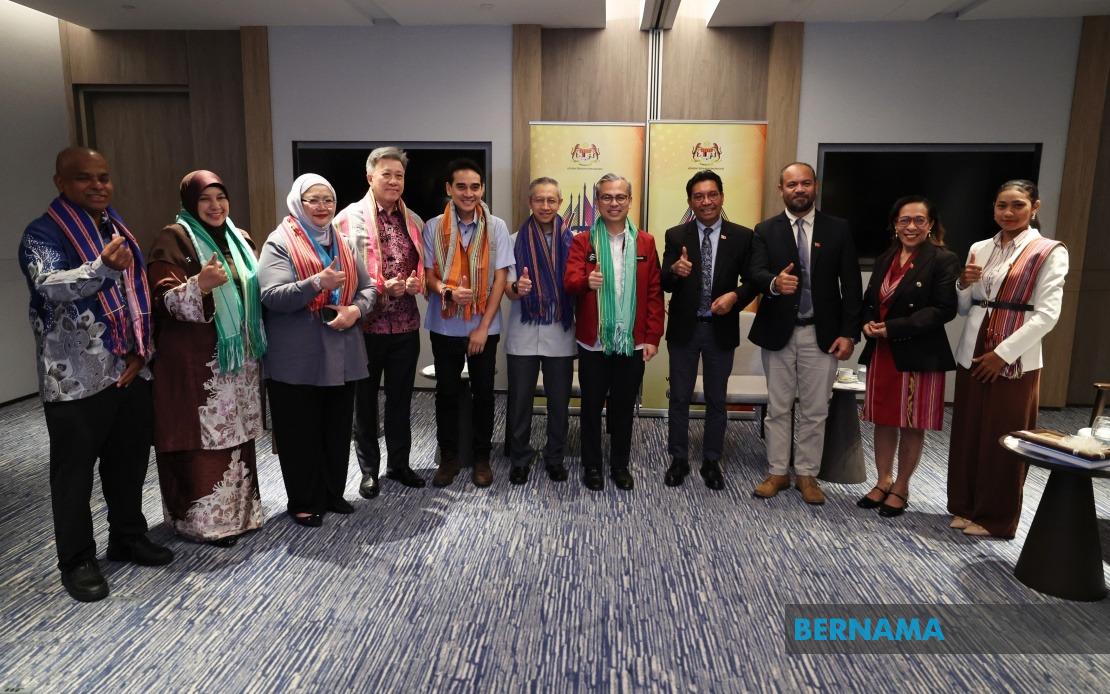
Malaysia's national news agency Bernama and Timor-Leste's official news organisation TATOLI have formalised their partnership through a memorandum of understanding aimed at deepening media cooperation between the two ASEAN nations. The agreement was signed during National Journalists' Day celebrations in Butterworth, with Communication Minister Datuk Fahmi Fadzil and Timor-Leste's Secretary of State for Social Communication Expedito Loro Dias Ximenes overseeing the exchange in the presence of Prime Minister Datuk Seri Anwar Ibrahim and other senior officials.
The collaboration represents a significant step in positioning Southeast Asian news agencies as central players in regional and global information distribution. Bernama Chief Executive Officer Datin Paduka Nur-ul Afida Kamaludin emphasised that the arrangement extends beyond mere content exchange, encompassing comprehensive training initiatives and multimedia sharing that will enhance both organisations' operational capabilities. By pooling resources and expertise, the two agencies aim to ensure that ASEAN nations maintain editorial control over narratives and information that shape public discourse within the region, rather than relying solely on international wire services.
A key dimension of this partnership involves expanding Bernama's linguistic reach into Portuguese, reflecting Timor-Leste's colonial heritage and distinct language landscape. Currently, Bernama distributes content in six languages: Bahasa Melayu, English, Tamil, Mandarin, Arabic, and Spanish. The addition of Portuguese would enable the Malaysian agency to reach Portuguese-speaking populations globally while simultaneously providing Timor-Leste audiences with Bernama's reporting across Tetum, Portuguese, Bahasa Indonesia, and English. This multilingual approach recognises that information accessibility is fundamental to fostering understanding between nations and building informed citizenries across diverse linguistic communities.
For Timor-Leste, which officially joined ASEAN in October 2025 as the bloc's 11th member state, the arrangement offers immediate practical benefits. Journalists from the island nation are scheduled to undertake training at Bernama facilities before the year's end, gaining exposure to professional standards across multiple media platforms. Bernama brings substantial institutional capacity to this initiative, having operated its Excellence Centre and School of Journalism for more than two decades. The Malaysian agency maintains specialised teaching staff across online journalism, television, digital media, radio, and photography disciplines, providing TATOLI with access to expertise that would otherwise require significant resource investment to develop independently.
The timing of this collaboration reflects Timor-Leste's strategic positioning within ASEAN's media landscape. TATOLI, established in 2016, remains a relatively young institution compared to Bernama, which was founded on April 6, 1967, and officially launched on August 30, 1967. This experience differential means Malaysian journalists and editors can mentor their Timorese counterparts in navigating evolving media landscapes, particularly as digital platforms continue transforming news production and distribution. The partnership acknowledges that institutional knowledge, particularly in managing multimedia operations and maintaining journalistic integrity across platforms, represents an asset that benefits the entire region.
TATOLI President Noémio Mateus Soares Falcão positioned the agreement within a broader commitment to professional journalism standards and ethical information dissemination. He highlighted the critical importance of responsible reporting in an era where digital platforms facilitate rapid information spread, often without adequate verification mechanisms. By collaborating with Bernama, TATOLI gains exposure to systems and practices designed to combat misinformation while maintaining credibility with audiences. This becomes increasingly vital as Southeast Asian societies grapple with false narratives and deliberately misleading content circulating across social media channels.
The cooperation initiative reflects growing recognition within ASEAN that regional news agencies must strengthen their collective capacity to compete with international media conglomerates. When national agencies collaborate on content sharing and professional development, they enhance their individual competitive positions while maintaining editorial independence. This approach differs markedly from smaller nations simply republishing international wire service content, which often reflects perspectives and priorities misaligned with local contexts. Bernama and TATOLI's partnership creates space for Southeast Asian narratives to be shaped by Southeast Asian journalists operating under regional ethical standards.
For Malaysian media professionals, the arrangement opens pathways for deeper engagement with Southeast Asian journalism practices beyond their immediate borders. The collaborative framework suggests that Bernama will host Timorese journalists for extended training periods, creating opportunities for knowledge exchange that flows bidirectionally. While Timorese journalists gain familiarity with established Malaysian operations, Malaysian staff simultaneously encounter different news environments, regulatory contexts, and audience expectations across ASEAN's diverse geography. This mutual exposure strengthens the entire region's journalistic capacity by introducing practitioners to varied approaches and challenges.
The participation of representatives from Cambodia and Laos in the National Journalists' Day celebration indicates that this bilateral arrangement may catalyse broader multilateral media cooperation across Southeast Asia. As nations progressively formalise agreements similar to Bernama-TATOLI's memorandum, ASEAN media infrastructure becomes increasingly interconnected, potentially laying groundwork for more comprehensive regional news sharing systems. Such infrastructure could eventually enable smaller ASEAN nations to access professional content from larger regional peers while contributing their own reporting on local developments of regional significance.
Practical implementation of the agreement will test both organisations' capacity to maintain quality while scaling operations. TATOLI's responsibility for disseminating official government information means the agency operates within particular constraints regarding editorial independence that differ from Bernama's structure. Successfully navigating these institutional differences while maintaining professional journalism standards will require careful attention to governance frameworks and ethical guidelines. The training component assumes particular importance in this context, as exposure to Bernama's standards and practices should equip TATOLI staff with frameworks for balancing official communication responsibilities with professional journalistic obligations.
The linguistic dimension of this partnership carries implications extending beyond simple translation logistics. By committing to Portuguese-language reporting, Bernama acknowledges that ASEAN's membership expansion introduces new language communities into the bloc's information ecosystem. This decision recognises that effective regional integration requires breaking down linguistic barriers that historically limited inter-ASEAN communication. Malaysian news consumers may gain improved access to Timorese perspectives through Portuguese translations distributed via international platforms, while Lusophone communities worldwide receive more balanced Southeast Asian reporting from sources closer to events unfolding in the region.
Looking forward, this collaboration establishes a template for future agreements between ASEAN nations' news agencies. By documenting specific commitments regarding content sharing, training schedules, and technical cooperation, Bernama and TATOLI create a replicable model that other regional media organisations might adopt. As digital technologies continue transforming journalism globally, regional alliances offering practical training and resource sharing become increasingly valuable for smaller nations seeking to maintain competitive newsrooms despite budget constraints and talent retention challenges. The memorandum between these two agencies thus represents not merely a bilateral arrangement but a potential foundational step toward more integrated ASEAN media infrastructure.


%22%2F%3E%3C%2Fpattern%3E%3C%2Fdefs%3E%3Crect%20width%3D%22100%25%22%20height%3D%22100%25%22%20fill%3D%22url(%23ph1ejxxg)%22%2F%3E%3Crect%20width%3D%22100%25%22%20height%3D%22100%25%22%20fill%3D%22url(%23ph1ejxxp)%22%2F%3E%3Ctext%20x%3D%2250%25%22%20y%3D%2250%25%22%20text-anchor%3D%22middle%22%20dominant-baseline%3D%22central%22%20fill%3D%22rgba(255%2C255%2C255%2C0.95)%22%20font-family%3D%22Georgia%2C%20'Times%20New%20Roman'%2C%20serif%22%20font-weight%3D%22700%22%20font-size%3D%22320%22%20letter-spacing%3D%22-0.02em%22%3EMMC%3C%2Ftext%3E%3C%2Fsvg%3E)