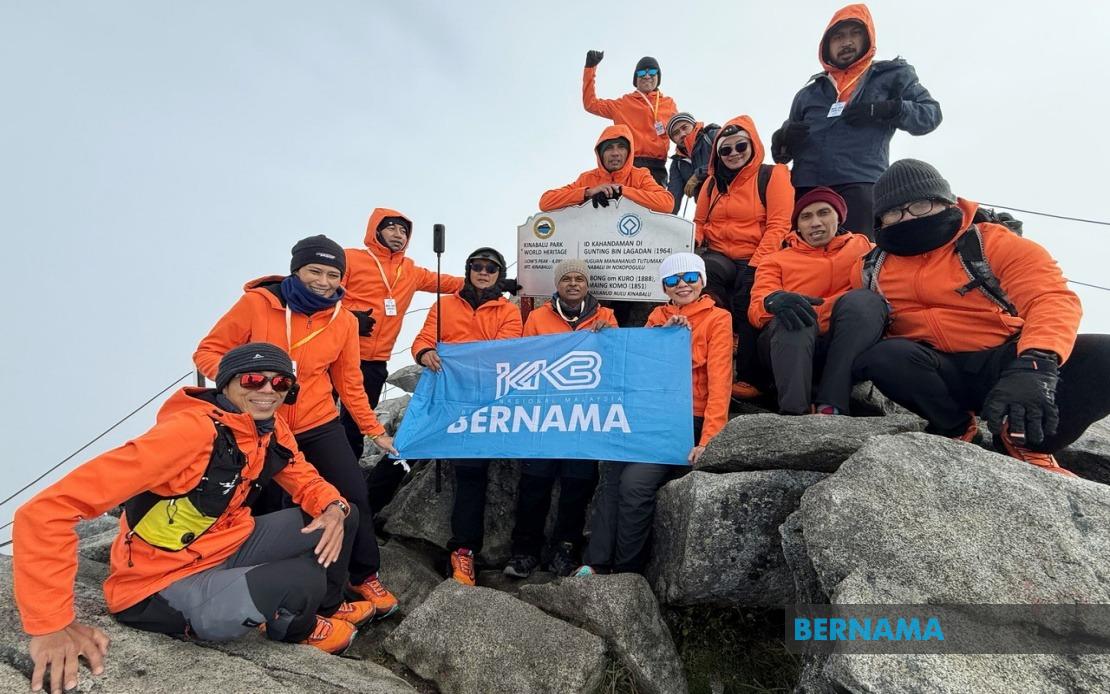
In a landmark expedition held on July 1, the Malaysian National News Agency (Bernama) successfully guided 23 staff members to the summit of Mount Kinabalu, Southeast Asia's tallest peak. The climb, which took place in conjunction with the National Journalists' Day (HAWANA) 2026 festivities, represents a significant moment for the organisation and underscores its commitment to fostering team cohesion and wellbeing among personnel. Led by Bernama Editor-in-Chief Arul Rajoo Durar Raj, the expedition drew participants from across the agency's operations, including reporters, photographers, sub-editors, television production crews, and administrative personnel—a cross-functional assembly that reflected the diverse nature of modern newsroom work.
The expedition was carefully structured to maximise both physical achievement and institutional recognition. Participants began their ascent at Timpohon Gate at 10 am on June 30, establishing their base at Panalaban refuge for the night before resuming the demanding climb at 2.30 am on July 1. The team reached the 4,095.2-metre summit at approximately 7.20 am, having navigated challenging weather that included persistent rain, dense mist, and strong winds throughout the ascent. For Arul Rajoo, the achievement carried personal significance, as he became the first Editor-in-Chief in Bernama's history to successfully reach the mountain's peak—a distinction that speaks to the organisation's leadership approach of engaging directly in such endeavours rather than directing from afar.
Bernama has positioned the expedition as pursuit of two Malaysia Book of Records entries, reflecting organisational ambitions that extend beyond the immediate accomplishment. The agency aims to establish itself as the largest group of media practitioners from a single organisation to ascend Mount Kinabalu, a record that speaks to the scale and coordination required to mobilise such a team on a challenging mountain climb. The second record sought is for being the first media organisation to produce and file news reports in four languages from the summit itself—a recognition that merges journalistic capability with logistical coordination at extreme altitude, where the thin air and challenging conditions ordinarily render complex tasks difficult.
The Kinabalu expedition was organised by the Bernama Staff Club (KKB), marking the first time the group has undertaken such an initiative. By framing the climb as a HAWANA 2026 celebration vehicle, organisers succeeded in elevating what might otherwise be a simple team-building exercise into a nationwide commemoration of journalism as a profession. The event achieved multiple objectives simultaneously: it generated institutional publicity, demonstrated the agency's physical and organisational resilience, strengthened interpersonal bonds across departmental lines, and promoted health consciousness among staff by normalising strenuous physical activity as part of corporate culture.
The logistical support infrastructure underpinning the expedition reveals the interconnected nature of Malaysia's corporate and institutional sectors. International sportswear manufacturer BMAI provided apparel and gear support, while regional carrier Batik Air assisted with transportation logistics. The energy beverage company 100PLUS backed the initiative, a strategic partnership likely aimed at associating the brand with physical endurance narratives. Additional support came from EHH Food Industry, Saloma Bistro, Malaysia Airports, the private intelligence publication Malaysia Insight, sports management firm UFL, Sabah Parks authority, and Marathon Baker, a logistics company. This ecosystem of sponsors reflects how major institutional undertakings in Malaysia routinely draw upon both multinational and domestic commercial partners.
Mount Kinabalu itself carries considerable cultural, scientific, and environmental significance that contextualises the expedition's importance. Towering at 4,095.2 metres above sea level, the mountain forms the centrepiece of Kinabalu Park, a protected reserve spanning 754 square kilometres located in Sabah. The mountain's status as a UNESCO World Heritage Site designates it as a globally significant natural landmark, while its incorporation into the Kinabalu UNESCO Global Geopark (KUGGp) recognises its importance for geological research and understanding of Southeast Asian geology. By conducting their expedition within this framework of international environmental and scientific designation, Bernama positioned itself as custodian of these values rather than merely tourists pursuing a recreational climbing objective.
The choice of Mount Kinabalu for a journalists' expedition carries symbolic weight within Malaysian discourse. The mountain represents national identity and resilience—characteristics that the journalism profession claims as its own. By demonstrating that Bernama personnel, drawn from across the age and fitness spectrum, could collectively reach the summit despite adverse conditions, the agency made an implicit statement about journalism's physical and moral fortitude. The fact that teams successfully filed multilingual reports from the peak suggests that contemporary journalism, even when operating from extreme locations and under severe constraints, retains its capacity to produce timely, professionally crafted content across multiple audiences and language communities.
The expedition's emphasis on team composition and cross-divisional participation deserves particular attention for what it reveals about institutional cultures in Malaysia's media sector. Bernama's deliberate inclusion of reporters alongside photographers, sub-editors, television crews, and administrative staff signalled that journalistic work is fundamentally collaborative—that breaking news stories and conducting quality journalism requires the integrated efforts of numerous professionals beyond those whose bylines appear in publications. By bringing these diverse roles together in an environment that required mutual support for safety and success, Bernama reinforced internal messages about interdependence and shared institutional purpose.
For Malaysian readers, particularly those employed in large organisations, the Bernama expedition resonates as a model of institutional engagement that balances corporate ambition with genuine employee wellbeing. The decision to pursue Malaysia Book of Records entries demonstrates organisational pride and recognition-seeking, yet this drive coexists with demonstrable investment in staff health, team bonding, and professional development. In an era when Malaysian corporations frequently draw criticism for prioritising shareholder returns over worker welfare, Bernama's public commitment to physical challenge and collective achievement offers a contrasting narrative—one where institutional reputation building and employee flourishing are presented as complementary rather than competing objectives.
The technical achievement of producing news reports in four languages from the summit represents a meaningful professional accomplishment that extends beyond the physical conquest of altitude. This aspiration indicates that Bernama maintains editorial ambitions across multiple language communities—Malay, English, Mandarin, and likely Tamil or another major regional language. The willingness to field multilingual reporting teams at extreme altitude suggests confidence in editorial capacity and commitment to serving diverse audiences, even when doing so presents substantial logistical and environmental challenges. Such capability has become increasingly valued in Southeast Asia's multilingual media environment, where audiences expect news services to communicate across linguistic and cultural boundaries seamlessly.
Looking forward, the Bernama expedition establishes a template that other Malaysian media organisations and institutions might consider emulating. The model—combining professional development, staff engagement, institutional recognition-seeking, and community celebration—offers an alternative to conventional team-building exercises that often feel disconnected from core institutional missions. By organising their initiative around Mount Kinabalu, a site of national significance with international environmental designation, Bernama connected personal achievement to broader narratives of Malaysian pride and natural heritage stewardship. Whether subsequent expeditions will follow from other news organisations or institutions remains to be seen, but the Bernama initiative has demonstrated that journalists and media workers, often stereotyped as desk-bound professionals, possess the capacity to undertake and document significant physical challenges while maintaining professional standards and pursuing organisational excellence.

