Wimbledon stands as an institution unlike any other in professional tennis. The All England Club's 149-year history represents far more than a sporting calendar fixture—it embodies a carefully maintained amalgamation of British social customs, sartorial codes, and ceremonial pageantry. From the mandatory white dress code extending to players' footwear, to the quintessential strawberries and cream consumed in the stands by hat-adorned spectators, to the ceremonial presence of members of the royal family, every element of the tournament functions as a deliberate preservation of tradition. The meticulous upkeep of the perennial ryegrass courts themselves has become almost as iconic as the matches played upon them, with groundskeeping practices refined across generations to maintain the tournament's distinctive playing surface and aesthetic character.
The tournament's visual presentation deliberately contrasts with contemporary sporting spectacles. Held simultaneously with the FIFA World Cup, Wimbledon's refined atmosphere and classical aesthetic appear utterly removed from the modern, high-energy presentation of international football. Yet beneath this polished veneer lies a reality that fundamentally mirrors competitive sports everywhere. The oldest Grand Slam event, encompassing approximately 675 matches across all categories, hosts the planet's elite tennis players locked in a desperate pursuit of the sport's most prestigious title. The fundamental difference between Wimbledon and other major sporting competitions lies not in the intensity of competition, but rather in how that competition presents itself to the world. The competitive core—that primal drive to prevail against formidable opponents—burns with identical ferocity regardless of whether players compete in white or colour, on grass or hard courts.
Photographers assigned to cover Wimbledon documented this underlying competitive intensity through moments invisible to casual spectators. These images revealed the tournament's true soul in instances both triumphant and devastating. The silence preceding a serve, the concentrated expression of a player executing a critical volley, the visible relief flooding across a victor's face, and the crushing realisation of defeat captured in an opponent's posture—these candid moments transcended the tournament's refined presentation to expose something fundamentally human and raw. The photographs functioned as visual anthropology, documenting how elite athletes process extraordinary pressure and the highest stakes in their profession.
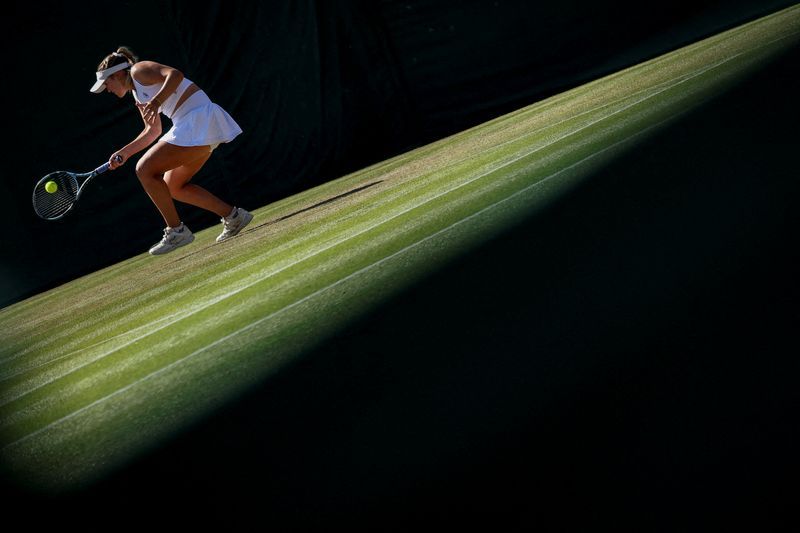
Alexandra Eala's collision with the grass during her match against third seed Iga Swiatek exemplified this competitive ferocity. The 21-year-old Filipino player challenged one of women's tennis's dominant forces, a six-time Grand Slam winner, and her gritted teeth as she fell encapsulated the physical and mental toll of competing at sport's highest echelon. Photographer Toby Melville, positioned to capture Eala's moment of celebration, instead inadvertently documented one of the tournament's most visceral competitive images. Melville's positioning proved prescient when Eala's fall transformed the intended upright composition into a landscape-oriented photograph of raw determination. The moment captured far more than athletic struggle—it revealed the absolute commitment demanded of players seeking to advance against the world's most accomplished competitors.
Frustration manifested in multiple forms throughout the tournament's two-week duration. Otto Virtanen's first-round encounter proved particularly revealing when the player, during moments of frustration, approached the courtside barrier with visible body language suggesting a desire to simply vanish into the green canvas of the court itself. Photographer Jaimi Joy's documentation of this moment exposed the psychological dimensions of professional tennis rarely visible to spectators seated in distant sections of the stadium. The image conveyed the accumulated pressure of competing in such a prestigious venue, where every mistake magnifies and every lost point carries disproportionate weight.
Conversely, certain players demonstrated the fearlessness required to thrive in Grand Slam environments. Naomi Osaka's journey through the tournament, culminating in her quarter-final appearance, attracted significant attention partly due to her distinctive aesthetic choices. Photographer Marko Djurica captured the two-time major champion strutting across Centre Court in a kimono-inspired dress, an image that seemed to encapsulate her composed confidence throughout her campaign. The photograph represented more than fashion documentation—it illustrated how elite athletes project control and assurance even when facing extraordinary competitive pressure.
The interplay between light and shadow throughout the tournament's venues added visual dimension to competitive narratives. Jannik Sinner's struggle during the men's final against Alexander Zverev demonstrated this dynamic perfectly. Melville's capture of the champion mid-air, stretching desperately to return a forehand, showed Sinner's shadow extending across the court in a manner that appeared to physically elongate his reach. The technical execution of tennis at this level demands such extraordinary extension and flexibility that the photographic documentation revealed the sport's aesthetic dimensions alongside its competitive brutality. Sinner's ultimately successful defence of his title reflected the mental and physical endurance required to navigate three weeks of elite-level competition.
Djurica's photograph of Guo Hanyu and Kristina Mladenovic embracing immediately after their women's doubles triumph illustrated how shadow and composition could enhance sporting narrative. The image's shadow appeared to transform one player's form into a fist raised in victory, creating a visual metaphor for triumph extending beyond the actual competitive achievement. The emotional intensity of winning a Grand Slam doubles title—the culmination of months of preparation and partnership—registered clearly in the physical embrace and in how the photograph captured that moment of shared victory.
As the tournament concluded and tournament staff removed the nets and cleared the stands, physical evidence of the competition's intensity remained inscribed upon the courts themselves. Andy Couldridge's time-lapse documentation of Centre Court revealed the accumulated wear from players' shoes across the tournament's duration, transforming pristine grass into visible pathways marking the tournament's passage. These worn patches represented thousands of steps taken by the world's finest athletes, each footfall representing countless hours of preparation, sacrifice, and competitive determination. The grass courts' transformation throughout the tournament visually documented the physical toll extracted by championship-level tennis, creating a natural record of the sporting battle that had transpired.
Wimbledon's enduring legacy transcends its carefully maintained traditions and ceremonial pageantry. While strawberries and cream, white dress codes, and royal patronage define the tournament's external presentation, the genuine measure of Wimbledon's significance rests in the fierce competitive crucible it provides for professional tennis's elite. The tournament represents a space where tradition and modernity coexist, where refined British customs frame the most intense professional athletic competition. Photographers covering the event succeeded in documenting this paradox, revealing through visual storytelling how Wimbledon simultaneously preserves the past while hosting the future of professional tennis. The tournament endures not because of its aesthetic presentation, but because it remains an authentic test of championship-level tennis excellence.

