Prime Minister Narendra Modi's ruling coalition has launched a fresh political offensive against the Cockroach Janta Party, a student-led pressure group that gained prominence through large-scale demonstrations in New Delhi last month. The accusation centres on what the government characterises as selective activism—vigorous engagement with education reform protests in the capital, but conspicuous restraint when similar agitations erupted in Jharkhand, an eastern state governed by opposition-aligned coalitions. This clash reveals deepening partisan tensions over protest movements in India and raises questions about how activist groups maintain credibility and momentum across disparate regional contexts.
The government's criticism arrived through BJP spokesperson Keya Ghosh, who described the Cockroach Janta Party as a "mute spectator" to the Jharkhand unrest. Ghosh alleged that the group's primary motivation during the New Delhi campaign was political opportunism—specifically, to "destabilise" the Modi administration rather than advance genuine policy reforms. The characterisation suggests the BJP views the Cockroach Janta Party less as a principled civil society movement and more as a tactical instrument wielded by opposition forces seeking to undermine the government's authority. This framing represents a common strategy whereby governing parties attempt to delegitimise protest movements by attributing them to partisan manipulation rather than authentic public grievance.
The Cockroach Janta Party initially gained prominence as a satirical online movement before evolving into an organised pressure group capable of mobilising substantial street presence. Last month, the group spearheaded student demonstrations across New Delhi protesting irregularities in competitive examinations administered by the Union Public Service Commission. The protests escalated to the point where Education Minister Dharmendra Pradhan resigned—a significant political victory that underscored the movement's organisational capacity and ability to command media attention. However, the group subsequently withdrew from active protest operations after Pradhan's departure, claiming its core objective had been achieved.
When protests erupted in Jharkhand over alleged manipulation in state recruitment examinations, the Cockroach Janta Party's response differed markedly from its New Delhi mobilisation. Rather than organising large-scale demonstrations or assuming leadership roles, the group offered rhetorical support to local students while remaining operationally distant from the ground-level agitation. This disparity troubled BJP strategists, who seized upon the inconsistency as evidence that the movement prioritises anti-government activism in Delhi over supporting students confronting corruption in states ruled by opposition parties. The accusation carries particular weight because Jharkhand is governed by a coalition dominated by the Jharkhand Mukti Morcha and the Indian National Congress, with the BJP relegated to opposition status.
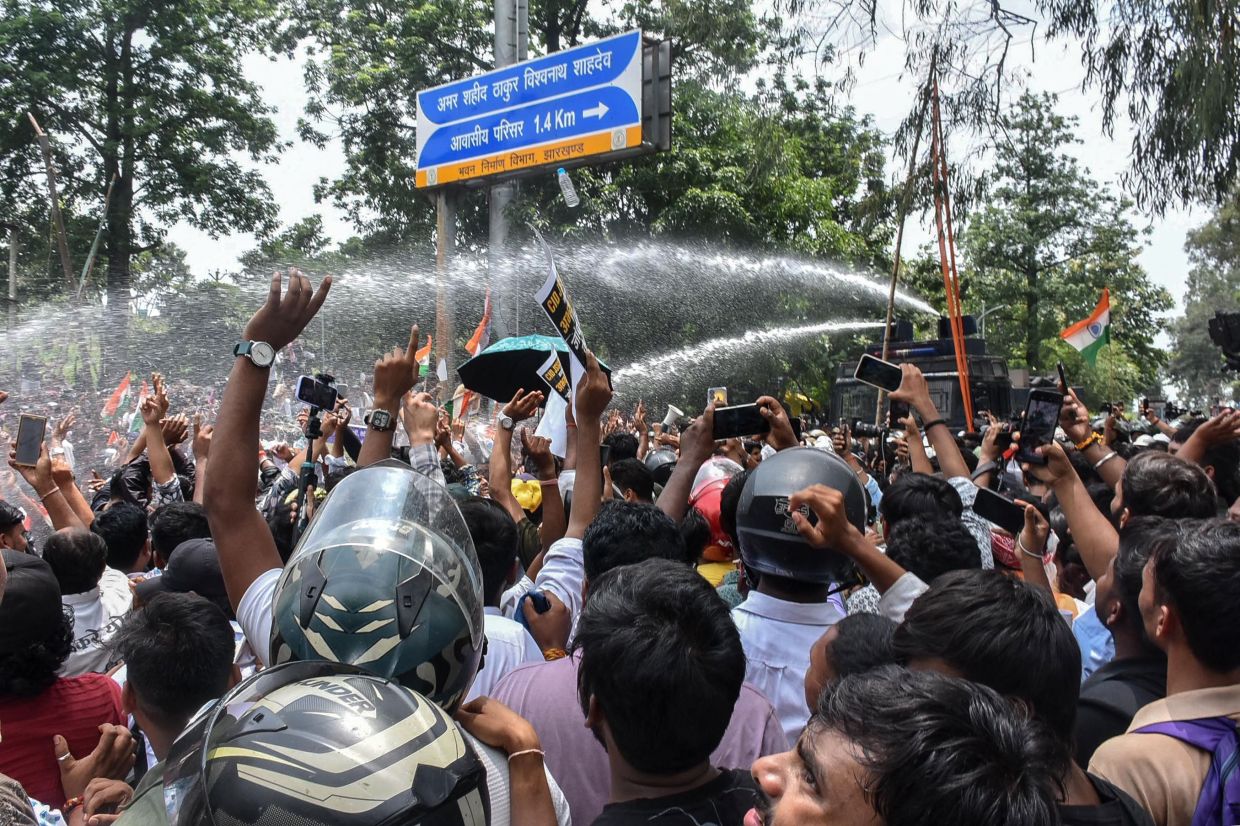
However, the picture proves more nuanced than the BJP's accusations suggest. Jharkhand's student protests have been predominantly locally-driven, led by regional job aspirants and educational activists without reliance on external coordination. The Cockroach Janta Party's reduced visibility reflects this organic, grassroots character rather than indifference. Simultaneously, the group's founder Abhijeet Dipke did publicly condemn police brutality during Monday's crackdown, when security forces deployed water cannons and batons against demonstrators—responding to the repression despite the movement's limited operational role in organising the agitation itself. This suggests the Cockroach Janta Party maintains ideological commitment to student welfare even when not directly orchestrating the protests.
Some Cockroach Janta Party members who participated in New Delhi demonstrations have independently travelled to Jharkhand and contributed to local protest efforts, according to reports from regional media outlets. Akshay Shinde, the group's national coordinator, confirmed this involvement whilst emphasising the movement's determination to remain engaged until all student demands are satisfied. This personal participation by individual activists distinguishes between the group's formal organisational stance and the voluntary commitments of its members, a distinction that complicates the BJP's broader accusation of hypocrisy. Activist movements routinely exhibit variation in regional engagement based on local capacity, existing relationships, and the autonomy of individual participants.
The BJP's criticism extends beyond the Cockroach Janta Party to encompass broader opposition leadership, particularly Congress president Rahul Gandhi. Ghosh publicly questioned why Gandhi—who leads the opposition in the Lok Sabha—has not visited protest sites in either New Delhi or Jharkhand. This rhetorical gambit attempts to implicate the Congress party in the same accusation of selective solidarity, suggesting that opposition figures mobilise student grievances opportunistically when serving ruling-party interests but abandon such causes when opposition-aligned governments face criticism. Gandhi has not physically visited either protest location, though he has released statements condemning police violence and affirming students' rights to peaceful assembly.
Gandhi's measured response through social media platforms—rather than personal visits to demonstration sites—reflects a deliberate strategic choice that contrasts with more visible forms of engagement. He has emphasised dialogue and non-violence as pathways to resolution, positioning the Congress party as a stabilising force advocating for rational conflict resolution rather than confrontational mass mobilisation. This approach acknowledges the legitimacy of student grievances whilst maintaining distance from the Cockroach Janta Party, thereby preserving the Congress's institutional gravitas and avoiding associations with movements that could be painted as destabilising. For Malaysian observers, this dynamic illustrates how opposition parties in larger democracies navigate the tension between supporting civil society movements and maintaining governmental credibility.
The Jharkhand protests themselves carry significance beyond immediate state-level politics. The demonstrations reflect broader anxieties across India regarding examination integrity, employment access, and bureaucratic corruption—issues resonating with students and job-seekers throughout the subcontinent. The state's mineral-rich economy and competitive job market amplify these pressures, making examination fairness a critical concern for regional stability and public confidence in institutions. The agitations demonstrate that student activism transcends traditional partisan boundaries, emerging organically from economic anxiety and institutional distrust rather than merely responding to elite political direction.
For Southeast Asian observers, the episode illustrates broader patterns in contemporary Indian politics. Activist movements increasingly operate as semi-autonomous forces capable of challenging government authority whilst maintaining sufficient ambiguity about partisan affiliation to complicate opposition attempts at co-option. The Cockroach Janta Party's evolution from satirical social media presence to organised pressure group reflects global trends wherein digital platforms facilitate rapid mobilisation around specific grievances without requiring traditional organisational hierarchies. Simultaneously, governing parties deploy accusations of hypocrisy and partisan motivation to undermine protest legitimacy—a strategy visible across democracies facing sustained civil society pressure.
The BJP's accusations reveal anxieties about the government's declining capacity to control the narrative around student discontent. By framing the Cockroach Janta Party as hypocritical rather than engaging substantively with the issues animating protests, the ruling coalition attempts to shift scrutiny away from underlying policy failures. However, this rhetorical strategy risks reinforcing perceptions of governmental defensiveness and unwillingness to address legitimate institutional weaknesses. As India's election cycle progresses and student-related grievances persist across multiple states, the dynamics between organised protest movements and political parties will likely intensify, with implications extending throughout South Asia's political landscape.

