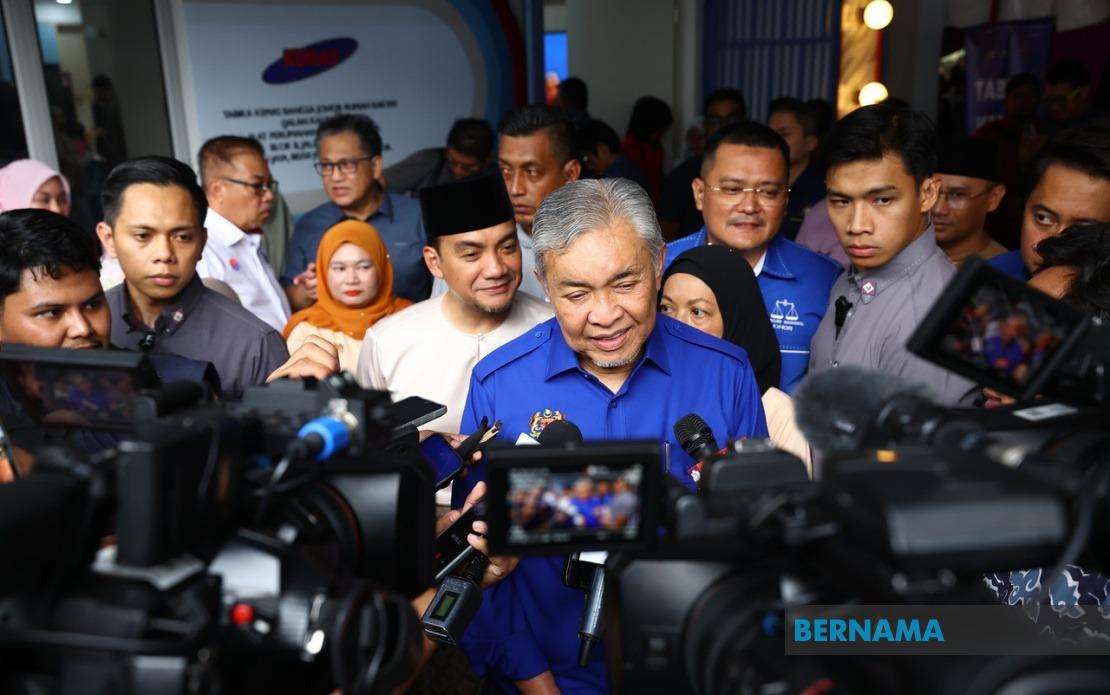
The Johor state election campaign has entered a more cordial phase, with Barisan Nasional's leadership publicly acknowledging the legitimacy of rival proposals as the two major coalitions make their final pitches to voters. Speaking in Johor Bahru on July 3, BN Chairman Datuk Seri Dr Ahmad Zahid Hamidi indicated that his coalition respects Pakatan Harapan's election manifesto, signalling an acceptance of healthy political competition in the lead-up to polling day on July 11.
Ahmad Zahid, who serves as Deputy Prime Minister and Rural and Regional Development Minister, made his comments after attending a community engagement session with parents at Tabika Kemas Bangsa Johor in the Larkin area. His remarks reflect a pragmatic approach to the campaign, acknowledging that in a functioning democracy, multiple parties should be free to present their visions for governance without facing dismissal or disrespect from competitors. The statement carries particular weight coming from the sitting coalition's top leadership, suggesting BN is confident enough in its own record to afford PH's proposals the courtesy of serious consideration.
Pakatan Harapan unveiled its platform for the election on the same day, introducing ten substantive policy commitments designed to appeal across different segments of Johor's electorate. The opposition coalition's manifesto includes establishing a Johor Health Scheme to improve healthcare access, providing down-payment assistance for first-time property buyers struggling with Malaysia's challenging housing market, allocating RM500 million for youth development and economic empowerment, and implementing targeted improvements to the education system. These proposals address several persistent challenges facing Malaysian households, particularly younger and middle-income demographics who have grown increasingly price-sensitive in the post-pandemic economy.
For BN's part, Ahmad Zahid anchored the coalition's case on the incumbent state government's demonstrated performance, asserting that previous administrations delivered on more than 90 per cent of their electoral promises. This emphasis on track record reflects a strategy prioritizing governance competence and implementation capability over purely aspirational commitments. The framing suggests BN believes voters will reward proven delivery, a calculation that may resonate among those who value administrative stability and tangible results over campaign rhetoric.
The BN manifesto itself spans the entire lifecycle of constituents, according to Ahmad Zahid's description. The platform encompasses support for expectant mothers and newborns, childhood development initiatives, educational enhancements for school-age children, university student assistance, and dedicated programmes for single parents navigating economic difficulties. This comprehensive approach attempts to neutralize the opposition's specific sectoral offerings by presenting a broader safety net applicable across age groups and family structures.
Crucially, Ahmad Zahid stressed that BN's welfare architecture operates on the principle of universal citizenship rather than selective targeting. His statement that any resident of Johor qualifies as part of "Bangsa Johor" and deserves equal access to state benefits attempts to preempt allegations of discriminatory implementation along racial or communal lines. This messaging addresses ongoing sensitivities regarding equitable distribution of public resources, a consistent point of political contestation in Malaysian electoral discourse.
The Johor contest itself has grown significantly in scale, with 172 candidates competing across 56 state assembly seats. Early voting is scheduled for July 7, providing an opportunity to gauge turnout patterns before the main election three days later. The participation rate and demographic composition of early voters often signal broader campaign momentum and which sections of the electorate are mobilizing most effectively.
Ahmad Zahid also underscored his personal commitment to Johor's continued advancement, pledging to leverage his ministerial portfolio to support state-level development initiatives. This commitment carries implications beyond symbolic reassurance, as the Rural and Regional Development Ministry controls budgetary allocations and programmatic resources that directly affect infrastructure projects, agricultural support, and regional economic development—areas of particular importance to Johor's mixed urban-rural constituency.
The respectful tone Ahmad Zahid adopted toward PH's manifesto may reflect broader political calculations. With Johor being one of Malaysia's most economically significant states and a traditional BN stronghold, the coalition likely views its position as sufficiently secure to permit magnanimous acknowledgment of opposition proposals without appearing defensive. Conversely, this courtesy may also signal BN's confidence that its implementation record and institutional advantages will ultimately prove decisive with voters regardless of what platforms competitors present.
The campaign period illustrates how Malaysian electoral politics has evolved since the intense partisan polarization of recent years. Both coalitions are now articulating substantive policy agendas addressing concrete governance challenges rather than engaging primarily in character assassination or ideological absolutism. For Malaysian voters, particularly those in Johor, this shift potentially enables more substantive evaluation of competing visions for state administration, economic opportunity, and social provision.
As the election approaches, the competing visions will face increasing scrutiny from an electorate that has grown more discerning about performance metrics and accountability. Neither coalition can rely solely on historical brand loyalty or ethnic bloc voting; instead, both must demonstrate how their specific proposals will improve tangible aspects of daily life—from healthcare costs and housing affordability to educational quality and youth employment prospects. The Johor election thus serves as a barometer for whether Malaysian voters prioritize demonstrated competence, innovative policy proposals, or some combination of both factors in their electoral calculus.

