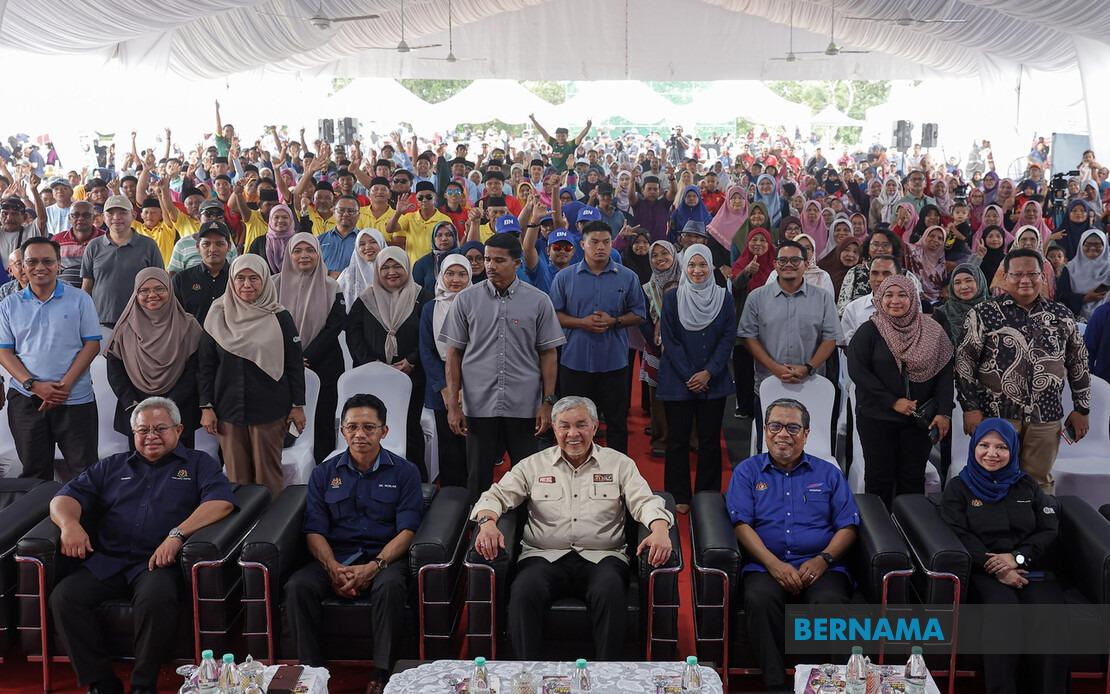
Malaysia's major political coalitions are exploring fresh strategies to navigate an increasingly fragmented electoral landscape, with Barisan Nasional chairman Datuk Seri Dr Ahmad Zahid Hamidi signalling that the results of the upcoming Negeri Sembilan state election will determine whether cooperation with Perikatan Nasional extends to future contests. Speaking at a programme in Jempol on July 18, Ahmad Zahid outlined how the two coalitions are testing a limited electoral arrangement ahead of potentially larger political realignments that could reshape Malaysian politics in preparation for the 16th General Election.
The current understanding between BN and PN represents a pragmatic response to Malaysia's evolving political dynamics, where the traditional two-coalition dominance has fragmented into multiple competing power blocs. Rather than engaging in all-out competition across every seat, the two coalitions have reached a tactical accommodation designed to prevent vote-splitting in key constituencies. This approach reflects recognition among senior political figures that in a crowded electoral field, poorly coordinated opposition can inadvertently benefit unexpected winners and destabilise governance outcomes that both coalitions might prefer to avoid.
Ahmad Zahid was careful to emphasise that the arrangement with PN stops short of a formal merger or binding political alliance. Instead, he characterised it as a mutual understanding focused on seat allocation and avoiding redundant contests where both coalitions would field candidates for the same position. The distinction matters significantly because formal coalitions carry implications for policy coordination, cabinet positions, and long-term governance partnerships, whereas tactical arrangements preserve each coalition's independence while reducing wasteful electoral competition. This flexibility allows both BN and PN to maintain their separate identities and party structures while experimenting with coordinated strategies.
The Negeri Sembilan state election, scheduled for polling day on August 1, with early voting on July 28, serves as the testing ground for this approach. The results will provide empirical evidence about whether such arrangements can deliver tangible electoral benefits to both coalitions compared to scenarios of direct competition. Success in Negeri Sembilan could demonstrate that vote consolidation yields higher seat counts than fragmented contests, making the case for extension to other battlegrounds. Conversely, disappointing results might prompt both coalitions to reconsider their strategies or adopt alternative approaches to maximising their combined political influence.
The broader implications of this experimentation extend well beyond Negeri Sembilan. Ahmad Zahid explicitly noted that performance in the state election would inform decisions about potential similar arrangements in the Melaka state election and, more critically, in the next General Election. For Malaysian political observers, this suggests that established coalition structures that have dominated national politics for decades are now subject to fluid recalibration. The willingness of BN and PN to explore tactical cooperation signals that both recognise survival in Malaysia's competitive political environment increasingly depends on strategic flexibility rather than rigid ideological positioning.
From a Malaysian perspective, such realignments carry substantial ramifications for governance and policy direction. The composition of coalitions determines not only election outcomes but also the priorities that shape budgets, development initiatives, and policy frameworks affecting ordinary citizens. A BN-PN arrangement would differ markedly in character and priorities from traditional BN governance or a PN-led government, potentially affecting everything from development corridors favoured by different geographic constituencies to social spending patterns that reflect each coalition's political base.
The timing of this electoral testing is also significant given Malaysia's political history. Past election cycles have witnessed dramatic shifts in voter preferences and coalition performance, from the 2018 general election that unexpectedly ended BN's decades of dominance to subsequent state elections that produced mixed results for various coalitions. The current period of experimentation suggests that political leaders across both BN and PN have absorbed lessons from these shifts and are adapting their strategies accordingly. Rather than assuming historical patterns will continue, they are conducting live experiments with new approaches.
Regional observers will also note that this development reflects broader trends across Southeast Asia, where traditional two-coalition systems have given way to more fragmented political landscapes requiring novel coalition engineering. Countries from Thailand to Indonesia have experienced similar transitions toward more fluid political arrangements, and Malaysia's exploration of tactical electoral cooperation fits within this regional pattern. The success or failure of Malaysian experiments with such approaches may provide instructive examples for other Southeast Asian democracies managing comparable political fragmentation.
For voters in affected constituencies, the BN-PN understanding introduces a new variable into electoral calculations. Rather than choosing between BN and PN as mutually exclusive options, voters in certain seats will face contests where one or the other coalition has withdrawn to allow the other a clearer field. This changes the strategic considerations voters employ when deciding their preferences, potentially affecting both turnout and vote distribution patterns. The extent to which voters accept or resist such pre-arranged electoral outcomes will itself provide important data about Malaysian electorate preferences and the legitimacy of coalition engineering strategies.
The stated willingness of both coalitions to evaluate and potentially revise their approach based on Negeri Sembilan results reflects political maturity and pragmatism. Rather than committing to fixed strategies regardless of outcome, BN and PN leadership are treating this initial experiment as a learning opportunity. This adaptive approach contrasts with earlier periods of Malaysian politics when coalitions typically locked into rigid configurations and pursued them through multiple election cycles regardless of performance feedback. The flexibility Ahmad Zahid describes suggests that future Malaysian elections may increasingly feature negotiated arrangements tailored to specific electoral contexts rather than uniform coalition structures applied nationwide.
Looking forward to GE16, the potential extension of BN-PN coordination would represent a significant reconfiguration of national politics. Such an arrangement would concentrate substantial parliamentary representation among two coalitions while marginalising other political groupings, potentially reshaping the balance of power in ways that could either stabilise governance or provoke unexpected political responses from excluded actors. The outcome of the Negeri Sembilan state election will therefore represent more than a simple test case; it will signal the likely trajectory of Malaysian coalition politics in the critically important general election that will follow.

