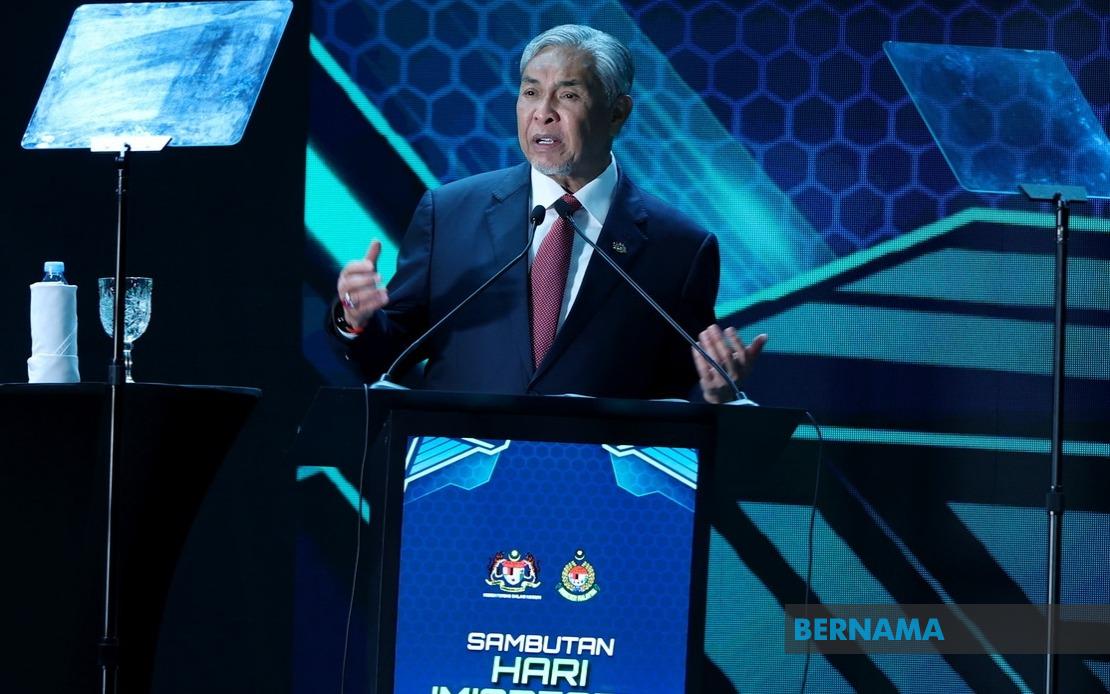
Barisan Nasional has reaffirmed its commitment to the Unity Government coalition, with party chairman Datuk Seri Dr Ahmad Zahid Hamidi declaring that the stance reflects decisions made at the UMNO General Assembly, the party's supreme decision-making forum. Speaking at the 2026 Immigration Day celebration in Cyberjaya on July 21, Ahmad Zahid, who also serves as UMNO president and Deputy Prime Minister, sought to dispel any uncertainty about BN's coalition partnership by emphasising the binding nature of resolutions adopted at the party's highest level.
The reaffirmation comes at a time when coalition politics in Malaysia remain fluid, with various partners occasionally testing boundaries and expressing concerns about their respective roles and influence. Ahmad Zahid's statement effectively signals that BN has institutionalised its commitment through formal party mechanisms, making a unilateral withdrawal or significant policy reversal procedurally complex. This approach reflects a calculated strategy to project stability and predictability to both coalition partners and the broader business and international community that views governmental continuity as essential for economic planning and investment decisions.
Ahmad Zahid underscored that the decision commands respect precisely because it emanates from the General Assembly, positioning dissent as inconsistent with party discipline and democratic processes. By framing BN's continued participation as a settled matter rather than an ongoing negotiation, he attempted to foreclose public debate about the coalition's durability. The emphasis on "no body higher than the General Assembly" serves a dual purpose: it legitimises the decision within UMNO's internal hierarchy while simultaneously signalling to other coalition partners that BN's commitment is not subject to casual revision based on shifting political circumstances.
The Unity Government itself has faced occasional strains since its formation, with periodic disagreements between BN, PKR-led Pakatan Harapan, and GPS over ministerial positions, policy priorities, and campaign strategies. BN's formal reaffirmation of commitment thus carries significance beyond mere reassurance, functioning as a stabilising mechanism at a moment when the coalition might face internal or external pressure. For Malaysia's business community and financial markets, such statements provide essential clarity about the continuity of government policy and regulatory frameworks.
Separately, Ahmad Zahid addressed the sensitive issue of ministerial conduct within coalition government frameworks. He acknowledged that Prime Minister Datuk Seri Anwar Ibrahim possesses the constitutional and executive authority to appoint or dismiss Cabinet members according to his discretion. This statement gained relevance following reports that Anwar had warned government officials against exploiting their positions to attack Unity Government coalition partners during state election campaigns. Such inter-coalition attacks risk destabilising the fragile equilibrium that holds diverse political parties together in shared governance structures.
The Prime Minister's reported warning specifically cautioned that any minister, deputy minister, or government agency official engaging in such conduct faced potential dismissal. Ahmad Zahid's acknowledgement of this prerogative effectively endorses Anwar's authority to enforce coalition discipline through personnel changes. This represents a significant development in coalition management, establishing an explicit mechanism for addressing conduct that threatens the government's cohesion and effectiveness. By validating the Prime Minister's powers in this domain, Ahmad Zahid simultaneously protected BN's interests by ensuring that such disciplinary action would apply uniformly across all coalition partners rather than targeting any single group.
The backdrop to these statements involves the ongoing challenge of maintaining coalition discipline while allowing individual parties to campaign and contest elections separately. Malaysia's political system requires multiple parties to govern together, yet those same parties frequently compete directly during electoral contests. This structural tension creates recurring friction points where ambitious politicians seeking to strengthen their party's electoral position inadvertently undermine broader coalition solidarity. The Prime Minister's warning and Ahmad Zahid's endorsement represent efforts to establish clearer boundaries between acceptable partisan campaigning and conduct that crosses into wholesale attacks on coalition partners.
From a Malaysian political perspective, BN's formal recommitment carries particular weight given the coalition's historic role as the dominant governing force through most of the nation's post-independence history. UMNO, the cornerstone party within BN, has traditionally functioned as the ultimate arbiter of federal-level politics, though its dominance has considerably weakened over the past decade. The current Unity Government arrangement represents a significant departure from BN's traditional governing majority, requiring sustained cooperation with former opponents and uncomfortable compromise on policy matters. Ahmad Zahid's emphasis on the binding nature of the General Assembly decision reflects an effort to stabilise this unprecedented arrangement.
The implications for Southeast Asian regional politics merit consideration as well. Malaysia's political stability directly affects regional security, economic growth, and diplomatic coordination within ASEAN. Extended periods of coalition instability or frequent government changes create uncertainty that extends beyond Malaysia's borders, potentially complicating regional initiatives and diminishing Malaysia's influence in multilateral forums. BN's formal commitment thus carries significance not only for domestic governance but also for the stability of broader regional arrangements.
Looking forward, Ahmad Zahid's statements establish clearer expectations about BN's behaviour within the coalition framework while also delineating the Prime Minister's authority to enforce coalition discipline through ministerial changes. This represents a pragmatic approach to managing the inherent tensions within Malaysia's current multi-party governing arrangement, establishing mechanisms that acknowledge both the reality of coalition politics and the need for unified government action. Whether these mechanisms prove sufficient to maintain coalition cohesion through anticipated electoral contests and shifting political circumstances remains to be observed, but they represent a conscious effort to institutionalise stability within the complex current political landscape.

