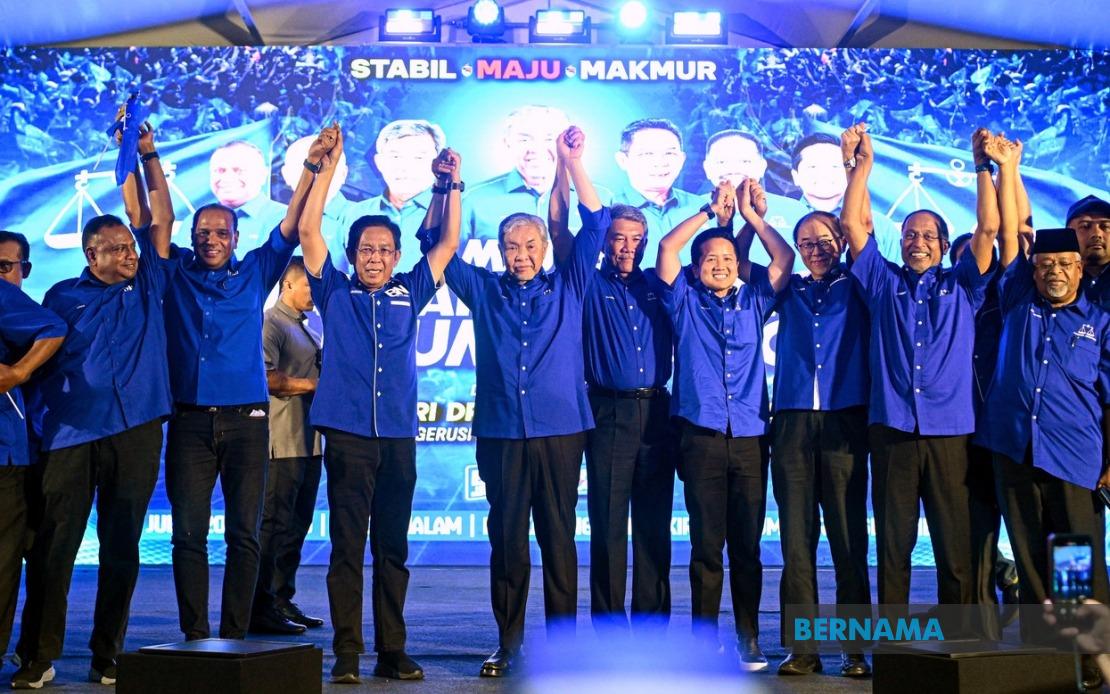
Barisan Nasional unveiled its slate of 25 candidates for the 16th Negeri Sembilan state election on Tuesday evening, signalling the coalition's readiness to contest the polls with a combination of seasoned lawmakers and fresh political talent. The announcement at Tuanku Abdul Rahman Stadium in Paroi came as BN formally launched its electoral machinery for what is expected to be a closely watched contest in the east-coast state.
Datak Seri Mohamad Hasan, the BN chairman for Negeri Sembilan and the coalition's deputy chairman at the national level, confirmed he will seek re-election in Rantau, the seat he has held continuously since 2004. His two-decade tenure represents one of the longest-serving representatives in the state, and his retention signals BN's confidence in his organizational strength within the Rantau division. Speaking at the candidate launch, Mohamad acknowledged UMNO president Datuk Seri Dr Ahmad Zahid Hamidi's decision to renominate him, framing the endorsement as an expression of trust in his stewardship of the seat.
Equally significant is BN's decision to renominate Datuk Seri Jalaluddin Alias in Pertang, where he has represented the constituency since 2013. Jalaluddin, who holds the position of Jelebu Member of Parliament and chairs the Negeri Sembilan UMNO Liaison Committee, brings both federal and state-level experience to his campaign. His retention in Pertang suggests BN is maintaining continuity in constituencies where incumbents have demonstrated electoral viability and organizational capacity.
The coalition has also retained several other established figures in its lineup. Datuk Mohd Faizal Ramli will defend the Linggi seat, while Datuk Mustapha Nagoor seeks another term representing Palong. These decisions reflect BN's strategy of leveraging incumbency advantages in seats where the coalition has established strongholds. The retention of multiple long-serving assemblymen indicates confidence in their ability to consolidate BN's existing support bases.
However, the incomplete nature of BN's candidate selection process adds an element of uncertainty to the coalition's preparations. According to the candidate list circulated to media outlets, BN has yet to finalize nominations for eleven state seats: Klawang, Serting, Lobak, Sikamat, Ampangan, Bukit Kepayang, Mambau, Paroi, Lukut, Bagan Pinang, and Gemas. The outstanding selections represent nearly 44 percent of the 25 constituencies in Negeri Sembilan, suggesting BN is still in the process of evaluating candidates or negotiating seat allocations with coalition partners.
For Malaysian political observers, the incomplete candidate list raises questions about the timing and internal dynamics of BN's selection process. The delay in finalizing candidates for a significant proportion of seats could reflect either careful deliberation aimed at optimizing candidate-constituency matching, or potential disagreements among BN component parties over seat distribution. In Malaysia's coalition-based political system, negotiating candidate allocations between UMNO, MIC, MCA, and other BN members often involves complex calculations around seat competitiveness and community representation.
The announcement comes as Negeri Sembilan prepares for a state election that will reshape the political landscape of a constituent state that has traditionally oscillated between different political forces. The state's electoral history demonstrates the volatility of Malaysian state politics, with power transfers occurring when opposition coalitions successfully mobilize voters or when incumbent administrations face internal challenges. BN's strategy of combining incumbency with fresh faces suggests an attempt to balance experience with the appeal of new leadership.
The role of Mohamad Hasan as both state BN chairman and national BN deputy chairman underscores the significance BN places on the Negeri Sembilan contest. His dual positions make him a key figure in coordinating the coalition's overall political strategy, and his decision to contest Rantau personally rather than focusing solely on party organization indicates the coalition's commitment to the state poll. This hands-on approach by senior leadership typically signals that BN views the election as consequential for its broader political position.
The pending selection of candidates for the eleven outstanding seats will likely occur in the coming weeks, with considerations around demographic representation, individual candidates' track records, and strategic positioning against opposition parties all factoring into final decisions. How quickly BN resolves these outstanding nominations and how competitive the final lineup appears could significantly influence the coalition's momentum heading into the campaign proper.
For the broader Malaysian political context, the Negeri Sembilan election serves as a barometer of voter sentiment and coalition effectiveness. Recent electoral cycles have demonstrated that despite BN's traditional dominance in certain states, no constituency can be taken for granted. The completion of BN's candidate selection process and the campaign strategies deployed will offer insights into the coalition's capacity to navigate contemporary Malaysian politics and maintain or expand its legislative influence in the region. The retention of experienced figures like Mohamad Hasan and Jalaluddin Alias suggests BN is banking on consolidating existing support, while the outcome will reveal whether this defensive posture proves sufficient against opposition mobilization efforts.

