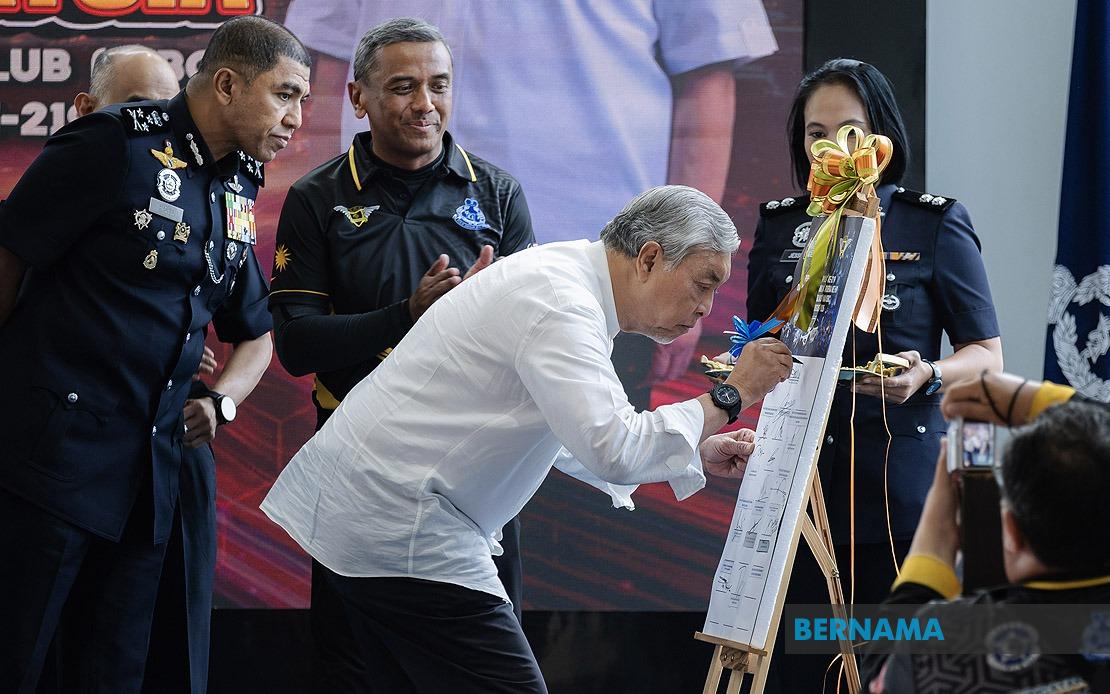
Barisan Nasional needs to develop an election strategy specifically calibrated to Melaka's distinct political circumstances rather than copying the successful blueprints deployed in neighbouring Johor and Negeri Sembilan, according to BN chairman Datuk Seri Dr Ahmad Zahid Hamidi. Speaking after a police charity event in Kuala Lumpur, the Deputy Prime Minister stressed that any political arrangements forged in the state must carefully weigh their advantages against potential risks, signalling that BN's approach to the forthcoming Melaka contest will be more nuanced than a straightforward application of previous winning formulas.
Ahmad Zahid's comments reflect the complex calculus facing BN as it prepares for the Melaka state election, due before the expiration of the current state government's mandate on December 31. The coalition captured a commanding 21 of 28 seats in the 15th Melaka state election, establishing what appeared to be a dominant electoral position. However, the subsequent inclusion of Pakatan Harapan assemblymen in the state executive council introduced a collaborative element that mirrors the Unity Government arrangement at the federal level, complicating the straightforward majoritarian template that worked in Johor and Negeri Sembilan.
The Deputy Prime Minister emphasised that negotiations surrounding any pre-election or coalition arrangements must be conducted with honesty, sincerity and a commitment to honouring agreements. Ahmad Zahid's insistence on these principles suggests awareness within BN leadership that previous political transactions in Malaysia have sometimes foundered when parties involved interpreted the terms of their agreements differently or when one party unilaterally altered the arrangement post-election. His warning against abandoning commitments once deals are struck addresses a credibility concern that has periodically undermined Malaysian coalition politics.
Responsibility for negotiating Melaka's political arrangements has been delegated to Melaka Chief Minister Datuk Seri Ab Rauf Yusoh, who also chairs the state BN branch. Ahmad Zahid indicated that any proposals emerging from these state-level talks would subsequently be elevated for scrutiny and final approval at the national level, embedding additional layers of oversight into the decision-making process. This escalation pathway suggests that BN's central leadership intends to maintain close oversight of developments in Melaka, given the state's strategic importance and its potential implications for national political stability.
The Deputy Prime Minister contextualised Melaka's electoral considerations within a broader framework of maintaining political equilibrium at the federal level. He noted that inter-party cooperation transcends mere Cabinet representation, extending instead to coordination mechanisms across government ministries and the adoption of whole-of-government approaches to policy implementation. This perspective frames state-level political engineering not as an isolated exercise in electoral mathematics, but as one component of a comprehensive national political management strategy designed to preserve stability across multiple tiers of governance.
BN's dominance in the Melaka state assembly—commanding 21 seats compared to Pakatan Harapan's five and Perikatan Nasional's two—provides the coalition with substantial negotiating leverage. Yet Ahmad Zahid's acknowledgement that Melaka requires a bespoke approach implies recognition that raw seat counts alone do not determine optimal political outcomes. The requirement to balance BN's electoral dominance with the need for broader coalition partnerships at the federal level creates tensions that must be carefully managed to prevent the state government from becoming a flashpoint for inter-party friction.
The distinction Ahmad Zahid drew between the Melaka context and the successful models deployed in Johor and Negeri Sembilan warrants close examination. Both those states produced overwhelming BN victories that translated into majority governments requiring minimal coalition complexity. Melaka, by contrast, presents a more intricate landscape where BN's clear numerical advantage exists alongside federal-level commitments to include opposition parties in governance structures. This structural difference necessitates a more sophisticated approach that maintains BN's dominance while accommodating the Unity Government's inclusive principles.
Malaysia's experience with state-level political agreements demonstrates that clarity regarding the scope, duration and implications of such arrangements proves essential for preventing subsequent disputes. Ahmad Zahid's stress on honest negotiations and binding commitments signals BN's intention to craft durable arrangements that survive potential political turbulence. The forthcoming Melaka election thus offers an opportunity for Malaysian political parties to demonstrate that coalition governance can function effectively when underpinned by transparent negotiations and mutual respect for agreed terms.
The timeline leading to the December 31 deadline provides BN with several months to complete negotiations and present voters with a coherent political vision for the state. How the coalition structures these arrangements will influence not only electoral outcomes in Melaka but also broader perceptions regarding BN's commitment to political stability and democratic governance. The careful language employed by Ahmad Zahid suggests senior BN leadership understands the reputational stakes involved and is determined to avoid the missteps that have previously undermined coalition credibility.

