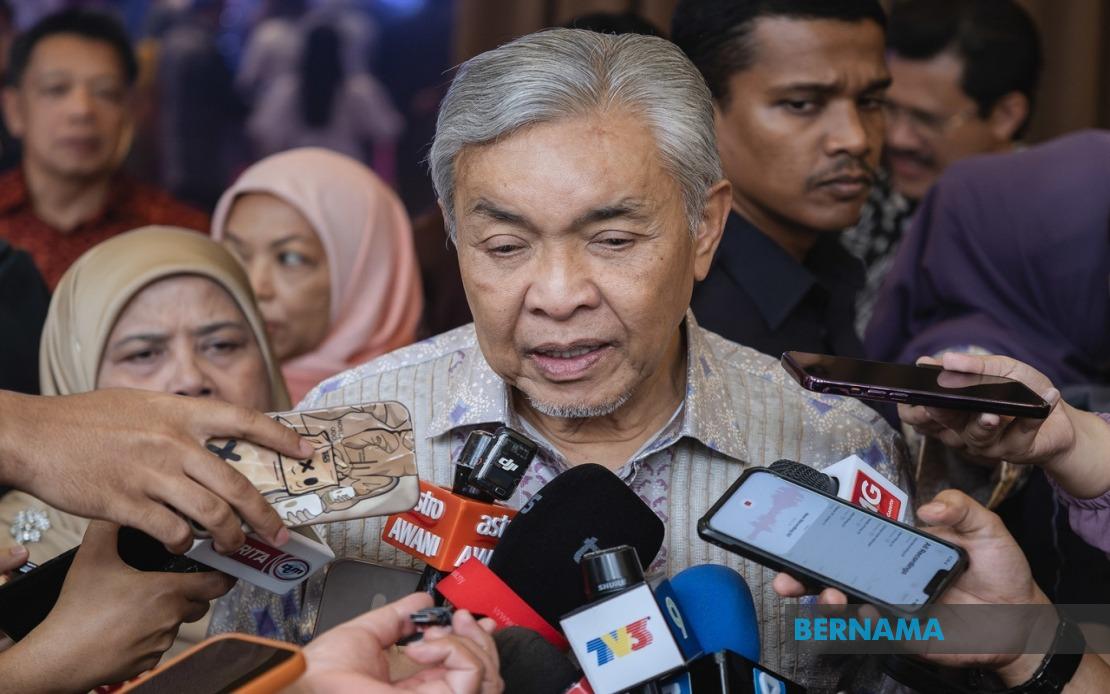
Barisan Nasional has given a categorical assurance that it will maintain strict boundaries between its political activities and the affairs of the Negeri Sembilan royal institution and the state's Council of Justice and Laws, a position underscored by Deputy Prime Minister Datuk Seri Dr Ahmad Zahid Hamidi as the coalition gears up for the state election scheduled for August 1. The commitment, made during discussions with party leadership at the state level, represents a deliberate signal that BN intends to conduct its campaign without encroaching on institutional domains that remain constitutionally and traditionally separate from partisan politics.
Ahmad Zahid, who leads UMNO, the dominant component party within BN, stressed that respecting the sovereignty of these institutions forms part of the coalition's electoral strategy. Speaking after attending a ministry ceremony, he articulated a clear operational principle that would guide party conduct throughout the campaign period. This demarcation carries particular significance in Malaysian politics, where the constitutional role of state rulers and the judicial framework represent foundational pillars that transcend electoral cycles and require protection from political maneuvering.
The emphasis on maintaining institutional integrity reflects broader sensitivities within Malaysia's federal structure, where the constitutional monarchy underpins the system of governance and where state rulers exercise specific powers in judicial appointments and other matters. For Negeri Sembilan specifically, the state has historical significance as a federal territory within the larger Malaysian federation, with its own constitutional arrangements. Any suggestion that a major political coalition might leverage royal or judicial institutions for electoral advantage would provoke serious concerns about democratic propriety and institutional independence.
Beyond this commitment to non-interference, Ahmad Zahid identified internal party unity as the central priority for BN's campaign across the 36 state seats at stake. This focus on consolidating support among leaders and members at various organisational levels suggests the coalition recognises fragmentation as a potential vulnerability in what appears to be a competitive electoral environment. The attention devoted to unity messaging indicates that BN perceives possible fractures within its membership that require active management before and during the polling period.
The electoral landscape has shifted markedly since the 15th Negeri Sembilan state election, when BN formed an electoral arrangement with component parties from Pakatan Harapan. That experiment in cross-coalition cooperation will not be repeated this time, according to Ahmad Zahid, signalling a return to more conventional competitive positioning. This represents a fundamental change in BN's approach to the contest, moving away from the collaborative model that characterised the previous election cycle. The reasons for abandoning this arrangement remain implicit in his remarks, but the shift suggests either that electoral circumstances or inter-party dynamics have made such cooperation impractical or undesirable for BN's leadership.
The upcoming contest thus presents a different political configuration than the previous state election, with BN competing as a more cohesive bloc rather than as part of a broader multi-coalition arrangement. This consolidation could enhance internal messaging consistency but may also narrow BN's potential coalition-building options should the election produce a fragmented legislature. For Malaysian observers, this repositioning underscores how state-level elections remain highly dynamic affairs, with party alignments and electoral mathematics shifting based on specific state conditions and relations among coalition partners.
Negeri Sembilan's position within Malaysia's political ecosystem gives this election more than routine significance. As a state with its own constitutional framework and a historically significant role in Malaysia's federal arrangements, the outcome carries implications for how federal-state relations evolve and how power distributions among BN's component parties may be recalibrated. The state has often served as a barometer for broader national political trends, and the August 1 election will provide early indicators of voter sentiment heading into what may become a significant electoral period for Malaysia.
Ahmad Zahid's explicit statement about avoiding legal and institutional interference also carries implicit messaging to other political actors. By drawing this line clearly in advance, BN's leadership may be attempting to establish norms that would constrain not only its own conduct but also that of opposition parties. Setting clear expectations about what constitutes acceptable political practice during the campaign helps establish a framework within which all contestants should operate, theoretically elevating the overall quality and propriety of the electoral process.
The timing of these remarks, with the campaign still in its preparatory phase, allows BN to establish its positioning before contested moments potentially arise. By pre-emptively addressing the sensitive intersection between politics and institutional integrity, the coalition positions itself as a guardian of constitutional propriety, a rhetorical advantage in electoral competition. This approach assumes that Malaysian voters value institutional stability and democratic restraint, a reasonable assumption given public discourse around democratic governance.
For the broader Southeast Asian context, BN's commitment to institutional boundaries reflects how Malaysia's political system maintains certain guardrails against the erosion of constitutional norms that sometimes occurs in the region. While no political system operates without tension between institutional and partisan interests, the explicit articulation of boundaries represents an important practice that reinforces democratic cultures. As elections across Southeast Asia increasingly test these boundaries, Malaysia's explicit reaffirmation of institutional respect offers an instructive contrast to contexts where such restraint erodes more readily.
The August 1 election will ultimately test whether BN's stated commitment to institutional non-interference translates into actual conduct and whether the coalition's emphasis on internal unity proves sufficient to meet electoral challenges. The result will provide important signals about both voter preferences in Negeri Sembilan and the relative strength of various political forces as Malaysia enters a potentially significant electoral period. Whether BN's strategy of focusing on cohesion while respecting institutional boundaries proves effective will depend on how these elements interact with broader state-level issues and voter priorities.

