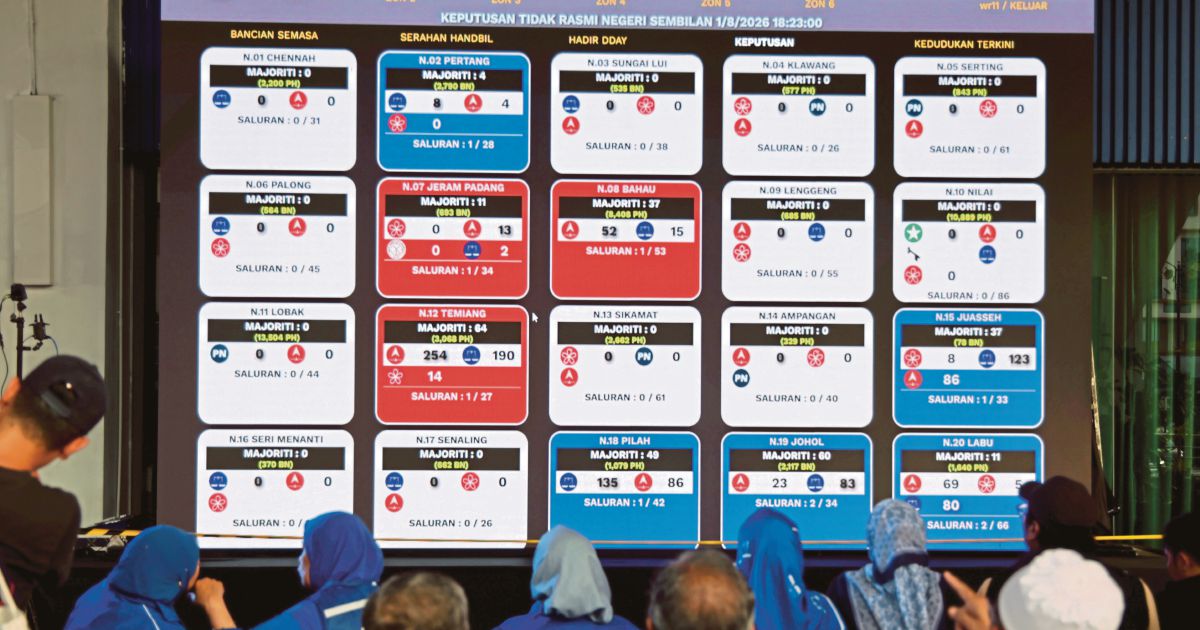
In what could signal a significant political realignment in Negri Sembilan, Datuk Dr Asyraf Wajdi Dusuki from Umno asserted that the combined Barisan Nasional and Perikatan Nasional coalition had secured 23 seats in the state assembly—a tally that would grant the coalition government-forming authority. The claim, made in Seremban, emerged as vote tallies from the state election were still being processed, marking an important development in the peninsular state's political landscape.
The figure of 23 seats carries particular significance in Negri Sembilan's legislative structure. Traditionally, a simple majority in the 36-member state assembly requires 19 seats, meaning that a 23-seat coalition would command a comfortable working majority. This cushion is crucial for stability, as it provides insulation against potential defections or absences that could threaten the government's survival on the floor of the assembly. In Malaysia's fractious contemporary politics, where party loyalty has frequently proven elastic, such buffer seats take on heightened strategic value.
The explicit coordination between Barisan Nasional and Perikatan Nasional represents a notable tactical development. These two coalitions, historically competitive forces in Malaysian electoral politics, have increasingly found themselves in pragmatic partnerships at the state level. Barisan Nasional, traditionally encompassing Umno, MCA, and MIC among others, has seen its dominance wane over the past fifteen years, whereas Perikatan Nasional—anchored by PAS and Bersatu—has gained traction, particularly among Malay-Muslim voters. Their combination at state level suggests both coalitions recognise the mathematical necessity of collaboration in an increasingly fragmented electoral environment.
Negri Sembilan has become a contested battleground in recent electoral cycles, reflecting broader patterns across Malaysia where no single coalition commands the overwhelming majorities that once characterised Malaysian politics. The state's electorate has grown more sophisticated and divided, with urban and rural constituencies displaying markedly different voting preferences. The assertion of a BN-PN supermajority would buck any trend toward increased polarisation or opposition strength in the state.
However, the informal nature of Asyraf's claim warrants careful attention. As an unofficial statement rather than an authoritative pronouncement from the state election commission, the figures require verification through formal channels. Electoral mathematics in Malaysia have occasionally produced surprises, particularly when independent candidates or smaller parties perform unexpectedly strongly in specific constituencies. The final composition of the assembly will only be confirmed once official returns are completely tallied and any recounts or disputed results are resolved.
The potential BN-PN government would need to navigate several practical challenges characteristic of coalition governance. Distributing ministerial portfolios and state executive committee positions equitably between Barisan Nasional and Perikatan Nasional components will require delicate negotiation. Historical tensions between Umno and PAS, despite their electoral partnership, could resurface during government formation talks. Additionally, smaller coalition members may press for representation commensurate with their electoral contribution, potentially complicating the allocation process.
For Malaysian political observers, the claimed outcome illustrates broader shifts reshaping the federation's political map. The decline of two-coalition certainties—where either the Barisan or a unified opposition commanded clear majorities—has given way to fluid multi-bloc competition. Negri Sembilan's experience, should the 23-seat figure hold, would exemplify how smaller states have become negotiating grounds where coalition mathematics matter intensely.
The timing of such claims also reflects modern electoral communication patterns. Political actors now frequently float seat counts through sympathetic media channels before official confirmation, attempting to shape narrative momentum even as votes are being counted. Asyraf's statement serves to establish a frame suggesting BN-PN victory while leaving room for adjustment should final figures differ slightly.
For Southeast Asian political economy, Negri Sembilan's outcome carries implications beyond its borders. Malaysia remains a bellwether for democratic politics across the region, and state-level electoral dynamics often presage national trends. A BN-PN coalition government would suggest that Malaysia's longest-ruling coalition continues to retain substantial capacity to recapture lost ground through strategic partnership with rising competitors. Conversely, if opposition forces significantly outperformed expectations, it could indicate further momentum away from the traditional ruling structures.
The economic implications of a stable BN-PN government formation would likely be stabilising for investor confidence, particularly given Malaysia's recent political volatility. State governments require operational continuity to implement development programmes and maintain fiscal discipline. A coalition with 23 seats provides substantially greater confidence in such stability than a razor-thin majority would.
Governance quality and administrative capability will ultimately determine whether this coalition proves effective beyond the arithmetic of seat counts. Both Barisan Nasional and Perikatan Nasional have held state governments previously, providing relevant administrative experience, though coalition dynamics sometimes complicate decision-making efficiency.
As formal results emerge from the election commission, the precise nature of BN-PN's majority—whether it exactly matches the 23-seat claim or fluctuates slightly—will become clearer. Regardless, the apparent direction toward a combined BN-PN administration represents a significant political moment for Negri Sembilan, underscoring how Malaysia's electoral landscape continues its transformation toward coalition-based governance predicated on negotiation rather than dominance.

