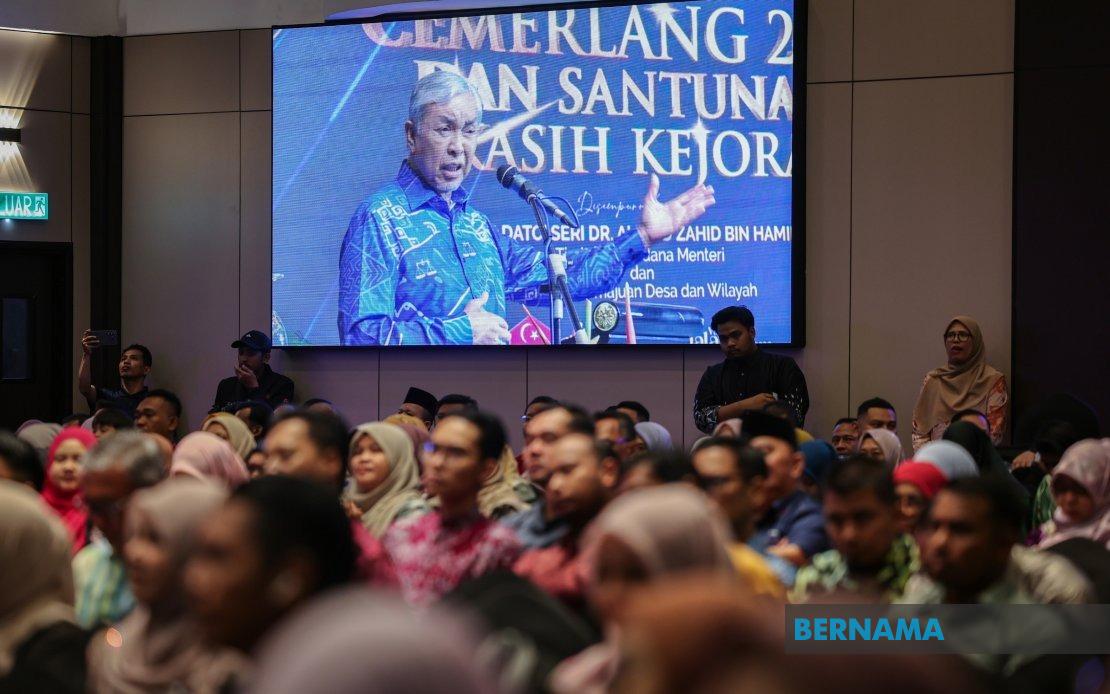
Barisan Nasional's campaign for the Johor state election is proceeding with full momentum, according to coalition chairman Datuk Seri Dr Ahmad Zahid Hamidi, who rejected characterizations of the effort as lacking energy or drive. Speaking in Kota Tinggi on July 2, Zahid framed such assessments as subjective political perception rather than an accurate representation of ground-level activity, acknowledging that rival coalitions retained the right to their own interpretations of campaign intensity.
The Deputy Prime Minister's pushback addresses a narrative that has circulated in political circles suggesting BN's mobilization in Johor has been underwhelming compared to previous election cycles. Zahid's response reflects a broader defensive posture, as the coalition seeks to project confidence heading into the state election while facing competition from multiple political formations. The BN chairman's remarks came during a press conference following his official opening of the Southeast Johor Development Authority's awards ceremony, providing him a platform to frame the narrative around both campaign vigor and governmental achievement.
Zahid emphasized that assessments originating from non-BN coalition parties regarding campaign quality remained their prerogative, suggesting the coalition was comfortable allowing its performance at the ballot box to serve as the ultimate validator of campaign effectiveness. This measured response contrasts with more confrontational political rhetoric, positioning BN as the more professional operator in the election environment. The coalition's confidence appears rooted partly in the track record of the state government, which Zahid highlighted as a source of voter appeal and institutional legitimacy.
Under Menteri Besar Datuk Onn Hafiz Ghazi's leadership, the Johor state government generated revenue of RM2.26 billion in the previous year, a figure Zahid identified as the highest among all Peninsular Malaysian states. This revenue performance underscores the government's fiscal strength and capacity to fund development initiatives, a messaging angle central to BN's campaign strategy for securing renewed voter support. By anchoring the campaign narrative to concrete governmental accomplishments, Zahid sought to shift focus from subjective assessments of campaign intensity toward measurable policy outcomes that presumably benefit constituents.
BN's ambition extends beyond maintaining its hold on Johor; the coalition is contesting all 56 state seats with the explicit goal of achieving what Zahid termed a resounding victory to strengthen its mandate. This comprehensive approach signals confidence in candidate quality and voter support across the state's diverse constituencies. A decisive electoral outcome would provide BN with enhanced legitimacy to pursue its five-year development agenda, the specifics of which the coalition had outlined in its campaign manifesto.
A potential point of friction in the campaign landscape involves the operational relationship between BN at the state level and Pakatan Harapan at the federal tier within the broader Unity Government framework. Some political observers have speculated that this partnership structure might confuse traditionally aligned Johor voters uncertain whether to support the state-level BN administration or maintain ideological allegiance to federal partners. Zahid addressed this directly, asserting that no genuine tension existed between state and federal cooperation, citing Johor's unique position as a state whose government predated the establishment of the Unity Government at the national level.
The Deputy Prime Minister characterized the working relationship between state and federal administrations as professional and harmonious, suggesting that cross-level collaboration within the Unity Government framework posed no electoral liability. This framing attempts to neutralize voter confusion while legitimizing the state government's partnership approach with federal counterparts. Zahid's argument rests on the notion that institutional cooperation need not dilute state-level political identity or voter preference.
The electoral landscape in Johor presents a fragmented competitive environment extending well beyond the traditional BN-versus-opposition binary. Pakatan Harapan is fielding 56 candidates matching BN's slate across all state seats, positioning the two coalitions as the primary contenders. However, Perikatan Nasional has entered the contest with 33 candidates, while smaller parties and formations including Bersama (15 candidates), MUDA (four), Parti Orang Asli Malaysia (one), Parti Sosialis Malaysia (one), and six independent candidates round out the ballot. This multi-polar competition significantly complicates vote distribution patterns and raises questions about vote splitting, particularly in constituencies where multiple parties appeal to overlapping voter demographics.
Within this competitive context, PAS president Tan Sri Abdul Hadi Awang has called upon voters to comprehensively reject Pakatan Harapan across all races and contests, including in direct encounters with BN candidates. Zahid's response distinguished BN's strategic approach from PAS's more absolutist positioning, emphasizing the coalition's professional posture and focus on individual candidate promotion. While welcoming any additional support that might accrue to BN, Zahid suggested the coalition would not engage in the more aggressive oppositional framing that PAS had adopted, instead maintaining a campaign narrative centered on governmental competence and development delivery.
This stylistic difference reflects broader strategic calculations about coalition positioning in Malaysia's evolving political landscape. BN's relative restraint in attacking PAS, despite the latter's blunt rejection of Pakatan Harapan, suggests an openness to post-election collaboration possibilities with Perikatan Nasional should electoral outcomes prove inconclusive or require coalition-building among multiple parties. Such flexibility contrasts with the more rigid positional demands emanating from Islamist-oriented formations and underscores the pragmatism that has historically characterized BN's approach to political mathematics at state and federal levels.
The Johor state election will proceed across two phases: early voting on July 7 accommodating eligible citizens unable to vote on the primary polling date, with the main election day set for July 11. This scheduling provides a compressed campaign period in which BN must translate its organizational capabilities and record of governance into electoral outcomes across 56 constituencies. The condensed timeframe places particular emphasis on the effectiveness of ground-level mobilization and voter persuasion mechanisms, areas where Zahid's assertions regarding campaign vigor will face practical testing.
For Malaysian and Southeast Asian observers monitoring the evolution of electoral politics in one of Malaysia's most electorally significant states, the Johor outcome carries implications extending beyond state governance. The result will provide insights into voter appetite for Unity Government coalition arrangements at state level, the sustainability of cross-coalition cooperation in polarized political environments, and the capacity of established coalitions to compete against newer political formations capturing disaffected voter segments. Zahid's confidence rhetoric must ultimately convert into ballot box performance to vindicate his campaign characterizations and position BN for longer-term political sustainability in a rapidly shifting electoral marketplace.

