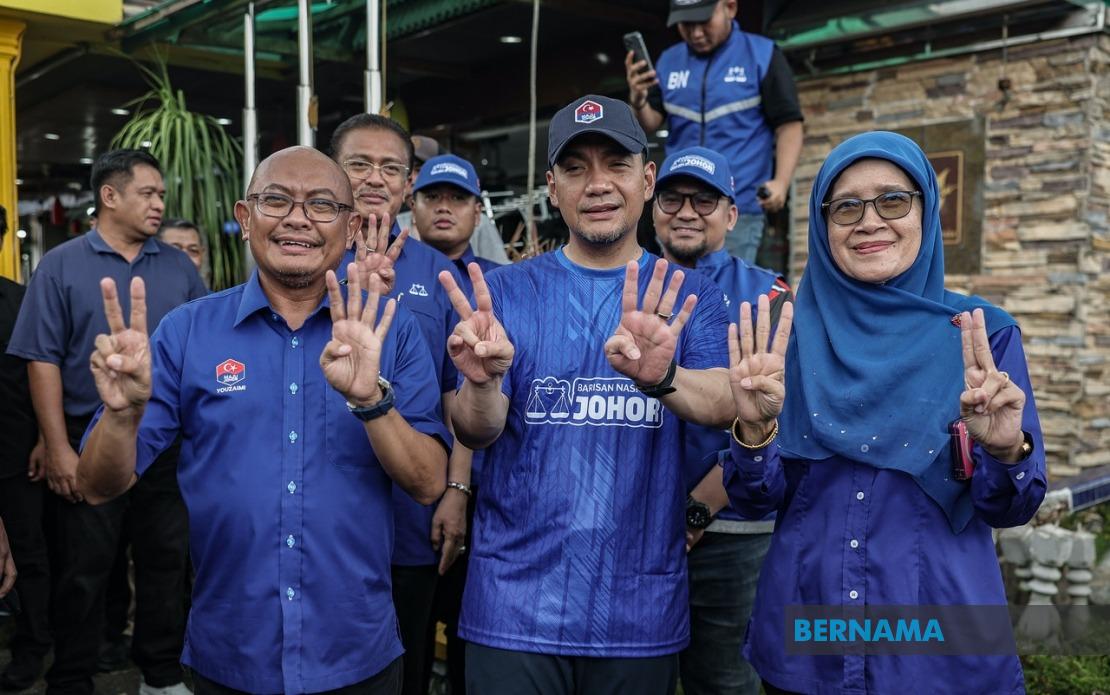
Barisan Nasional's enduring coalition model rests fundamentally on the willingness of component parties to subordinate immediate electoral interests to broader political objectives, according to Johor Menteri Besar Datuk Onn Hafiz Ghazi. Speaking at a party machinery meeting in Mersing ahead of the July 11 state election, Onn Hafiz articulated the philosophical underpinning of BN's power-sharing arrangement as a system requiring sustained sacrifice from all participating organisations to maintain both internal cohesion and the coalition's competitive position against rival political blocs.
The foundation of Onn Hafiz's remarks centred on the historical record of UMNO's engagement with the Tenggaroh state seat, a constituency that has remained under MIC representation for over four decades despite repeated attempts by the Malay-Muslim party to capture it. Rather than characterising these electoral defeats as evidence of systemic dysfunction, the Menteri Besar framed UMNO's willingness to accept the outcome as a demonstration of institutional maturity. He credited the dominant party's machinery with consistently mobilising support for MIC's candidates across successive election cycles, thereby reinforcing the notion that coalition solidarity transcends individual seat contests or narrow party advancement.
The arithmetic of Tenggaroh itself underscores the tension inherent in Malaysia's communal electoral geography. With approximately 39,000 registered voters and a mere 500 electors of Indian origin, the constituency's demographic composition would ostensibly favour UMNO candidates in a majoritarian system. Yet Onn Hafiz emphasised that BN's continued commitment to the multiracial cooperation framework—the very foundation of the original 1957 independence compact between UMNO, MCA and MIC—takes precedence over crude demographic calculations. This stance reflects a broader strategic calculation that the legitimacy derived from maintaining a multiracial governing coalition outweighs the marginal electoral gains that might accrue from unilateral seat-hoarding by UMNO.
The 2023 Johor state election results, in which BN retained the Tenggaroh seat with a majority of 1,356 votes, now serve as a baseline from which the coalition is attempting to expand its electoral performance. Onn Hafiz announced an ambitious target of tripling this margin to 3,000 votes for Mohd Youzaimi Yusof, the BN-UMNO candidate contesting the seat. This escalation reflects both heightened expectations ahead of the July 11 polling and an implicit acknowledgment that the effectiveness of the power-sharing formula must ultimately be validated through electoral performance gains. Should BN fail to improve substantially on its previous showing, the internal political logic sustaining component party discipline would face renewed pressure.
The Tenggaroh contest itself has evolved into a three-cornered affair, with Perikatan Nasional fielding Muhamad Amerul Muhamad from Bersatu and Pakatan Harapan nominating Md Yusof Dawam of PKR. This fragmentation of the opposition vote may inadvertently benefit the BN-UMNO candidate, though such benefits derive from external political dynamics rather than from any refinement of the coalition's internal bargaining mechanisms. The presence of PN—which incorporates significant Malay-Muslim constituencies that UMNO traditionally dominates—complicates the traditional bipolar framework that previously characterised Malaysian electoral competition.
Onn Hafiz's emphasis on the disciplinary requirements of the power-sharing system carries implicit messaging to potential dissenters within UMNO ranks who might view the allocation of specific seats to component parties as constraints on UMNO's maximalist ambitions. By invoking the four-decade loyalty narrative, the Menteri Besar was essentially arguing that short-term frustration over seat allocation must yield to recognition of the strategic benefits conferred by maintaining a stable, multiracial coalition capable of governing effectively. This rhetorical strategy attempts to reframe political concessions as evidence of institutional strength rather than weakness.
For Malaysian observers, Onn Hafiz's formulation raises substantive questions about the sustainability of power-sharing arrangements in an increasingly fragmented electoral environment. The emergence of PN as a structurally significant competitor has disrupted the assumption that BN's component parties would automatically defer to coalition discipline because no viable alternative existed. When UMNO members perceive that Bersatu or other Malay-Muslim actors might offer superior electoral terms, the incentive structure that historically sustained component party loyalty undergoes transformation. The challenge confronting BN leadership involves recalibrating this incentive structure to ensure that component parties continue perceiving coalition membership as offering better prospects than available outside the framework.
The timing of the Mersing machinery meeting in late June provided Onn Hafiz with a platform to mobilise grassroots UMNO cadres behind the power-sharing principle precisely when internal doubts might be highest. By celebrating UMNO's historical forbearance in Tenggaroh and by articulating ambitious numerical targets for electoral improvement, the Menteri Besar attempted to synthesise two potentially conflicting messages: that sacrifice for the coalition remains expected while that sacrifice would be rewarded through enhanced overall coalition performance. Whether this symbolic and rhetorical approach suffices to sustain discipline across multiple constituencies remains uncertain.
The broader Southeast Asian context adds another interpretive layer to these developments. Malaysia's power-sharing model, alongside similar arrangements in other plural societies such as Lebanon or Mauritius, represents one of the world's most institutionalised attempts to manage political competition through built-in constitutional protections for minority representation. Yet the model depends absolutely on elite commitment to its underlying logic. When demographic or generational change produces political leaders less invested in historical compromises, the institutional framework becomes vulnerable. Onn Hafiz's speeches thus serve not merely as tactical electoral messaging but as implicit defence of the pluralist covenant itself.
The early voting scheduled for July 7, followed by the main polling on July 11, will provide empirical evidence regarding the effectiveness of BN's power-sharing discipline and Onn Hafiz's leadership framing. Should the coalition substantially improve on previous performances across multiple seats including Tenggaroh, the narrative of sacrifice yielding collective benefit gains reinforcement. Conversely, disappointing results might prompt renewed questioning of whether allocating winnable seats to component parties continues to serve BN's strategic interests. For Malaysian politics more broadly, the election outcome will signal whether power-sharing remains a viable governance model or whether electoral pressure is pushing Malaysia's dominant coalition towards configurations prioritising single-party advancement over multiracial compromise.

