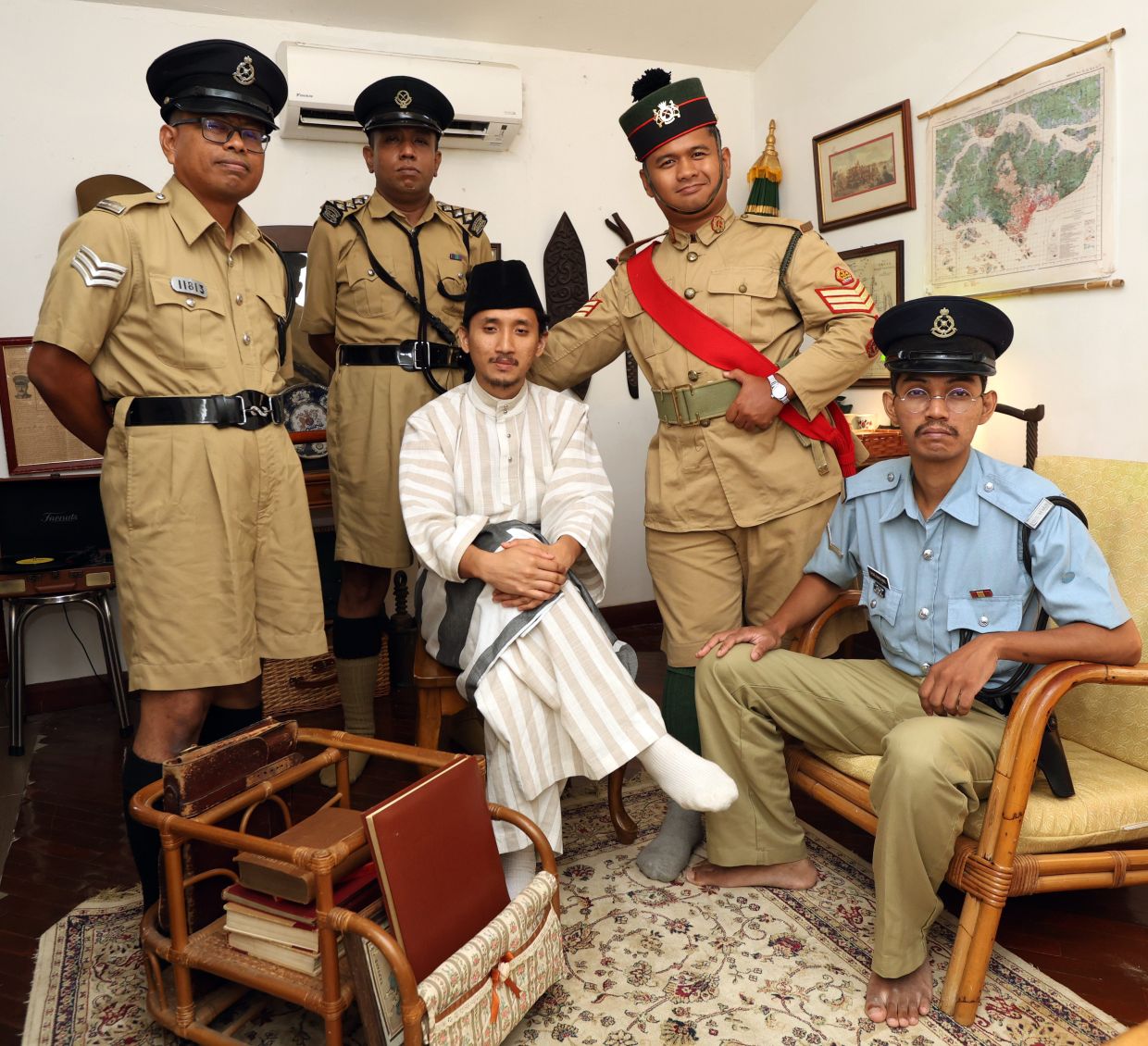
Every weekend, members of Persatuan Reka Ulang Sejarah (PRUS) gather to discuss and demonstrate Malaysia's military heritage, dressed meticulously in period-accurate uniforms while record players crackle softly in the background. What began as casual gatherings among vintage uniform collectors has evolved into a registered society dedicated to making history tangible and engaging for Malaysians who might otherwise encounter the nation's past only through textbook pages. The group's transformation reflects a growing recognition that historical awareness requires more than passive reading—it demands active participation, sensory engagement, and authentic representation of how Malaysians actually lived and served during formative periods in the nation's development.
The roots of PRUS trace back to the early 2010s, when military paraphernalia enthusiasts convened at an event organised by the Port Dickson Army Museum, held at the then-operational Royal Malaysian Air Force Base in Sungai Besi, Kuala Lumpur. These initial gatherings gradually crystallised into a loose collective operating under the banner "We Are Re-enactors" before pursuing formal registration. The transition to official society status under PRUS in 2023 marked a watershed moment, enabling the group to expand beyond private hobby meetups into structured educational programming within schools and cultural institutions. This formalisation responded to a specific gap in Malaysian historical education: the widespread confusion surrounding military uniforms across different eras and branches of the armed forces, particularly when archival photographs existed only in black and white, making visual distinction exceptionally difficult for contemporary observers.
Chairman Abdul Hakim Abdul Rani, who works professionally as a tour guide, identifies educational accuracy as the society's foundational principle. PRUS emerged from frustration with how historical periods often collapse into generic presentations, stripping away the distinctive details that make each era recognisable and comprehensible. The group's members invest considerable effort in understanding not merely what uniforms looked like, but how soldiers of different periods carried themselves, moved, communicated, and navigated their environment. This commitment to granular authenticity distinguishes PRUS from costume groups or theatrical enterprises focused primarily on entertainment value. Every marching technique, every protocol for address, every movement emerges from exhaustive study of original military manuals and archival documentation, transforming re-enactors into embodied repositories of historical knowledge.
The depth of PRUS's educational philosophy became evident during a two-day, one-night jamboree held in July, where members underwent training in map reading, navigation, marching procedures, and basic tactical movements based on pre-Independence military manuals. Abdul Hakim, drawing on his previous service with the Territorial Army (Askar Wataniah), facilitated these sessions with firsthand knowledge of how armed forces actually operated during specific historical periods. Crucially, the group adapted combat simulations to comply with contemporary regulations, substituting sticks for weapons while maintaining the structural integrity of historical training methodologies. This approach privileges educational fidelity over theatrical spectacle—participants and observers alike gain insight into the operational realities facing Malaysia's military forces across different historical moments, rather than experiencing sanitised dramatisations disconnected from actual historical circumstances.
Beyond public exhibitions and school visits, PRUS has extended its influence into Malaysia's film and television industry, advising productions on historical costume authenticity and occasionally appearing as background performers. Vice chairman Mohd Fadzreeq Mokti emphasises that these film industry collaborations represent far more than supplementary casting opportunities. Rather, PRUS members function as historical consultants ensuring visual accuracy down to minute details—button placement, fabric textures, insignia variations—that casual viewers might not consciously register but which collectively determine whether a production authentically represents a specific historical moment or instead presents a distorted, anachronistic version. This role reflects broader industry recognition that audiences, particularly younger viewers accustomed to documentary-style historical content, increasingly expect productions claiming historical grounding to demonstrate rigorous period accuracy.
The society's calendar peaks during Malaysia's commemoration season, particularly August and September when National Month festivities and Malaysia Day celebrations generate heightened public interest in national heritage. PRUS members deploy their uniform collections and accumulated expertise at museums and public exhibitions, strategically targeting youth audiences who might otherwise encounter Malaysian history only within classroom constraints. Abdul Hakim has observed concerning gaps in younger Malaysians' familiarity with foundational historical figures and pivotal national events—gaps he views with considerable concern given their implications for national cohesion and collective understanding. This observation underlies the society's strategic focus on schools as primary intervention points, recognising that early exposure to engaging, intellectually stimulating historical content shapes how young Malaysians subsequently relate to their nation's past throughout their lives.
Mohd Fadzreeq, who teaches at a secondary school, provides concrete evidence of this educational impact. When he appears at his institution dressed in historical military uniform—a practice approved by his headmaster—students respond with visible enthusiasm and invariably request future appearances. These reactions reveal hunger for historical engagement among youth that transcends conventional textbook learning. Students lack regular opportunities to visit museums or handle historical artefacts, and their learning styles often favour hands-on, interactive experiences over abstract classroom instruction. The transformative potential of Mohd Fadzreeq's uniform-wearing visits suggests that strategic deployment of embodied historical representation within educational settings can substantially elevate student engagement with and retention of national historical content.
The concept of PRUS members as "walking museums" encapsulates their broader social function. These individuals don't merely display uniforms; they inhabit historical periods, embodying deportment, speech patterns, and behavioural conventions that characterise specific military eras. When encountering PRUS members in full period presentation, members of the general public frequently initiate conversations, posing questions that spark dialogue about historical detail and broader national narrative. This organic, unprompted engagement differs fundamentally from passive museum visits where visitors control pacing and depth of engagement. The society's approach facilitates spontaneous learning moments triggered by visual stimuli, capitalising on human curiosity and social interaction to transmit historical knowledge in formats that resonate more powerfully than conventional educational channels.
The intellectual infrastructure supporting PRUS's authenticity demands shouldn't be underestimated. Members dedicate substantial personal time to studying archival materials, military manuals, photographs, and secondary historical scholarship, accumulating specialised knowledge that positions them as informal experts within their communities. This scholarly dimension distinguishes PRUS from costume enthusiast groups that prioritise aesthetic appeal or entertainment value. Instead, PRUS operates within a framework prioritising historical truth and educational integrity, treating re-enactment as a legitimate pedagogical methodology rather than mere roleplay. The group's registered society status provides institutional credibility and access to educational platforms that informal groups cannot easily secure, enabling systematic expansion of their historical reach throughout Malaysian society.
For Malaysian educators and cultural policymakers, PRUS represents a model for addressing acknowledged deficiencies in national historical awareness among younger populations. The society demonstrates how structured, knowledge-intensive engagement with material culture—in this case, military uniforms and associated paraphernalia—can catalyse sustained interest in historical periods that students might otherwise dismiss as remote or irrelevant. Their work particularly resonates for Malaysian youth who may harbour limited understanding of how national independence actually unfolded, what contemporary military forces resembled during earlier eras, and how Malaysian identity crystallised through specific historical moments. By transforming historical study from abstract intellectual exercise into sensory-rich, interactive experience, PRUS contributes meaningfully to the collective national project of cultivating historical consciousness among rising generations of Malaysians.
Looking forward, the society's expansion into formal educational partnerships and continued collaboration with cultural institutions suggests broader institutional recognition of experiential history's pedagogical value. As PRUS matures and expands its programming, the model it represents—informed enthusiasts leveraging specialised knowledge to make national history tangible and engaging—may inspire similar initiatives focused on other dimensions of Malaysian heritage. Whether documenting colonial-era administrative structures, pre-colonial sultanate systems, or more recent independence-era political developments, the principles animating PRUS suggest potential for creating multiple "walking museums" addressing different historical periods and dimensions of national experience. For a nation grappling with questions about historical memory, national identity, and intergenerational transmission of cultural knowledge, PRUS's quiet work of historical resurrection offers both practical methodology and hopeful demonstration of how passion for the past can positively shape understanding of the present and future.

