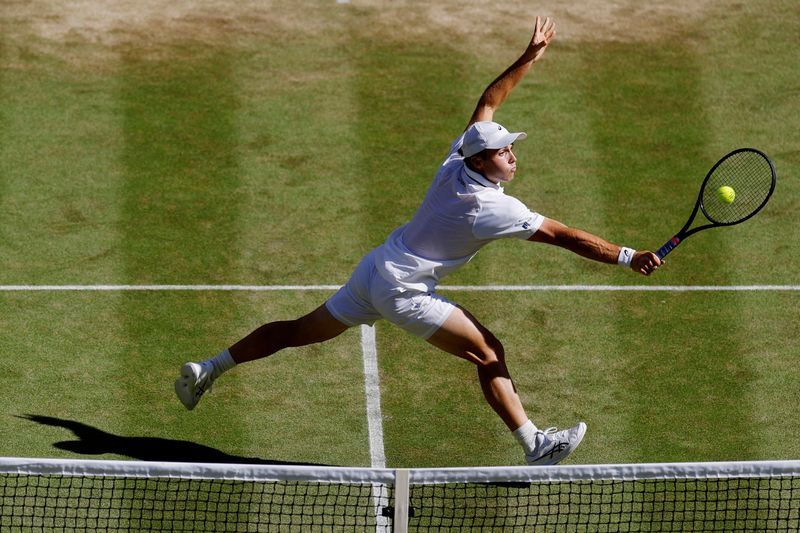
Arthur Fery, a France-born wildcard playing for Britain, has unexpectedly become the nation's sole representative deep into this year's Wimbledon Championships, reaching the quarterfinals with a series of dramatic comebacks that have captivated crowds at the All England Club. The 24-year-old turns that age on Sunday, which also happens to be the date of the men's singles final, raising the tantalising prospect that he could spend his birthday playing on Centre Court if his improbable run continues.
Fery's journey through the tournament has been marked by extraordinary displays of resilience. Making his Centre Court debut only on Monday, he has now navigated two successive five-set thrillers to advance deeper into the draw than any other British player currently competing. His latest victory came against former world number three Grigor Dimitrov, a classy 35-year-old player who appeared destined for victory when leading 4-3 with a break advantage in the fourth set. Yet Fery produced a stunning comeback in front of a crowd still intoxicated by England's simultaneous World Cup triumph over Mexico earlier that day, with the roar when he secured match point resonating through Wimbledon in a way rarely heard in recent years.
The contrast between Fery's success and the collapse of other British players highlights just how remarkable his achievement has become. Of the 19 British singles competitors who arrived at the Championships, 15 exited in the opening round, leaving the London-raised player to shoulder the entire nation's hopes almost unilaterally. He qualified for the tournament as a wildcard, a status typically reserved for promising domestic talent or sentimental selection, yet he has vindicated that decision emphatically.
Fery's third-round conquest of Zizou Bergs on Saturday perhaps provided an even starker illustration of his mental fortitude. Trailing two sets to one and facing a double break deficit in the fourth set, he orchestrated a remarkable turnaround to prevail in what became the longest match of the entire tournament up to that point. Remarkably, he accomplished this feat whilst contending with a succession of nosebleeds that threatened to disrupt his rhythm and concentration. The physical and psychological demands of such a match would have broken most players, yet Fery not only survived but flourished.
His next obstacle will be Flavio Cobolli, the Italian world number 10 whom Fery has already defeated this year at the Australian Open. That prior victory suggests the British wildcard possesses the weaponry and tactical nous to trouble the seeding, though Cobolli's ranking and experience at the highest level represent a significant step up in tournament intensity. Nevertheless, Fery arrives with genuine momentum and the weight of an entire nation's sporting attention.
The Stanford-educated player's rise through the rankings has been steady rather than meteoric, but his performances at Wimbledon have accelerated his trajectory considerably. He began this fortnight ranked 114th in the world, yet his quarterfinal appearance means he has already secured sufficient ranking points to move inside the top 70. Such rapid ascension would have seemed fanciful just weeks earlier, yet Fery's showing suggests he possesses genuine quality that transcends his previous ranking.
Evidence of his underlying talent comes from an unexpected source: American sixth seed Taylor Fritz, who trained alongside Fery during preparations for last year's World Tour Finals. Fritz was sufficiently impressed by what he observed to comment publicly on the British player's capabilities. According to Fritz, Fery demonstrated a forehand stroke of considerable quality for his physical stature, an unbelievable serve, and the ability to construct points methodically from the baseline. So consistent was Fery's dominance during their practice sessions that Fritz found himself losing regularly, prompting the American to reassess his initial expectations of the player.
Fery himself has been somewhat overwhelmed by the scale of support and atmosphere surrounding his matches. Speaking after his victory over Dimitrov, he acknowledged the extraordinary sporting theatre unfolding around him, juxtaposing his own Wimbledon campaign with England's simultaneous World Cup progress. He recognised that such experiences might prove singular in any tennis player's career, and expressed determination to cherish every moment regardless of how far his run extends.
The broader context of British tennis at Wimbledon adds poignancy to Fery's achievements. For years, the sport's governing bodies and media have lamented the absence of a strong British male presence at the Championships. Investment in talent development and professional infrastructure has not yet translated into the kind of consistent quarterfinal and semifinal appearances that characterised British tennis in previous decades. Fery's unexpected breakthrough offers a glimmer of hope that homegrown talent can yet compete at the elite level, though one player's remarkable run cannot paper over systemic challenges within the professional pathway.
The sporting calendar has conspired to amplify Fery's significance beyond what his ranking might ordinarily command. His progression has coincided with intense national focus on English summer sport, creating a cultural moment where his matches against celebrated opponents carry weight extending beyond the tennis court itself. For Malaysian and Southeast Asian observers, Fery's journey illustrates how sporting narratives can transcend geography and nationality, capturing global imagination through sheer dramatic momentum and emotional authenticity.
Looking ahead, Fery faces the dual challenge of maintaining concentration whilst managing the extraordinary attention now directed towards him. Previous British players have foundered under similar pressure, their games deteriorating as external expectations intensified. Whether Fery possesses the psychological maturity to navigate such pressures remains uncertain, though his composure under duress during his matches thus far suggests emotional stability beyond his years. His next encounter with Cobolli will prove instructive in determining whether his run represents a genuine breakthrough or an elaborate flash of brilliance destined to fade as quickly as it emerged.

