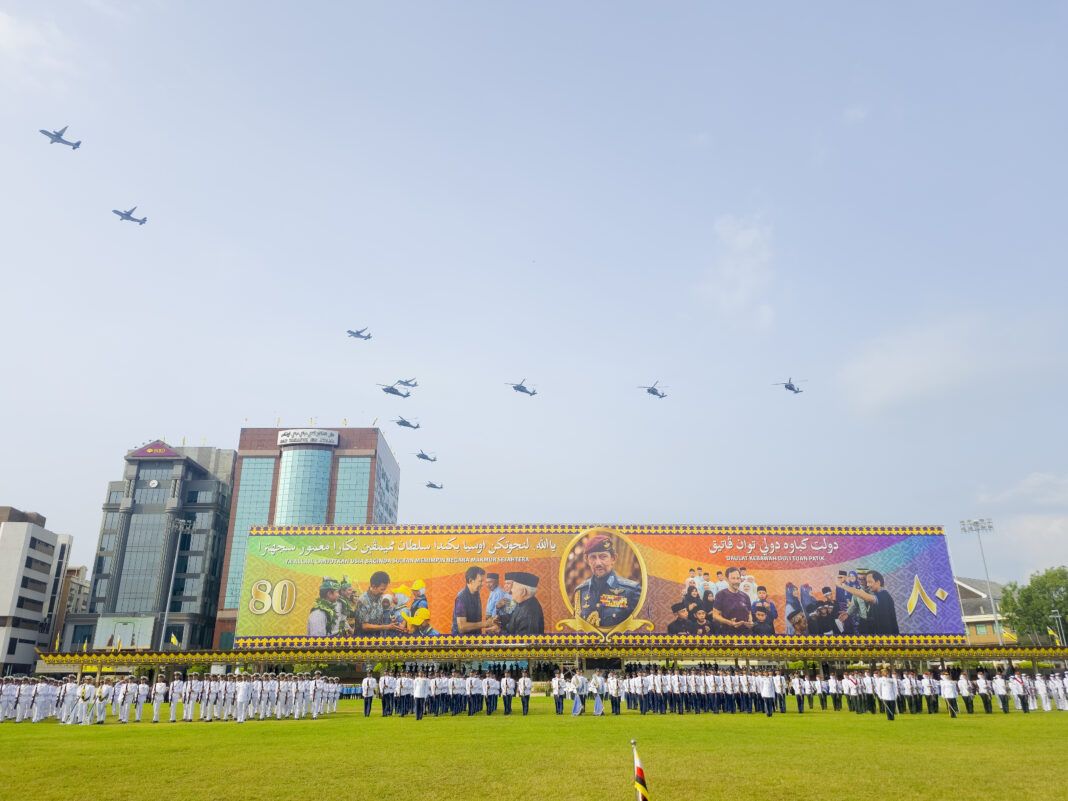
Brunei's government has entered the final countdown to honouring its reigning monarch's milestone birthday, with senior officials overseeing the completion of comprehensive rehearsals for the main ceremonial event. The full dress rehearsal for the guard of honour parade marking His Majesty Sultan Hassanal Bolkiah, Sultan and Yang Di-Pertuan of Brunei Darussalam's 80th birthday celebration took place on Saturday, July 11, at Taman Haji Sir Muda Omar 'Ali Saifuddien in Bandar Seri Begawan, signalling that nearly all technical and logistical aspects of the occasion are now in place.
The involvement of Brunei's most senior officials underscores the ceremonial significance accorded to this royal milestone. The Chief of Adat Istiadat Negara Yang Amat Mulia Pengiran Indera Setia Diraja Sahibul Karib Pengiran Anak Idris Pengiran Maharaja Lela Pengiran Muda Abdul Kahar attended the rehearsal in his capacity as both custodian of national ceremonial traditions and co-adviser for the National Committee overseeing the 2026 celebration, indicating how deeply embedded this observance is within Brunei's institutional framework.
Six ministers holding key coordinating and sectoral responsibilities participated in the preparation exercise, reflecting the whole-of-government approach that has characterised the planning process. Datuk Seri Setia Awang Ahmaddin Abdul Rahman, who coordinates social policies and manpower matters alongside his Home Affairs responsibilities, was present alongside Pehin Datu Lailaraja Major General (Rtd) Datuk Paduka Seri Awang Halbi Mohd Yussof, the defence and national security coordinator. This dual attendance by leaders handling internal security and defence functions suggests the event will incorporate significant ceremonial military components requiring intricate coordination.
The parade's venue, Taman Haji Sir Muda Omar 'Ali Saifuddien, is a symbolically charged location within Brunei's landscape. Situating this nationally important observance in a public park named after a revered historical figure reinforces the connection between current monarchy and Brunei's foundational governance heritage, making the setting itself part of the ceremonial narrative rather than merely a convenient logistical choice.
Three additional Cabinet-level figures serving as co-chairs of the birthday committee also attended the rehearsal, each bringing specialised oversight of their respective portfolios. Datuk Seri Setia Awang Nazmi Awang Mohamad's responsibility for public service governance implies his involvement in coordinating the civil service elements of the celebration, while Datuk Seri Setia Dr Mohd Isham Jaafar's health portfolio involvement likely encompasses medical coordination and public health considerations for what will be a major public gathering. Pengiran Datuk Seri Setia Shamhary Pengiran Datuk Paduka Mustapha brings cultural, youth and sports expertise to ensure the celebration resonates with multiple demographic segments of Bruneian society.
The staging of a full dress rehearsal seven to nine months before the actual celebration demonstrates the meticulous planning standards applied to state occasions in Brunei. This advance preparation allows officials to test coordination mechanisms across multiple agencies, identify potential logistical challenges, train personnel involved in ceremony execution, and refine procedural details that will define the public experience of the event. For smaller nations like Brunei, such comprehensive rehearsals prove particularly valuable given the resource constraints that often accompany coordinating major celebrations.
The ceremonial guard of honour parade represents a specifically formal genre of public tribute, one deeply rooted in Commonwealth parliamentary traditions that continue to shape Brunei's official protocols. Such parades typically showcase military precision, hierarchical ordering of participants according to protocol, and carefully choreographed pageantry intended to project national dignity and institutional stability. The decision to conduct a full rehearsal rather than relying on partial practice suggests planners recognise the parade's importance as a defining image of the celebration.
For Malaysia and other Southeast Asian neighbours, Brunei's methodical approach to honouring royal occasions offers insight into how Brunei maintains ceremonial traditions while adapting them to contemporary public life. The involvement of both security and cultural ministry officials indicates how such celebrations bridge ceremonial formality with accessible public participation, a balance that regional kingdoms must continuously negotiate.
The scheduled parade is set to proceed on Wednesday morning at the same Taman Sir Muda Omar 'Ali Saifuddien location, meaning the rehearsal essentially functioned as a final technical validation before public execution. The repetition of venue between rehearsal and actual event minimises variables and allows the space itself to be thoroughly understood by all coordinating agencies. This practical approach reduces the risk of last-minute complications and demonstrates why advance rehearsals, though resource-intensive, remain standard protocol for significant state ceremonies across the region.
Brunei's emphasis on ceremonial excellence reflects the Brunei Darussalam's broader commitment to projecting stability and institutional continuity, particularly important for a small nation navigating regional geopolitical complexities. The 80th birthday celebration thus functions simultaneously as a genuine honour to the reigning sultan and as a carefully managed state project demonstrating governmental competence and national unity to both domestic and international audiences.

