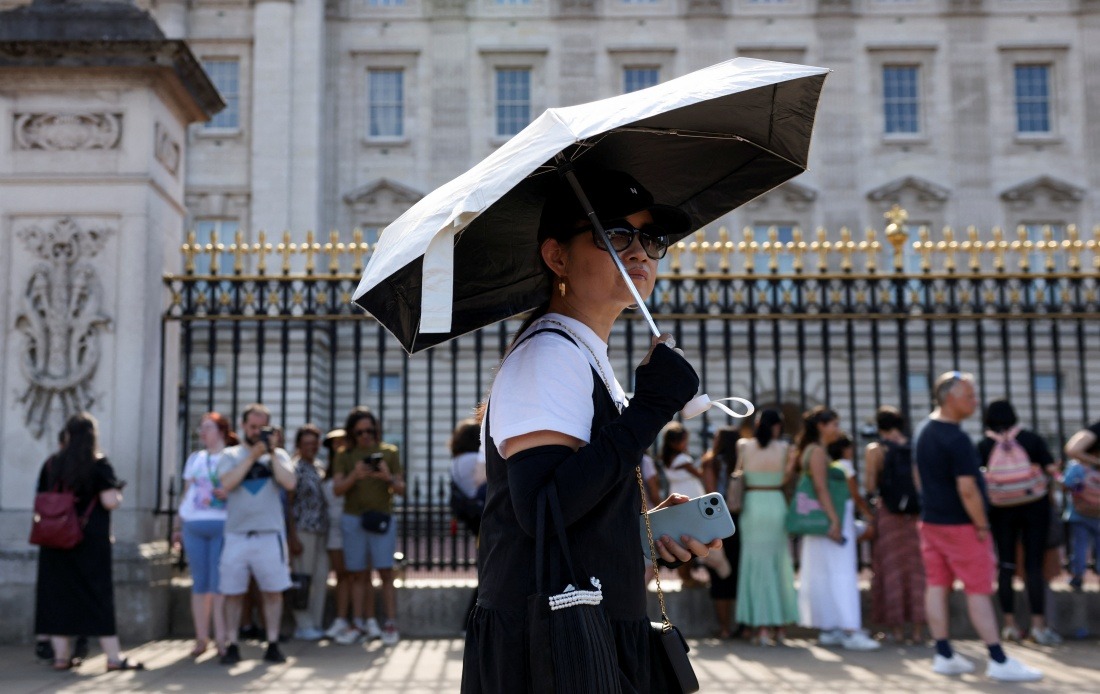
Britain's iconic ceremonial traditions have taken an unusual pause as the nation braces for one of its most severe heatwaves in recent memory. The UK Household Division announced on Tuesday that all ceremonial guard changes in Windsor and London, most notably at Buckingham Palace, would be cancelled through Thursday as temperatures are expected to soar to dangerous levels. The move reflects growing concerns about public safety and the welfare of personnel involved in these long-standing royal ceremonies, marking a significant disruption to traditions that have endured for centuries.
The decision came in response to a rare red weather warning issued by the UK's Met Office, the highest alert level in the country's weather warning system. Such warnings indicate exceptional circumstances where extreme weather poses a serious threat to life and wellbeing across large areas. Meteorological forecasts predict temperatures will reach 39 degrees Celsius on Wednesday and Thursday, with some regions potentially experiencing even higher readings. This marks a critical moment for Britain, where infrastructure, building standards, and public systems are not designed for sustained extreme heat comparable to Mediterranean climates.
The Household Division's statement emphasized that safeguarding personnel and spectators remained paramount in the decision-making process. The institution noted that the wellbeing of soldiers, military working horses, and members of the public who gather in substantial numbers to witness these ceremonies could be jeopardized by prolonged exposure to the forecasted temperatures. The horses used in ceremonial duties, in particular, require careful management during extreme heat, as they are susceptible to heat stress and dehydration. By suspending the full ceremonial operations, the military sought to eliminate unnecessary risk to both human and animal participants.
While the guard changes were cancelled entirely, the Royal Horse Guards' scheduled Wednesday ceremony was modified rather than completely postponed. Military officials announced that this particular changing ceremony would proceed earlier in the morning, circumventing the hottest part of the day when temperatures would be at their peak. Crucially, the revised ceremony would operate without its usual elaborate ceremonial trappings, streamlining the event to minimize exposure time for all involved. Additionally, soldiers participating in any remaining duties were to be positioned in shaded locations whenever possible and rotated at shorter intervals than normal, allowing them to recover from heat exposure more frequently.
The ramifications of this heatwave extended far beyond London's ceremonial centers. Educational institutions across southern England found themselves forced to close their doors, unable to provide safe learning environments for students and staff. Somerset County Council reported that approximately 100 schools within its jurisdiction would remain shuttered during the extreme heat period. The neighboring county of Buckinghamshire faced similar circumstances, with a comparable number of institutions suspending operations. Gloucestershire proved even more severely affected, with more than 80 schools ceasing classes during the critical days of the heatwave.
The geographical distribution of school closures mapped directly onto the red weather warning zone, which encompassed Somerset, Buckinghamshire, Gloucestershire, and London itself. Within London, nearly 10 major educational institutions opted to cancel in-person lessons, transitioning to remote learning where feasible or simply suspending instruction for the duration of the extreme heat. This widespread disruption to education underscored the severity of the weather threat and demonstrated how meteorological extremes can cascade through multiple sectors of society simultaneously.
For Malaysian observers, this scenario illustrates how even developed nations with substantial resources face significant challenges when confronted with environmental extremes outside their historical norms. The UK's response—cancelling cultural events and closing schools—reflects a precautionary approach prioritizing human safety over institutional continuity. Malaysia, as a tropical nation accustomed to heat and humidity, faces different but equally significant climate challenges, including monsoon flooding and landslides during extreme rainfall events. The British experience demonstrates how critical advance warning systems and decisive institutional responses become when weather threatens public welfare.
The heatwave itself represented an anomalous weather event for the UK context. June heat records were expected to be shattered, marking the kind of climatic departure that increasingly characterizes weather patterns across the Northern Hemisphere. Scientists have linked such extremes to broader climate change trends, where regions previously insulated from temperature extremes now face periodic severe heat episodes. For Southeast Asia, where Malaysia maintains regional significance, understanding how different nations adapt to climate-related challenges offers valuable lessons for regional preparedness and response strategies.
The Household Division's decision ultimately reflected institutional maturity and public-safety consciousness. Rather than maintaining traditions at the cost of personnel wellbeing, the organization demonstrated flexibility and responsibility. This pragmatic approach, suspending but not entirely abandoning ceremonies while implementing modified versions where feasible, offered a middle path between cancellation and risky continuation. Such adaptability becomes increasingly important as climate variability creates new operational challenges for institutions worldwide, suggesting that both preservation of tradition and protection of people require evolving institutional frameworks capable of responding to unprecedented circumstances.

