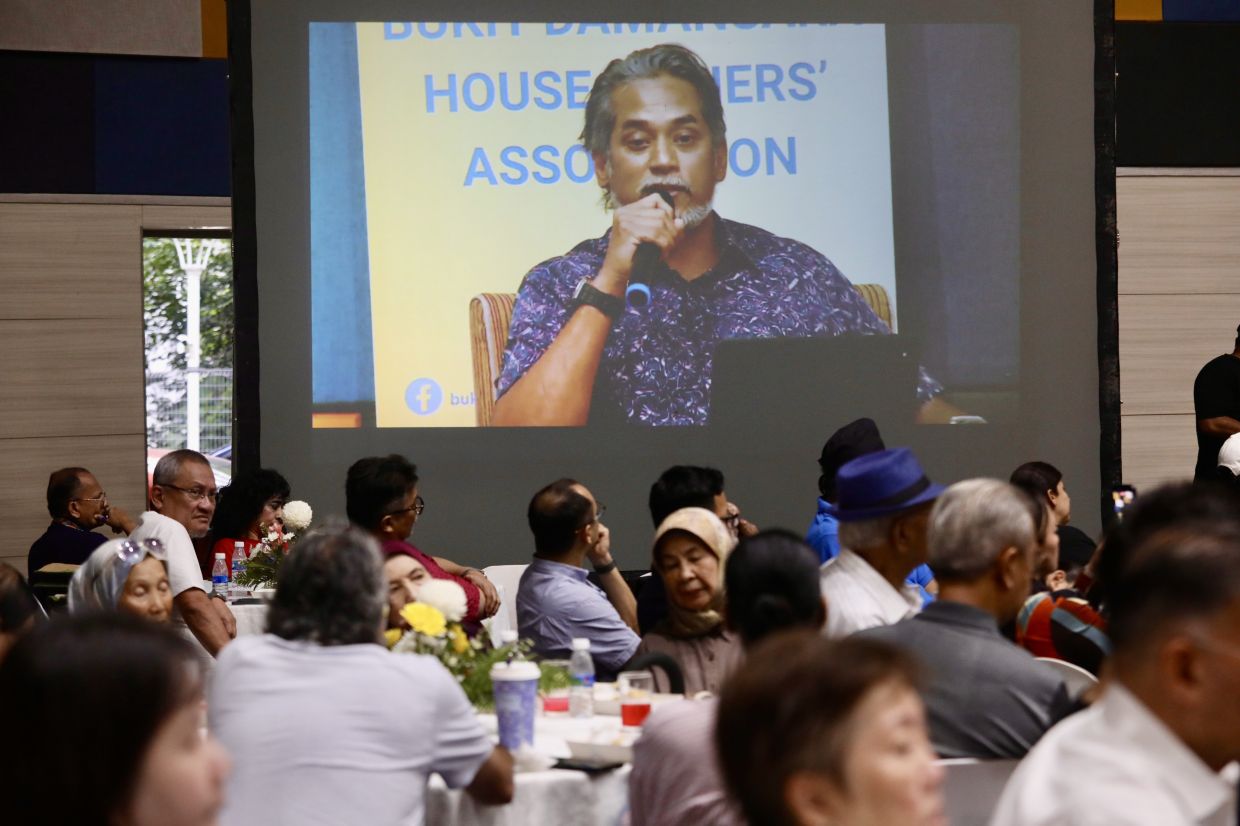
Approximately 400 residents of Bukit Damansara gathered for a town hall dialogue early this month, demanding that Kuala Lumpur City Hall rescind a construction permit issued for the renovation of a semi-detached property that would add an entire floor to the structure. The three-hour community forum, organised by the Bukit Damansara Home Owners' Association and held at Pusat Komuniti Bukit Damansara under the theme "Your Voice Matters," revealed deep frustration among neighbouring residents who claim they were excluded from consultation processes regarding the controversial works.
The gathering marked the first major public engagement since Khairy Jamaluddin assumed the presidency of the home owners' association in early August. In his capacity as moderator, Khairy facilitated discussions between residents and representatives from City Hall's Planning Department, including executive director Rosli Nordin, alongside Brickfields deputy police chief Supt Ahmad Firdaus Mustafia Kamal, who were present to field questions and explore practical remedies to community grievances.
Resident A. Zakki, representing the concerns of his peers, outlined the chronology of a project that has become a flashpoint for neighbourhood tensions. The original semi-detached home, designed as a two-storey property, maintains architectural consistency with other residences along its row. In December 2025, City Hall approved construction of an additional storey, transforming the building into a three-storey structure. When opposition emerged, authorities issued a stop-work order in January 2026. However, roughly two months before the town hall—in June—the project received fresh approval and has since progressed to approximately 10 percent completion, with load-bearing pillars already visible on the property's perimeter.
The architectural transformation has generated resistance rooted in broader concerns about neighbourhood character. Zakki explained that nineteen neighbours have formally registered their opposition through a signature campaign, arguing that the expansion fundamentally alters the visual and structural identity of the semi-detached row. Beyond aesthetic considerations, the construction process itself has inflicted tangible damage to adjacent properties, with structural cracks appearing in neighbouring homes as a consequence of ongoing works. Residents have collectively petitioned City Hall to withdraw the construction permit immediately and suspend all further development.
Rosli, responding on behalf of the municipal authority, acknowledged the difficulties residents face as a result of the renovation activities. However, his commitment stopped short of pledging the withdrawal residents demanded, instead indicating that City Hall would "take note" of the grievances raised. This tepid response underscored a fundamental disconnect between resident expectations and municipal willingness to overturn an already-granted permit, reflecting broader tensions between property development rights and neighbourhood preservation concerns that plague many Malaysian residential communities.
Beyond the renovation dispute, the town hall revealed multiple infrastructure challenges affecting Bukit Damansara's daily functioning. Traffic congestion around SK Bukit Damansara and Stella Maris International School Damansara peaks during morning drop-off hours (7am to 7.30am) and afternoon collection periods (2pm to 4pm), creating safety hazards and flow disruptions. Supt Ahmad Firdaus indicated that police are addressing the matter, though specifics on enforcement strategies remained vague. Ameirul Azraie Mustadza, chairperson of the school's Parent-Teacher Association, disclosed that the school had contemplated enlisting Rela—the government's auxiliary civil defence volunteer corps—to manage traffic, but financial constraints within the association's budget precluded such action.
The school leadership has maintained ongoing communication with traffic authorities, appealing for enhanced police presence to manage peak periods. Currently, monitoring occurs sporadically rather than on a daily basis, leaving residents to manage congestion during the busiest commute windows. The school has consistently reminded parents against double-parking in the vicinity, yet voluntary compliance remains inconsistent. This situation mirrors challenges facing numerous Malaysian residential areas where school-adjacent traffic management depends heavily on parental discipline and intermittent official intervention rather than sustained, systematically-planned solutions.
A second major infrastructure concern emerged regarding water supply reliability in Bukit Damansara. Multiple pipe burst incidents have recently afflicted the neighbourhood, prompting residents to call for comprehensive inspections of the aged pipeline network. An Air Selangor representative participating in the dialogue acknowledged awareness of the bursts and outlined plans to progressively replace the deteriorating pipeline infrastructure throughout Bukit Damansara. The timing of such replacement work remains uncertain, reflecting a common pattern where Malaysian water operators identify ageing networks yet struggle to allocate sufficient resources for timely remediation across sprawling suburban areas.
Khairy characterised the town hall as a mechanism for bridging communication gaps between residents and decision-makers, emphasising the forum's value as an open platform for articulating localised concerns and exploring collaborative solutions. He pledged personal commitment to following up on issues raised, assisting in accelerating problem resolution, and helping identify remedies addressing residents' grievances. His remarks reflected aspirations common among local political representatives to position themselves as effective intermediaries between grassroots communities and administrative bureaucracies.
The Bukit Damansara situation encapsulates broader tensions within Malaysian urban governance. Residents increasingly expect meaningful consultation before projects affecting their neighbourhoods advance, yet municipal processes often grant approvals with limited meaningful community input. The semi-detached renovation controversy highlights how property development rights, neighbourhood preservation, construction safety standards, and community consultation intersect in ways that local authorities struggle to balance equitably. For residents in other Malaysian developments facing similar pressures, Bukit Damansara's experience demonstrates both the potential power of organised community mobilisation and the limitations residents face when municipal decisions have already been formalised, raising questions about whether town halls can genuinely reverse previous administrative determinations or merely provide forums for managing dissatisfaction after key decisions have already been implemented.

