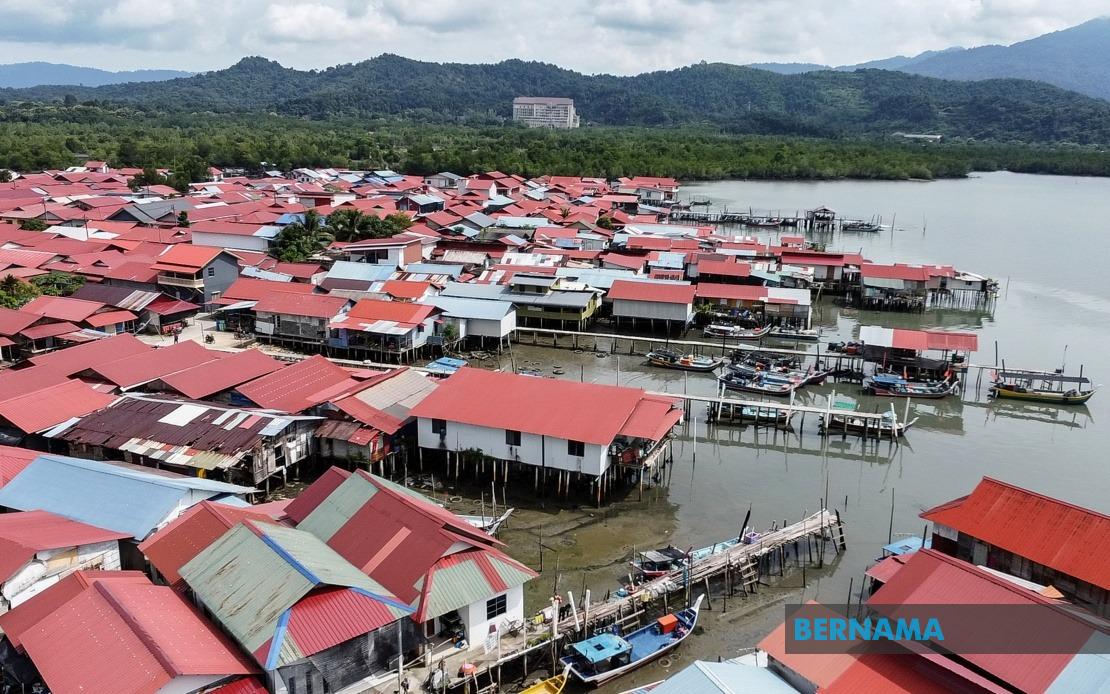
The stigma surrounding Bukit Malut in Langkawi does not align with documented evidence, according to Associate Professor Dr Mohd Na'eim Ajis from Universiti Utara Malaysia's College of Law, Government and International Studies. Speaking after a recent visit to the settlement, the academic challenged persistent claims that the community serves as a Rohingya enclave, drug trafficking hub, or general crime hotspot, pointing instead to objective data that contradicts these narratives.
Official records reveal that approximately 92.2 per cent of Bukit Malut's estimated 5,500 inhabitants possess valid Malaysian identity cards, or MyKads. The remaining residents face documentation complications but are not necessarily foreign nationals, as commonly assumed. This figure fundamentally reframes the settlement's demographic composition and undermines the widespread characterisation of the area as predominantly populated by undocumented migrants or international refugees seeking asylum in Malaysia.
Criminal activity statistics further challenge the settlement's reputation as a lawless zone. Dr Mohd Na'eim emphasised that official data demonstrates a low crime rate, with no serious criminal incidents recorded over the preceding five years. This stands in stark contrast to the pervasive public perception that Bukit Malut represents a danger zone requiring urgent intervention or containment. The disconnect between public perception and measurable reality highlights how narrative and reputation can become detached from verifiable facts, particularly in marginalised communities that lack effective public communication strategies.
The historical context illuminates how Bukit Malut's current population came to inhabit the Langkawi settlement. During Japan's military occupation of Malaya between 1942 and 1945, thousands of civilians—including many from Kedah—were conscripted to labour on the Burma Railway, an infrastructure project of infernal conditions that earned the grim sobriquet "Death Railway." Following World War II's conclusion, some of these forced labourers settled in Ranong near the Thai-Myanmar border, establishing communities away from their homeland.
In the 1980s, recognising a humanitarian obligation, both federal and Kedah state authorities coordinated efforts to repatriate and resettle these ethnic Malay descendants in Langkawi. The residents became collectively known as Kedah Muslim Malays, or MIK, establishing themselves on land that would eventually become known as Bukit Malut. This origins story reveals the settlement as a result of deliberate government policy rather than spontaneous illegal migration, yet this foundational narrative has largely vanished from contemporary public discourse.
The forty-year history of Bukit Malut means that several generations have matured within the community, developing roots, employment, and family networks in Langkawi. Despite this temporal integration, residents have endured persistent marginalisation rooted in mischaracterisations that bear little resemblance to documented reality. The accumulation of negative perceptions over decades has calcified into a collective identity that overshadows the actual composition and conduct of the settlement's inhabitants.
Dr Mohd Na'eim advocates for a comprehensive strategic intervention that extends beyond conventional urban development or relocation schemes. Rather, he emphasises the necessity of systematically correcting public misconceptions through coordinated communication campaigns grounded in factual information. This approach recognises that infrastructure improvements alone cannot dispel deeply entrenched negative narratives; instead, authorities must actively counteract false claims using verifiable evidence and transparent engagement with media and civil society.
Higher education institutions potentially serve as anchors for community engagement initiatives capable of reshaping Bukit Malut's public image. Universities could facilitate structured programmes that bring students, researchers, and community members together to document actual conditions, generate reliable data, and amplify resident voices. Such collaborative approaches leverage academic credibility whilst fostering genuine dialogue rather than imposing top-down corrective narratives that may lack authenticity or community endorsement.
The physical circumstances of Bukit Malut reflect the settlement's organic development and resourcefulness. As of May 2024, approximately 1,400 residential structures—some built on land and others constructed over water—housed the population of 5,500 individuals. This configuration demonstrates adaptive settlement strategies responsive to topographical constraints and available resources. Yet this architectural inventiveness has sometimes been pathologised in media coverage as evidence of disorder or illegality, when it more accurately represents pragmatic problem-solving by residents navigating spatial and economic limitations.
Historical disputes regarding land ownership have further complicated the settlement's status and contributed to uncertainty about residents' security of tenure and development prospects. These unresolved property questions create vulnerability for inhabitants and provide rhetorical ammunition for those seeking to characterise Bukit Malut as unstable or problematic. Clarifying legal status and establishing transparent, equitable frameworks for land governance would simultaneously improve residents' security whilst eliminating a key justification for continued marginalisation.
For Malaysia's broader policy landscape, the Bukit Malut case exemplifies how marginalised communities can suffer reputation damage disproportionate to actual evidence of wrongdoing. The settlement's residents deserve recognition as Malaysian citizens entitled to equivalent development opportunities, public services, and social dignity as other communities. This principle extends beyond Bukit Malut to encompass all populations targeted by stereotype or prejudicial policy formulation detached from empirical foundation.
Addressing the settlement's accumulated challenges requires political will transcending conventional bureaucratic approaches. Government bodies must prioritise evidence-based policymaking that actively interrogates and contradicts false narratives, supported by adequate resource allocation for community development. Simultaneously, media outlets and civil society organisations bear responsibility for scrutinising sensationalist claims and demanding documentary verification before amplifying negative characterisations of vulnerable populations.

