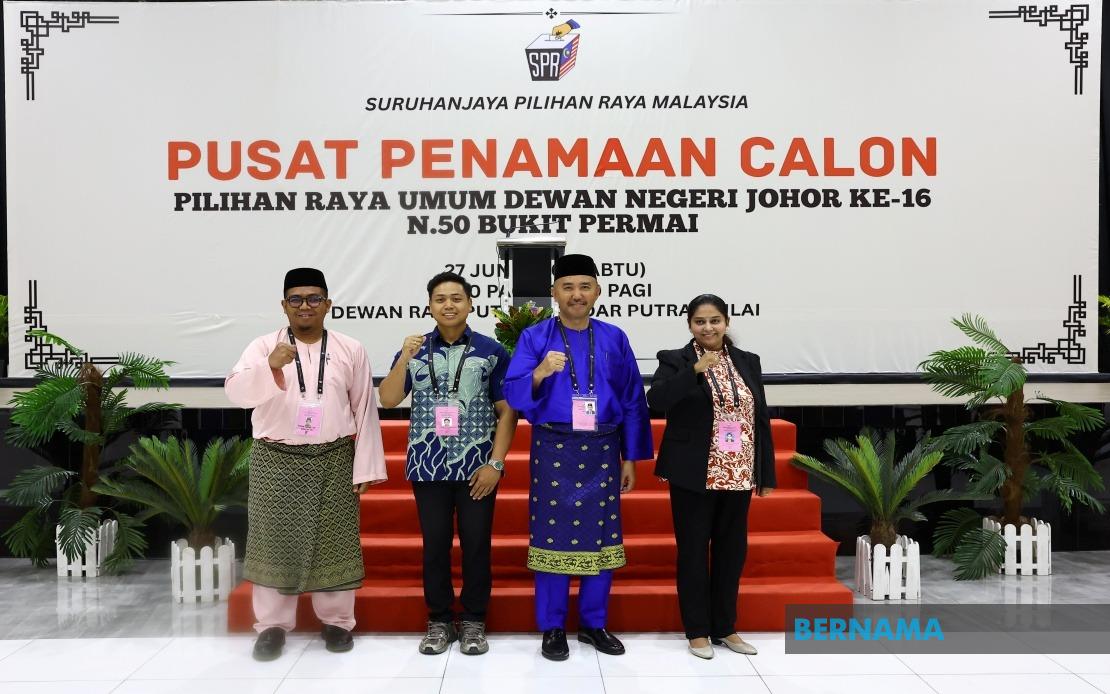
The race for the Bukit Permai state assembly seat has taken shape as a wide-open contest, with four candidates officially nominated to contest the 16th Johor state election. Datuk Mohd Jafni Md Shukor, the sitting Barisan Nasional representative, seeks to retain his constituency against stiff opposition from across the political spectrum, setting up what promises to be one of the more tightly fought races in the upcoming poll.
Mohd Jafni faces challenges from three quarters. Mohamad Shafwan Ani flies the colours of Pakatan Harapan, seeking to wrest the seat from the incumbent. Perikatan Nasional has fielded M. Lina Manoh, bringing fresh representation from the northeastern coalition. Meanwhile, Parti Bersama Malaysia, a relative newcomer to the electoral landscape, has put forward Muhammad Aidil Riduan Mohd Yusof to make a statement in the contest.
The nominations were officially closed and candidate declarations were made public on June 27 at the nomination centre in Dewan Raya Putra in Bandar Putra, Batu Pahat. The returning officer, Afzan Azhari, presided over the process and confirmed all four candidates met the necessary requirements to contest. The presence of Johor DAP chairman Teo Nie Ching at the centre underscored the significance of this particular seat within Pakatan Harapan's broader strategy for the state election.
Mohd Jafni enters this contest as the defending champion, having claimed victory in the 2022 Johor state election with a commanding majority of 4,755 votes. That previous election also saw a four-cornered contest, suggesting that the Bukit Permai constituency has become a battleground where multiple political forces believe they have credible chances of success. His track record of winning under similar circumstances could provide him with operational experience and voter familiarity that newer candidates lack.
However, the composition of challengers indicates that the political landscape has shifted since 2022. The inclusion of Bersama Malaysia as a contestant is noteworthy, as the party represents one of Malaysia's newer political entrants. The presence of a fourth candidate could fragment the anti-incumbent vote or, conversely, consolidate alternative options for voters seeking change. Perikatan Nasional's participation reflects the broader resurgence of the coalition in peninsular Malaysian politics, particularly following its performance in recent elections elsewhere in the country.
The electoral calendar has been set with precision to ensure a smooth conduct of polls. Early voting has been scheduled for July 7, providing flexibility for those unable to vote on the main day. The actual polling will take place on July 11, giving voters a narrow window during which political messaging, campaigning, and last-minute persuasion efforts will be at their most intense. This compressed timeline means candidates will need to deploy resources strategically to maximise voter contact and turnout.
For Bukit Permai specifically, the contest reflects broader patterns visible across Johor's political terrain. The state has become more competitive in recent election cycles, with Barisan Nasional no longer enjoying the overwhelming dominance it once commanded. Pakatan Harapan's challenge, meanwhile, hinges on whether it can consolidate anti-BN sentiment, particularly in constituencies where previous contests have been decided by narrow margins. The entry of Perikatan Nasional adds complexity, as it seeks to position itself as a middle ground between the two traditional coalitions.
From a Malaysian political perspective, Bukit Permai encapsulates the challenges facing traditional power brokers in an increasingly fragmented electoral environment. Voters now have genuine choices, and the presence of four serious candidates means that whoever emerges victorious will likely do so with less than the commanding mandates that were once commonplace. This reflects Malaysia's broader democratic maturation, where results are less predetermined and competitive dynamics genuinely shape outcomes.
For Johor specifically, the state has become a critical testing ground for national political trends. The state's economic importance and its position as a gateway between Malaysia's developed west coast and the less urbanised east creates a diverse electorate with varying concerns. Bukit Permai, situated in Batu Pahat, represents the kind of mixed urban-rural constituency that will determine the overall composition of the state assembly. A Barisan Nasional hold here would suggest the coalition's traditional base remains resilient, while a victory for any challenger would indicate successful consolidation of opposition support.
The implications of the Bukit Permai outcome extend beyond the constituency itself. Malaysian elections at the state level increasingly serve as bellwethers for national political sentiment. A decisive result in any direction could influence calculations within the respective coalitions regarding their viability and direction. For Johor in particular, the election will help determine whether the state remains a Barisan Nasional stronghold or whether the opposition has successfully established itself as a genuine alternative.
Campaigning has effectively begun with the formal nomination process concluded. Each candidate will now focus on articulating their vision for Bukit Permai's development, addressing constituent concerns, and attempting to differentiate themselves from competitors. The narrowness of Mohd Jafni's previous victory margin suggests this seat remains genuinely competitive, and no candidate can assume victory is assured. The four-way nature of the contest adds unpredictability, as outcomes will depend not merely on which side mobilises better but on how votes distribute across the four options available to electors.

