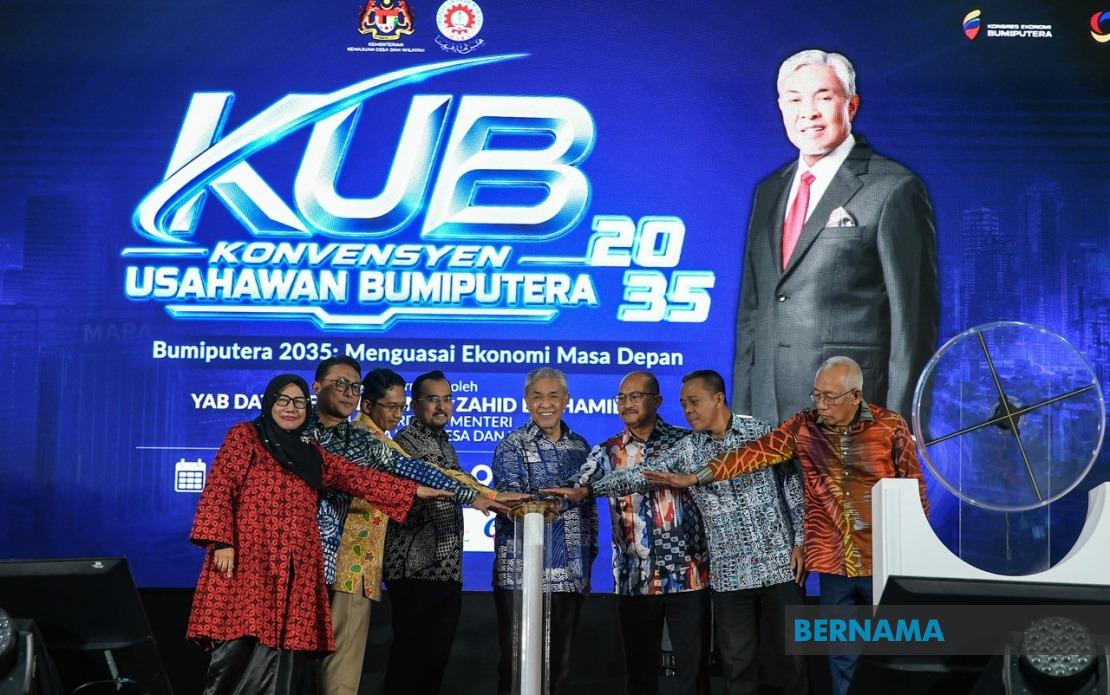
Deputy Prime Minister Datuk Seri Dr Ahmad Zahid Hamidi has signalled a significant strategic shift in Malaysia's approach to Bumiputera entrepreneurship, calling for a transition from enabling business participation to fostering genuine ownership and control. Speaking at the closing ceremony of the Bumiputera Entrepreneurs Convention (KUB) 2035 Declaration in Alor Setar on August 27, Ahmad Zahid articulated a vision that moves beyond the traditional framework of including Bumiputera entrepreneurs in the broader economic value chain towards empowering them to command their own sectors.
The Deputy Prime Minister's remarks underscore a recognition that decades of policies aimed at facilitating Bumiputera participation have achieved mixed results, with many entrepreneurs remaining dependent on government support mechanisms rather than developing self-sustaining, competitive enterprises. Ahmad Zahid's framing of the challenge as a need to "build ownership, scale up and create greater control" reflects deeper conversations within government circles about the effectiveness of existing Bumiputera economic programmes and their long-term sustainability.
Central to Ahmad Zahid's message is an implicit acknowledgement that responsibility extends beyond government corridors. While reaffirming the state's commitment to providing opportunities, strengthening the entrepreneurial ecosystem, and broadening access to resources, he emphasised that entrepreneurs themselves must demonstrate the courage to expand operations, engage in direct competition, and generate value independently. This dual accountability framework suggests growing impatience with passive reliance on preferential treatment and a shift towards expecting Bumiputera business leaders to demonstrate genuine entrepreneurial ambition and capability.
To support this transformation, Ahmad Zahid, who also holds the Rural and Regional Development portfolio, outlined three interconnected structural reforms for the Bumiputera entrepreneurship ecosystem extending to 2035. The first involves integrating fragmented support mechanisms, a critical issue that has long plagued Malaysian entrepreneurial development. Currently, aspiring and established Bumiputera business owners navigate a bewildering landscape where financing, technical training, and market access operate through separate government agencies, financial institutions, and private sector channels, often with minimal coordination.
This fragmentation creates inefficiencies and missed opportunities. An entrepreneur seeking growth capital may discover that government-backed financing programmes operate independently from training initiatives, while market access programmes follow entirely different application processes and timelines. The resulting bureaucratic complexity discourages scaling ambitions and absorbs resources that could otherwise fuel business expansion. By integrating these support instruments, the government aims to create a more user-friendly environment where entrepreneurs can access comprehensive support packages aligned with their specific developmental stages and sectoral needs.
The second pillar of Ahmad Zahid's proposed ecosystem transformation involves fundamentally reorienting how the government produces and nurtures entrepreneurs. Rather than focusing on generating large numbers of new business registrations—a metric that has historically dominated policy discussions—the framework emphasises growing existing entrepreneurs into mature, competitive operators. This reflects international best practice, where entrepreneurial development is understood as a spectrum rather than a binary state. An entrepreneur who launches a modest venture differs vastly from one who scales operations across multiple locations or exports internationally, yet Malaysian programmes have traditionally treated entrepreneurship development as a singular phenomenon.
By shifting towards growing entrepreneurs, the system would theoretically allocate resources more strategically, concentrating support on businesses with genuine growth potential rather than spreading thin assistance across countless marginal operations. This represents a recognition that not all business ventures deserve equal public investment, and that more targeted support for high-potential entrepreneurs would yield better returns for both the individuals involved and the broader economy.
The third element of the proposed reform addresses a challenge that extends beyond Bumiputera entrepreneurs specifically: ensuring that Malaysia's overall economic growth strengthens local companies rather than predominantly benefiting multinational corporations or imported services. This reflects concerns that rapid economic growth in certain sectors has not proportionally benefited domestically-owned businesses, particularly those led by Bumiputera entrepreneurs. By intentionally directing growth benefits towards local enterprises, the government seeks to create a more inclusive development model where expanding economic opportunities translate into concrete advancement for locally-rooted businesses.
These proposals carry particular significance for Southeast Asia's broader economic trajectory. Malaysia's Bumiputera framework remains unique in the region, and its evolution directly influences intra-regional competition for investment and talent. Countries watching Malaysia's approach to Bumiputera entrepreneurship include Indonesia, Thailand, and the Philippines, all of which grapple with similar questions about equitable economic participation and the role of preferential policies in fostering genuine entrepreneurial capacity.
For Malaysian entrepreneurs themselves, Ahmad Zahid's message carries both encouragement and expectation. The emphasis on government support continuation reassures existing and prospective business owners that state backing remains available. Simultaneously, the call for courage and competitive engagement implicitly warns that future support may increasingly depend on demonstrating genuine growth trajectories and market viability rather than meeting narrow demographic criteria alone.
The feasibility of executing these three ecosystem reforms will determine whether Malaysia can genuinely transition from a participation-focused model to an ownership-and-scale model. Success requires not merely policy adjustments but coordinated action across multiple government agencies, genuine engagement with the private sector, and acceptance that some existing programmes may need to be discontinued or fundamentally restructured. The coming years will reveal whether these ambitious intentions translate into systemic change or remain largely aspirational pronouncements.

