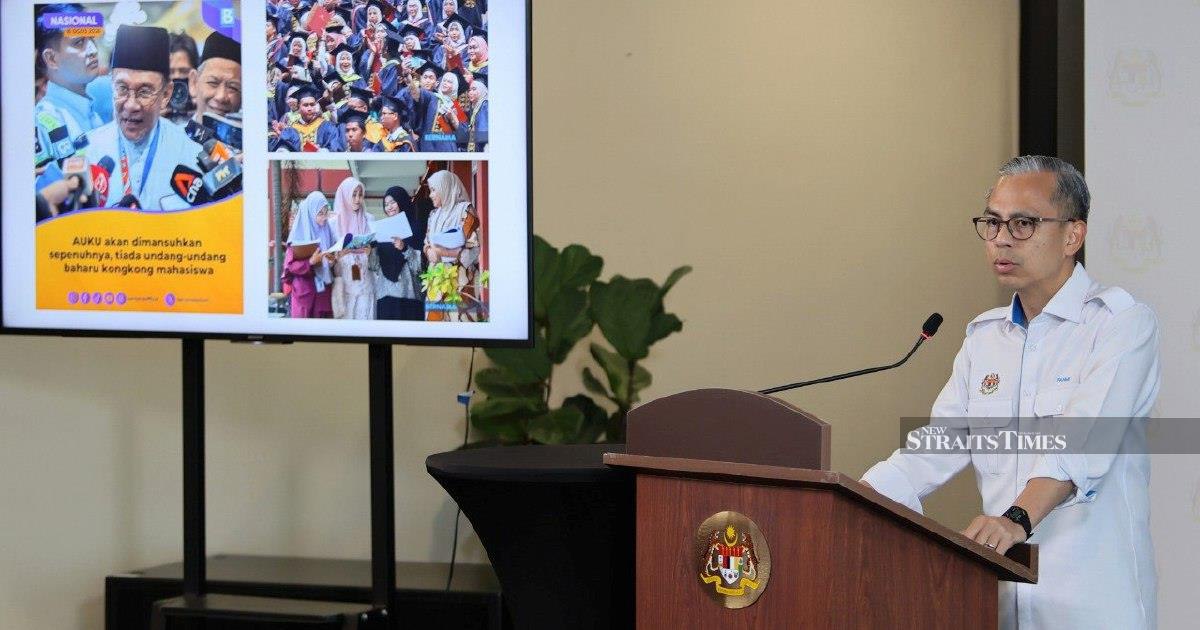
Prime Minister Datuk Seri Anwar Ibrahim's recent comments concerning Taiwan failed to merit discussion at Malaysia's highest decision-making forum, according to government spokesman Datuk Seri Fahmi Fadzil speaking from Putrajaya. The cabinet's apparent decision to sidestep the matter comes in the wake of a pointed rebuke from Taipei over Anwar's remarks, marking a notable diplomatic moment in Malaysia's carefully balanced approach to cross-strait affairs.
The omission from cabinet deliberations suggests the government views the controversy as insufficiently urgent for formal ministerial debate, or alternatively, that it prefers to allow the matter to dissipate without institutional endorsement of any particular stance. Fahmi's confirmation that no discussion took place indicates a deliberate choice in how the administration manages sensitive geopolitical commentary, particularly when such statements risk undermining Malaysia's stated commitment to neutrality on the Taiwan question.
Malaysia's traditionally cautious diplomatic posture on Taiwan reflects a complex balancing act. The country maintains official relations with the People's Republic of China while managing significant trade, investment, and people-to-people ties with Taiwan. Any statement by a sitting prime minister touching on Taiwan therefore carries weight beyond mere domestic politics, potentially signalling shifts in Malaysia's approach to a rivalry that has grown increasingly tense across the region.
Taipei's strong response to Anwar's comments underscores how closely the island monitors statements from Southeast Asian leaders. Taiwan's authorities have grown more assertive in responding to what they perceive as commentary favouring Beijing's position, particularly as China increases diplomatic pressure across the region. The island has ramped up its efforts to maintain international support and demonstrate that its democratic system warrants recognition and engagement from the global community.
For Malaysian policymakers, the decision not to engage with Anwar's Taiwan remarks at the cabinet table may reflect either confidence that the comments require no clarification, or conversely, a preference for minimising their prominence within the apparatus of government. The absence of ministerial discussion could also indicate that various departments already maintain clear protocols for handling Taiwan-related matters, making formal cabinet review redundant.
The incident nonetheless illuminates ongoing tensions in managing high-level political speech on geopolitical matters. Prime ministers inevitably make remarks that can be interpreted through multiple lenses, and in the region's polarised environment around Taiwan, even carefully worded statements can generate controversy. The cabinet's avoidance of the matter suggests faith in the administration's existing frameworks for diplomatic communication, or possibly reflects an unwillingness to revisit potentially fractious policy questions.
Malaysia's strategic position as a major Southeast Asian economy with deep commercial ties in both directions across the Taiwan Strait positions it uncomfortably between competing interests. Anwar's government, like its predecessors, must navigate calls from Beijing for alignment against Taiwan while maintaining sufficient engagement with Taipei to protect Malaysian business interests and avoid antagonising democracies aligned with the United States.
The timing of these remarks and the cabinet's non-response carry implications for how Malaysia signals its foreign policy priorities internally and externally. Observers across Asia will interpret the lack of cabinet discussion as either a sign of institutional complacency on Taiwan matters, or more charitably, as evidence that the government maintains sufficient consensus on this sensitive issue to preclude the need for formal deliberation.
As cross-strait tensions continue to influence regional dynamics, Malaysia's approach to containing and contextualising statements by its leaders on Taiwan deserves closer scrutiny. The cabinet's reticence to engage formally with Anwar's comments may itself become a data point in how various actors assess Malaysia's true position on one of Asia's most consequential unresolved questions. Whether this silence reflects stability or precarity in Malaysia's Taiwan policy remains an open question for diplomatic observers tracking the country's positioning in an increasingly fractious geopolitical environment.

