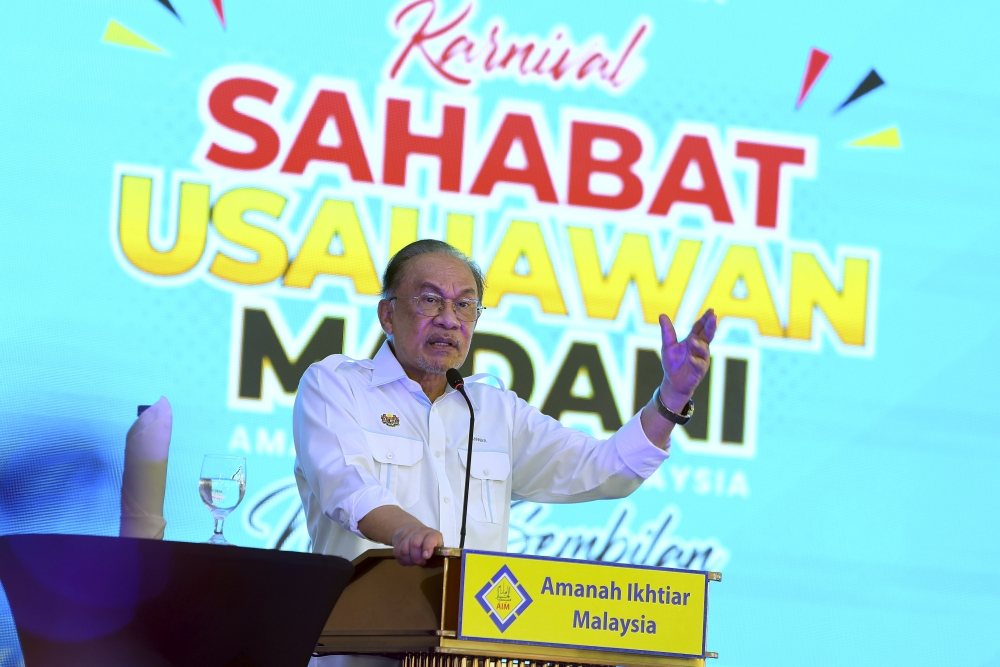
Prime Minister Datuk Seri Anwar Ibrahim has moved to dispel concerns about Cabinet-level opposition to programmes designed to support the Malay and Muslim communities, insisting that his administration remains steadfastly committed to these constituencies. Speaking in Jempol, the Premier reiterated that no minister has ever raised objections to proposals aimed at advancing the welfare and interests of these groups, underscoring the government's unified position on constitutionally enshrined protections.
The statement carries particular weight given ongoing political discourse about the balance between affirmative action policies and other national priorities. Anwar's clarification appears designed to address latent anxieties within Malay-Muslim circles, where suspicions occasionally surface that certain Cabinet members might harbour reservations about the scope or implementation of community-focused programmes. By publicly reaffirming Cabinet solidarity on this matter, the PM is attempting to shore up confidence among a core constituency that remains sensitive to perceived threats to Malay-Muslim special rights outlined in the Federal Constitution.
Malaysia's constitutional framework grants certain safeguards to the Malay-Muslim majority, including provisions for education, business opportunities, and religious matters. These protections have long been a cornerstone of the nation's social contract and remain deeply embedded in national identity discussions. However, as Malaysia becomes increasingly diverse and globalised, questions periodically emerge about how these historical arrangements intersect with competing demands for equal opportunity and meritocracy, creating potential friction within government circles.
Anwar's comments suggest that despite Malaysia's multicultural complexity and the PKA's coalition partnerships with non-Malay and non-Muslim parties, there exists no fault line within the Cabinet over these fundamental issues. This messaging is particularly important for maintaining internal coalition harmony and preventing claims that any government partner might be subtly undermining traditional protections. The Premier is essentially providing reassurance that programmatic commitments to Malay-Muslim advancement enjoy universal Cabinet endorsement.
The timing of Anwar's remarks reflects the government's ongoing effort to navigate between competing political pressures. On one hand, there is expectation from Malay-Muslim voters and civil society organisations that the administration will robustly protect and expand community-targeted initiatives. On the other, the coalition's structure necessitates accommodation of diverse political perspectives, including those from communities that might view certain affirmative action measures with some ambivalence. Anwar's statement serves to reassure the former constituency without explicitly addressing tensions with the latter.
From a practical governance standpoint, Anwar's assertion about Cabinet consensus is significant because it means that bureaucratic implementation of such programmes should proceed without ministerial foot-dragging or passive resistance. When a Prime Minister explicitly confirms that all Cabinet members support particular policy directions, it establishes clear expectations for administrative action and resource allocation. Ministers who might privately harbour concerns know that their avenue for influence lies elsewhere, not through obstructionism within Cabinet deliberations.
The statement also carries implications for Malaysia's approach to identity politics in a competitive regional context. As Southeast Asian democracies grapple with questions of majority and minority rights, national cohesion, and developmental priorities, Malaysia's approach remains distinctive. Anwar's reaffirmation that constitutional protections for Malays and Muslims remain non-negotiable even within a diverse coalition government sends a signal about where the government's foundational commitments lie, while attempting to preserve broader national harmony.
Ministerial unity on sensitive constitutional matters is particularly crucial in Malaysia's context, where public statements by individual Cabinet members can rapidly mobilise communal sentiment or fuel inter-community tensions. When the PM publicly confirms that no dissent exists on programmes supporting specific communities, it reduces the likelihood that disgruntled voices within government can exploit such initiatives for factional advantage or political positioning. This disciplinary effect matters substantially in maintaining Cabinet coherence.
The Jempol statement should be read against the backdrop of Malaysia's periodic cycles of heightened sensitivity around Malay-Muslim rights. Typically, such anxieties intensify during political transitions, electoral cycles, or when there is perceived encroachment from other quarters. By preemptively addressing potential doubts about internal Cabinet support for these programmes, Anwar is attempting to close off a potential political opening that opposition parties or internal rivals might otherwise exploit.
Moreover, Anwar's position reflects a sophisticated understanding that communal politics in Malaysia requires constant tending and reassurance. Statements of commitment from senior leadership towards specific constituencies are not mere rhetoric—they function as important political currency, signalling to civil society, religious leaders, and community organisations that their concerns remain central to government deliberations. The absence of such signals, conversely, can swiftly generate suspicion and alienation.
Looking forward, maintaining this claimed Cabinet consensus will require careful management of resource allocation, bureaucratic implementation, and public communication. Ministers will need to ensure that programmes targeting Malays and Muslims receive adequate funding and attention, and that any budgetary constraints are not perceived as reflecting disproportionate sacrifice by these communities. The PM's reassurance is only as credible as the material outcomes it produces.
Anwar's remarks underscore that despite Malaysia's evolution toward more inclusive governance, the constitutional settlement that grants special protections to Malays and Muslims remains, in his view, non-controversial and non-negotiable within Cabinet. This positioning attempts to square a difficult circle: maintaining traditional protections while operating a genuinely plural coalition government. Whether this consensus holds under fiscal pressure or political challenges remains to be tested.

