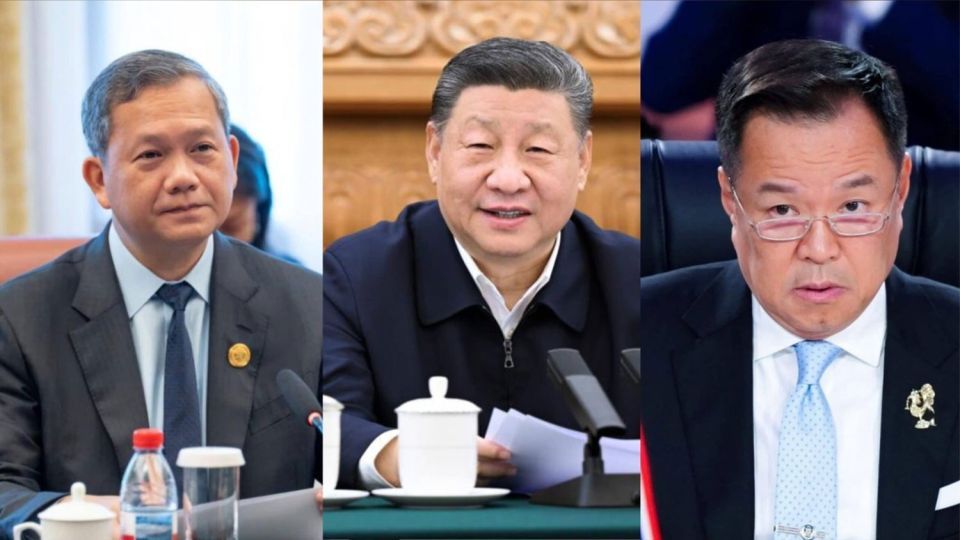
Cambodian Prime Minister Hun Manet and his Thai counterpart Anutin Chanvirakul are preparing for a significant diplomatic engagement in China next month, with both leaders scheduled to open the World AI Conference 2026 in Shanghai on July 17 at the invitation of Chinese President Xi Jinping. The three-day visit represents an opportunity for high-level engagement with Beijing's top leadership, yet observers are watching closely to see whether China will seize the moment to mediate on a bilateral issue that has festered between the two Southeast Asian neighbours for months: their unresolved border crisis.
Manet's delegation will comprise a substantial ministerial entourage, including Foreign Minister Prak Sokhonn, Defence Minister Tea Seiha, and Sun Chanthol, the first vice-chairman of the Council for the Development of Cambodia. The composition of such delegations often signals the importance placed on bilateral discussions beyond the official conference agenda. Anutin will similarly bring his foreign minister, Sihasak Phuangketkeow, suggesting both capitals view the Shanghai gathering as an occasion for substantive talks alongside the artificial intelligence forum proceedings. Both leaders are scheduled for separate audiences with Xi and Premier Li Qiang, providing multiple venues for diplomatic conversations.
Cambodia's foreign ministry framed the visit as a continuation of efforts to deepen ties with its largest strategic partner. Official statements emphasised the strengthening of the Comprehensive Strategic Partnership of Cooperation and the advancement of Cambodia-China frameworks collectively described as the Diamond Cooperation Framework and all-weather community partnership. Such language, repeated in successive diplomatic communiques, reflects the consistent messaging Phnom Penh has used to underscore its alignment with Beijing's geopolitical vision. Thailand's foreign ministry issued similarly calibrated remarks about reinforcing Bangkok-Beijing cooperation, though with notably less elaboration on specific partnership architectures.
Yet beneath the ceremonial elements lies a persistent territorial dispute that has not been addressed through official channels since December. Both leaders did shake hands at the ASEAN Future Forum held in Hanoi in early June, but that encounter generated no substantive engagement on the boundary question. The absence of direct negotiations over several months reflects the frozen state of relations on this critical issue, with Cambodia alleging that Thai military forces continue to occupy portions of shared territory and prevent roughly 20,000 Cambodian civilians from returning to their homes.
Analysts are closely monitoring whether Beijing will employ its considerable economic and diplomatic leverage to push both nations toward the negotiating table. As a major trading partner and strategic investor in both Cambodia and Thailand, China possesses significant influence over their foreign policy calculations. Regional observers have suggested that the Shanghai conference provides an ideal setting for Chinese mediation, given the presence of top-level decision-makers and the opportunity for frank discussions away from public scrutiny. Such intervention would align with China's broader strategic interests in maintaining stability within its Southeast Asian sphere of influence.
However, experts caution that domestic political dynamics within Thailand may prove more intractable than external diplomatic pressure. According to Kin Phea, director of the Royal Academy of Cambodia's International Relations Institute, the fundamental obstacle centres not on civilian leadership but on military institutions that exercise substantial autonomous power over Thai foreign and security policy. Phea argues that Thailand's uniformed forces have failed to implement agreements reached between civilian governments, instead using their structural autonomy to pursue actions that Phea characterises as encroachment on Cambodian sovereignty. This analysis suggests that even if the Thai government were to commit anew to resolving the dispute, implementation would depend on military compliance.
Phea pointed to the December 2025 Fuxian Consensus, a Chinese-brokered framework that ostensibly established principles for peaceful resolution of the boundary question. Rather than marking a breakthrough, however, that agreement has proven insufficient to arrest Thai military activities in contested areas. Phea contended that effective resolution would require China to assume a more interventionist posture, actively pressuring Thailand to respect prior commitments and withdraw forces from disputed zones. Such an approach would represent a departure from Beijing's traditional preference for non-interference in neighbours' internal affairs, suggesting how serious some Cambodian analysts view the deadlock.
The path forward hinges on the Joint Boundary Commission, the formal mechanism established to negotiate demarcation and resolve disputes. According to Phea's assessment, this body requires revitalisation through renewed Thai commitment and active Chinese backing. Without such engagement, the territorial question risks remaining frozen indefinitely, with Cambodia unable to restore civilian access to occupied regions and regional tension persisting beneath the surface of official diplomatic courtesies. The Shanghai gathering will test whether the gathering momentum of China-led regional cooperation provides sufficient impetus to break this stalemate.
For Malaysia and other ASEAN members, the Cambodia-Thailand impasse carries broader implications. Unresolved disputes within the bloc complicate collective decision-making and weaken ASEAN's capacity to project unified positions in dealings with external powers. A successful Chinese intervention in resolving this boundary question could signal Beijing's increasing role as an arbiter of Southeast Asian conflicts, a development that would reshape the regional balance of power and ASEAN's own standing as an institution. Conversely, continued Thai resistance to serious negotiations could demonstrate the limits of external pressure and the persistence of nationalist military interests in shaping Thai policy despite civilian government preferences.
The Shanghai conference thus transcends its official purpose as a gathering on artificial intelligence. It represents a critical moment in determining whether the diplomatic infrastructure and Chinese economic leverage that characterise modern Southeast Asian regional relations can be mobilised to resolve long-standing grievances. Both Hun Manet and Anutin bring to the table different domestic constraints and strategic calculations, yet each faces pressure to demonstrate progress on an issue that affects their credibility with their own populations and within the region more broadly.

