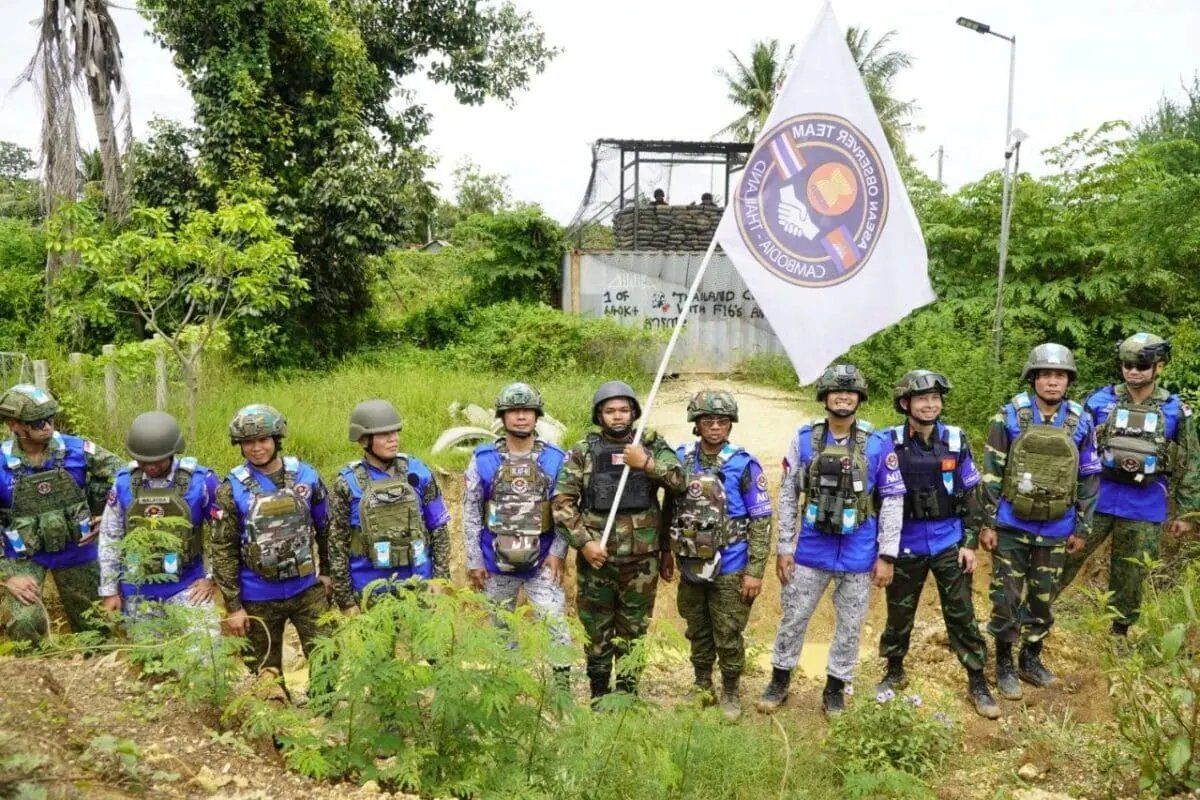
Cambodia's Minister of Information Neth Pheaktra has escalated rhetoric over the disputed border with Thailand by pivoting toward a strategy centred on third-party verification. His response to Thailand's military chief's rejection of Cambodian allegations of territorial encroachment emphasises that independent observers—including Asean monitors, diplomatic representatives, and United Nations officials—have now personally witnessed physical evidence of Thai security infrastructure on areas Cambodia claims as sovereign territory. This shift in approach fundamentally alters the nature of the dispute from a bilateral disagreement over interpretation into a matter of documented international observation.
The catalyst for Pheaktra's remarks came from Air Chief Marshal Prapas Sornchaidee, director of Thailand's Joint Information Center, who categorically denied that Bangkok had pursued any policy of invading or occupying Cambodian territory. Prapas maintained that Thai military activities, including road construction and the establishment of fortified positions, were strictly defensive in character and aimed at protecting Thai personnel and civilians while preserving Thailand's national sovereignty in areas under its control. Thailand's position remains that questions of territorial jurisdiction cannot be settled through military occupation or unilateral actions, but must instead rely on formal legal mechanisms, historical documentation, and established boundary agreements.
Pheaktra seized on a crucial distinction within Prapas's own argument. Both nations nominally agree that boundaries should be determined through agreed legal and technical frameworks rather than through facts created on the ground through military control. Yet the Cambodian minister argued this principle has been systematically violated through the physical presence of shipping containers, razor wire barriers, trenches, and military installations that Cambodia contends are located within its territory. By framing the issue around what he termed the "eyes of third parties," Pheaktra attempted to move beyond the stalemate of competing national narratives by introducing independent witnesses whose accounts carry diplomatic weight.
The centrepiece of this strategy involves recent inspections conducted by the Asean Observer Team in Cambodia, led by its Philippine head of mission. The team examined three separate zones in Banteay Meanchey province that have become flashpoints in the border dispute. At Boeung Trakuon in Kouk Romiet commune, observers documented 44 shipping containers distributed across 14 separate locations. Cambodia maintains that this blockade has prevented approximately 7,873 residents from 1,869 families—nearly one-quarter of whom are children—from returning to their homes. Similar inspections at Chouk Chey and Prey Chan villages revealed an additional 72 containers positioned across 10 locations. Across all three areas, Cambodia reports that 13,259 people, including more than 3,400 children, remain displaced and unable to access their residences and livelihoods.
Pheaktra's emphasis on external verification carries particular significance for Southeast Asian regional dynamics. Asean's protocols typically insist on consensus and non-interference in internal matters, which constrains the organisation's ability to make definitive judgements on bilateral territorial disputes. Yet the presence of an Asean Observer Team conducting systematic inspections represents a subtle but meaningful shift toward collective verification of humanitarian conditions. For Cambodia, this provides a buffer against accusations that it is manufacturing evidence or exaggerating claims. The Philippine mission's documented findings create an independent record that neither Phnom Penh nor Bangkok can easily dismiss without appearing to reject Asean oversight itself.
The Cambodian position has also been reinforced by international human rights scrutiny. UN Special Rapporteur on the situation of human rights in Cambodia Tom Andrews visited displaced communities and the border region during a mission in July, subsequently reporting that approximately 650,000 Cambodians were displaced during the broader conflict period, with over 20,000 individuals still unable to return to their homes. Andrews documented testimonies from displaced persons who attributed their inability to return specifically to occupation by Thai security forces. These findings, though focused on humanitarian rather than sovereignty questions, carry substantial diplomatic weight and complicate Thailand's narrative that its military presence poses no obstruction to civilian return.
Pheaktra employed symbolic language to underscore Cambodia's position, stating flatly that "shipping containers are not border markers, barbed wire is not a treaty, trenches are not boundary maps, and planting a flag is not a title deed to territory." This rhetorical approach serves multiple purposes: it appeals to international law principles, it acknowledges the practical reality of physical structures on the ground, and it frames Thailand's military infrastructure as inherently illegitimate regardless of its stated protective purpose. By treating containers and military installations as evidence rather than mere allegations, Pheaktra transformed the dispute from a question of competing interpretations into a matter of observable fact that requires explanation.
Cambodia's preferred mechanism for resolution remains the Joint Boundary Commission, a bilateral body established through the 2000 Memorandum of Understanding and the 2003 Terms of Reference. Cambodia argues that the boundary should be determined through historical Franco-Siamese treaties, conventional maps, boundary documents, and the technical work of the JBC—not through military occupation or security justifications. This position maintains consistency with international law principles that oppose the acquisition of territory through force or the creation of facts on the ground, principles that should theoretically resonate with Thailand's own stated position that boundaries cannot be determined through unilateral military action.
Thailand's response, however, indicates little flexibility. Prapas asserted that Thailand would continue protecting areas it considers its own territory and would not suspend security measures simply because Cambodia made unilateral demands. This stance reflects Thailand's fundamental conviction that the areas in question belong to Thailand and that security infrastructure serves legitimate national defence purposes. The impasse thus reflects not merely a disagreement over facts but a deeper disagreement over the actual location of the international boundary itself—a question that the JBC has struggled to resolve for more than two decades despite numerous meetings and technical surveys.
The humanitarian dimension adds another layer of complexity. Cambodia links the container blockade and displaced persons directly to provisions in the December 27 ceasefire agreement, specifically Point 4, which stipulates that affected civilians must be permitted to return to their homes on their respective sides without obstruction and in safety and dignity. From Cambodia's perspective, the continued displacement of thousands behind barriers constitutes a violation of this agreement and evidence that the post-conflict situation remains fundamentally unresolved. Pheaktra's declaration that "a ceasefire is not a licence to create new facts on the ground" directly invokes the spirit of ceasefire agreements, which typically aim to freeze situations as they existed at the moment of agreement rather than permitting new military installations or demographic changes.
For Malaysia and other Southeast Asian nations, this dispute carries several implications. The Cambodia-Thailand border remains an open sore that periodically threatens regional stability and consumes diplomatic attention that might otherwise address transnational challenges. The increasing involvement of Asean observers and UN representatives suggests that the dispute is gradually internationalizing, which could either facilitate resolution through transparent third-party involvement or complicate it by adding external stakeholders to negotiations. Malaysia has historically played a quiet diplomatic role in supporting Asean mediation efforts, and this dispute tests the organisation's capacity to address members' security concerns while maintaining the principle of non-interference.
The strategy Pheaktra articulated—grounding Cambodia's claims in observable third-party verification rather than relying solely on national government statements—may also influence how similar disputes are approached regionally. In an environment where bilateral disagreements over facts remain common across Southeast Asia's complex maritime and terrestrial boundaries, the precedent of inviting independent Asean and international observation could either become a model for verification or provoke concerns among nations wary of external scrutiny of their own border practices. The Cambodia-Thailand situation thus extends beyond the immediate humanitarian plight of displaced persons to raise broader questions about how Southeast Asian nations manage sovereignty, verify facts, and resolve disputes in an increasingly interconnected region.
Ultimately, Pheaktra's pivot toward emphasizing third-party observation represents an acknowledgment that bilateral negotiations have reached an impasse and that Cambodia requires external legitimacy for its claims. Thailand's continued reliance on sovereignty arguments without substantive engagement with the humanitarian consequences of its security posture suggests that the dispute will persist unless one or both parties moves toward compromise or unless external pressure becomes sufficiently intense to force negotiations. The containers remain in place, the families remain displaced, and the boundary remains undefined—conditions that will likely continue until the two countries find mechanisms to break the current deadlock.

