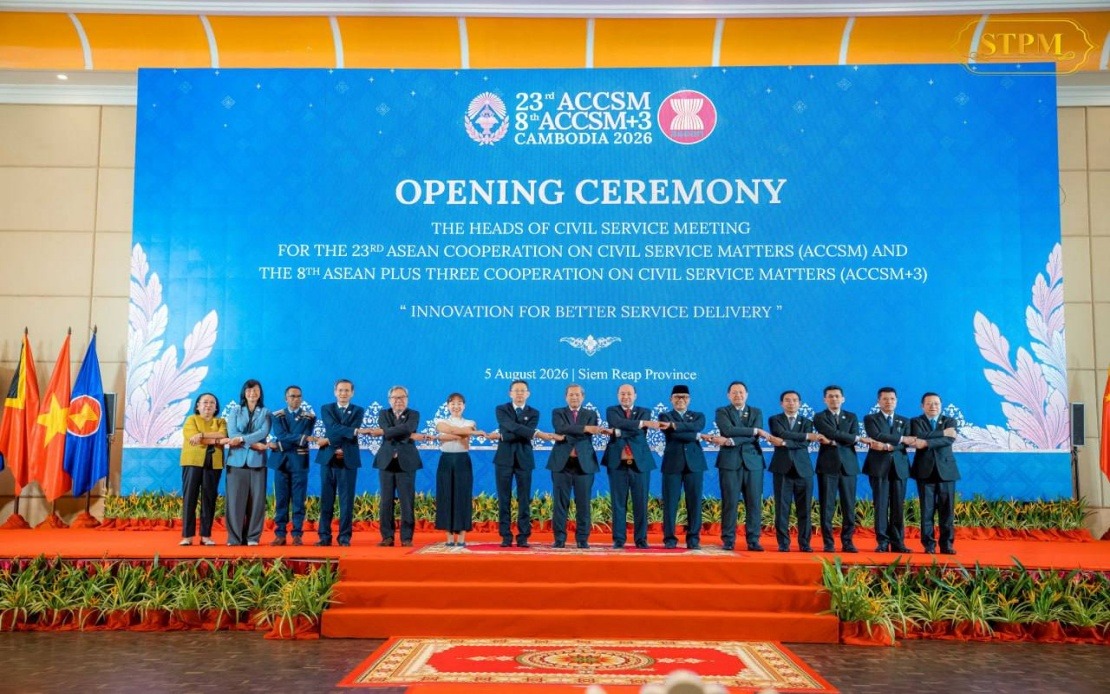
Cambodian Prime Minister Hun Manet has called on ASEAN member states to leverage artificial intelligence and digital innovation as tools for delivering superior public services that address citizens' immediate needs and help close development gaps within the bloc. Speaking at the 23rd ASEAN Cooperation on Civil Service Matters conference and its companion 8th ASEAN Plus Three gathering held in Siem Reap from August 3 to 5, Hun Manet stressed that technological advancement must serve a broader social purpose rather than become an end in itself.
The Cambodian leader's intervention reflects a growing recognition across Southeast Asia that digital transformation in government extends far beyond simply acquiring new systems or software. Instead, the focus must shift toward understanding what citizens actually require from their governments and ensuring that innovation serves those tangible demands. This distinction is crucial for a region where development remains uneven and where the capacity to implement cutting-edge technology varies significantly between wealthier and less-developed economies.
Hun Manet articulated a vision where innovation is anchored in solid institutional foundations and human capital development. He acknowledged that ASEAN comprises nations at vastly different stages of economic and technological maturity, creating both challenges and opportunities for collective advancement. Rather than expecting all members to adopt artificial intelligence at identical speeds, he advocated for a measured, sustainable approach tailored to each country's particular circumstances and absorptive capacity.
The emphasis on institutional capacity and human resources carries special weight for ASEAN. Many governments across the region have invested heavily in digital infrastructure yet struggle with implementation when skilled personnel remain scarce or when institutional structures prove inadequate to manage complex technological systems. Hun Manet's framing suggests that ASEAN nations must invest equally in training civil servants and strengthening bureaucratic processes alongside their technology rollouts.
More broadly, the Cambodian Prime Minister positioned innovation as essential to ASEAN's collective resilience in confronting shared regional challenges. Climate-related disasters, economic imbalances, poverty, and underdevelopment affect multiple member states simultaneously, yet individual countries often lack the resources or expertise to address these issues independently. By treating innovation as a platform for collaboration rather than competition, ASEAN could theoretically harness its combined intellectual and financial resources for mutual benefit.
Hun Manet's call for knowledge-sharing and harmonised policies reflects a persistent tension within ASEAN. While the bloc professes commitment to regional integration and cooperation, individual governments frequently prioritise national interests and maintain protectionist approaches to technology and data. Building genuine mechanisms for joint learning and capacity-building requires overcoming institutional inertia and political sensitivities that have long hampered deeper ASEAN integration.
For Malaysia and other middle-income Southeast Asian nations, Hun Manet's message carries particular relevance. These countries have begun digital transformation efforts but face the practical challenge of ensuring public services become genuinely citizen-centric rather than merely technology-heavy. The risk exists that governments invest in artificial intelligence applications that optimise back-office processes while failing to streamline frontline service delivery or enhance accessibility for ordinary people.
The ACCSM platform, which has operated for over two decades, represents ASEAN's primary institutional mechanism for civil service cooperation and reform sharing. By elevating innovation within this forum, Hun Manet positioned technological advancement as a core aspect of good governance rather than a peripheral administrative concern. This framing could encourage more substantive discussions about how member states actually implement digital initiatives and address the inevitable gaps between policy ambitions and on-the-ground reality.
Governments across the region are indeed accelerating their adoption of AI and digital technologies to modernise public administration, as Hun Manet noted. Ministries are introducing automated systems for licensing, taxation, and benefit distribution; courts are experimenting with digital case management; and health services are exploring telemedicine and data analytics. Yet these initiatives often proceed in isolation, with limited coordination across borders or learning from neighbours' experiences.
The sustainability dimension of Hun Manet's remarks deserves particular attention. Rapid technology adoption without corresponding attention to training, maintenance, and regular updating has left several developing countries with defunct systems and stranded investments. A sustainable pace acknowledges that implementation capacity is itself a finite resource and that rushing adoption creates risks of system failure, public frustration, and wasted expenditure.
Hun Manet's appeal for ACCSM to remain a vital platform suggests recognition that formal ASEAN institutions often function better when focused on practical professional networks rather than grand geopolitical designs. Civil servants dealing with identical challenges—pension system digitisation, public health data management, or anti-corruption oversight—may find more genuine common ground than diplomats negotiating abstract political principles.
The broader context of these remarks involves genuine regional anxiety about AI's governance implications. As artificial intelligence systems increasingly make or influence government decisions affecting citizens' lives, ASEAN nations face urgent questions about transparency, accountability, and equity. A coordinated regional approach to AI governance standards could prevent a race to the bottom where member states compete by loosening safeguards.
Ultimately, Hun Manet's message encapsulates an emerging consensus in Southeast Asia that technology alone cannot solve governance challenges; rather, human judgment, institutional strength, and inclusive decision-making must guide how and when innovation is deployed. For Malaysia and peer nations in ASEAN, this philosophy should inform technology investments and public service modernisation efforts for years ahead.

