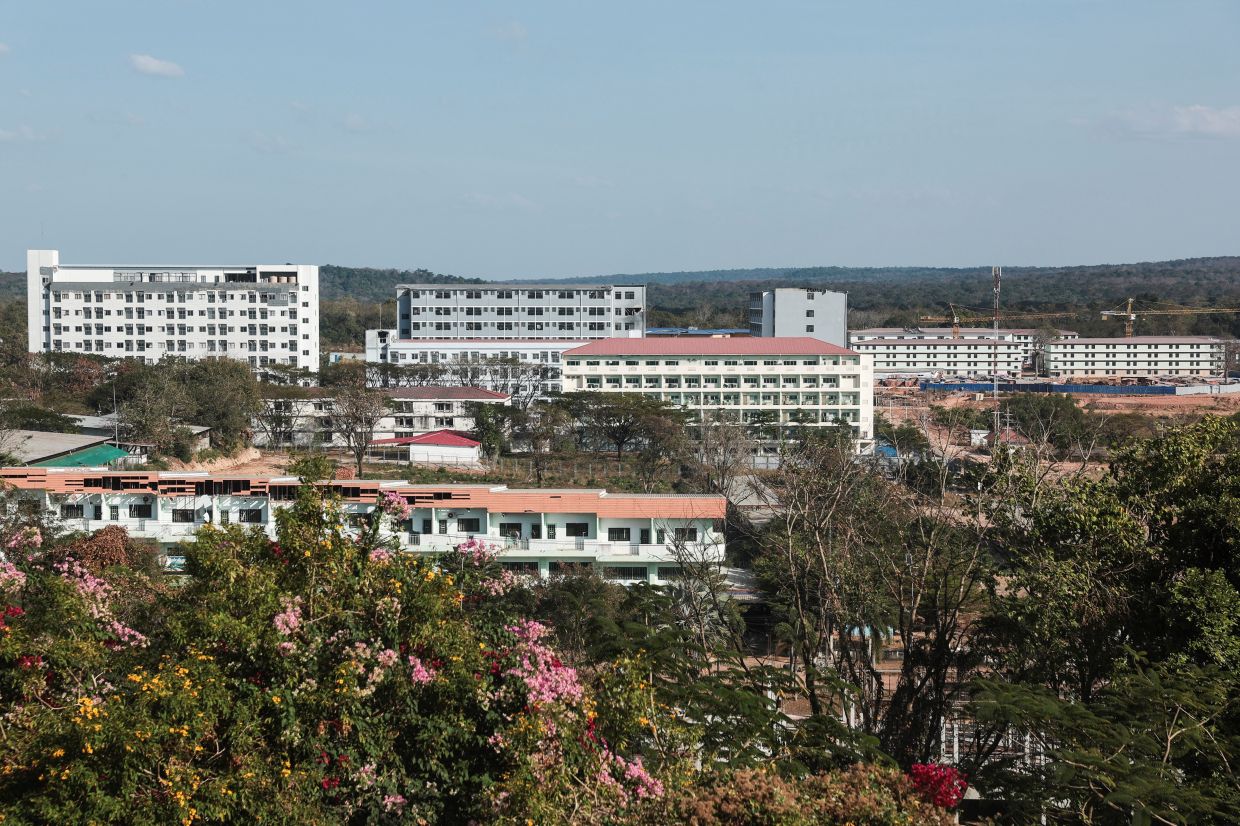
An investigation by Reuters has uncovered troubling connections between a powerful Cambodian business magnate and one of Southeast Asia's most notorious scam compounds, raising difficult questions about the region's ability to hold elites accountable for profiting from transnational crime. The gambling empire of Lim Heng leased out multiple structures at inflated rates from grounds adjoining its casino, the Royal Hill establishment located on the Thai-Cambodian border, where criminal syndicates orchestrated massive fraud and human trafficking schemes targeting victims worldwide. A rental agreement dated March 2024 demonstrates that the properties were rented at significantly above-market pricing, a detail that underscores the commercial nature of what authorities describe as a criminal enterprise.
The structures in question had been specially modified to create convincing facades of police stations and financial institutions from numerous countries, serving as elaborate backdrops for coordinated impersonation scams perpetrated against international victims. Investigators and individuals who worked at the compound have provided detailed accounts of the operation's scope and sophistication. Reuters journalists conducted on-site visits to the property in 2024 and interviewed Thai military personnel who described Chinese-led criminal gangs conducting scamming operations at the Royal Hill location. While investigators have found no direct evidence that Lim Heng Group participated directly in the trafficking or fraudulent schemes, the company's leasing arrangement meant it derived commercial benefit from premises where serious crimes occurred.
The revelation carries particular significance because it exposes the murky intersection between legitimate business and organized crime in Cambodia's casino sector. Lim Heng Group has not responded to multiple attempts by Reuters to seek comment on the matter, including phone calls, emails, and a registered postal inquiry. Similarly, Royal Hill's management declined to address questions regarding cyberscam and trafficking activities at the facility. Legal experts in Cambodia note that landlords of scam compounds can potentially face criminal charges if investigators determine that property owners possessed knowledge of criminal activities and permitted them to continue operating. The Cambodian Human Rights Action Coalition and Phnom Penh attorney Piseth Duch, who specializes in business and human rights matters, have both emphasized this legal principle.
The company appears to have become aware of trafficking allegations by September 2024, when representatives filed legal complaints against two Cambodian news publishers whose articles reported the presence of confined foreigners at the casino compound. The legal filings, dated September 16 and subsequently reviewed by Reuters, alleged "incitement to discrimination" but contained no specific reference to which claims in the original reporting the company objected to. One of the targeted publishers, Penn Nuon, confirmed receipt of the legal complaint and stated that his reporting had been accurate. He subsequently chose to remove the article after consulting legal counsel, seeking to resolve the matter. However, Reuters could not establish whether the complaint was ultimately dropped, and the Phnom Penh court where the filings occurred declined to provide information.
The broader context of Southeast Asian scam operations cannot be ignored when examining Lim Heng's potential complicity through property leasing. The region has become infamous as a manufacturing hub for fraud, where predominantly Chinese-led criminal organizations hold trafficking victims in brutal conditions and force them to perpetrate romance scams and police-impersonation frauds against targets across the globe. American victims alone lost an estimated US$10 billion to fraudsters operating from the region during 2024, according to calculations by the United States government. Many syndicate operators engaged in these schemes maintain simultaneous involvement with casinos, which provide convenient mechanisms for laundering illicit proceeds and obscuring the origins of criminal wealth. Jason Tower, a researcher with the Global Initiative against Transnational Organized Crime nonprofit organization, has emphasized this connection between gambling establishments and fraud infrastructure.
Cambodia's casino sector presents a particularly acute governance problem because ownership frequently concentrates among individuals with substantial political connections. Amnesty International's investigation, drawing on gambling regulator records and witness accounts, identified casino owners directly operating at least a dozen scam centers within Cambodia. Reuters has not independently verified these figures, but the pattern is evident. Sophal Ear, a professor at Arizona State University specializing in Cambodian politics, has noted that the kingdom's casinos are systematically controlled by businesspeople maintaining intimate ties with the ruling elite. Lim Heng exemplifies this pattern: he has been photographed attending social functions alongside senior military generals, holds a royal title equivalent to a European duchy, and donated US$20,000 to Cambodia's military apparatus last year, a contribution documented by a business association listing him as a member.
The Royal Hill facility itself presents a striking contrast between official government claims and documented reality. The Cambodian authorities have persistently described the compound as merely a hotel operation, even as international media outlets broadcast images of fabricated police stations and fake bank offices recovered from the site during 2024. This discrepancy raises uncomfortable questions about either the competence or the willingness of Cambodian officials to confront the problem. The Royal Thai Police, specifically General Thatchai Pitaneelaboot, have stated publicly that Chinese gangsters perpetrated scams at the Royal Hill location without elaborating on the perpetrators' identities. Thai security agencies have prepared multiple reports during 2024 establishing Lim Heng's ownership of the site, documents that Reuters obtained and reviewed.
Cambodia's government has made public commitments to dismantle scam centers and has taken some tangible steps in that direction. The kingdom extradited casino owner and alleged scamming kingpin Chen Zhi to China and enacted legislation specifically targeting scam operators. Chhay Sinarith, a senior Cambodian minister responsible for combating online fraud, responded to Reuters inquiries by emphasizing the government's commitment to international cooperation against scams. He acknowledged that Cambodia was investigating alleged fraud operations in the Royal Hill vicinity but suggested that Thai security forces should return control of seized locations to facilitate Cambodian investigations. However, the Thai military currently occupies the site following a brief December border conflict during which Thailand conducted airstrikes against Royal Hill, claiming that Cambodian forces had commandeered casino buildings for drone and sniper operations.
The physical structure of Royal Hill itself is notable: a deteriorating building featuring neoclassical architectural elements and gold-trimmed spires situated mere meters from the Thai border. The compound is surrounded by high fencing topped with razor wire enclosing multiple buildings, at least four of which were utilized for criminal activities according to Thai security officials and testimony from Pornpen Aimhun, a Thai woman who reported being trafficked to work at Royal Hill. Reuters obtained and reviewed the rental agreement between Royal Hill and a Chinese national, viewed at an office within one of the buildings that Thai military personnel identified as a location used by scam supervisors. The contract specified that Royal Hill would lease three buildings within its compound to the Chinese tenant for a two-year period at US$200,000 monthly. The document was signed by both the tenant and Seng Chanthy, identified as a Royal Hill employee at the time, though Seng Chanthy did not respond to requests for comment regarding the contract.
The monthly rental rate of US$200,000 for three buildings in a remote border town represents an extraordinary commercial premium that warrants scrutiny. For comparison, Reuters identified a mixed-use building in an upscale Phnom Penh neighborhood with dimensions comparable to the largest of the three Royal Hill structures, which was advertised for lease in May at only US$25,000 monthly. This eight-fold difference in pricing suggests that the rental arrangement reflected something other than standard commercial real estate valuation. Such pricing disparities typically indicate that the lessor either possessed specialized knowledge about the tenant's activities or that the premium reflected the value of discretion and lack of scrutiny. The inflated pricing provides circumstantial evidence of awareness regarding the buildings' intended criminal purpose, though such evidence may prove challenging to establish in legal proceedings.
The involvement of Thai military forces in exposing the compound adds another geopolitical dimension to the narrative. Thailand occupied the Royal Hill site after conducting military strikes during December border skirmishes with Cambodia, justifying the airstrikes by claiming that Cambodian forces had positioned drone and sniper teams within casino buildings. The Thai military subsequently invited Reuters journalists to the compound in February and March to document evidence that Royal Hill functioned as a scam facility, seeking to publicize the facility's true purpose. This unusual transparency from Thai military authorities contrasts sharply with official Cambodian government statements characterizing Royal Hill as a legitimate hotel operation.
The implications for Malaysia and the broader Southeast Asian region are substantial. The Lim Heng case demonstrates how scam infrastructure can flourish when powerful individuals possess the political insulation to lease properties to criminal operators without meaningful accountability. Malaysian authorities monitoring transnational organized crime should recognize that scam operations targeting Malaysian citizens and originating from within the region frequently possess connections to gambling establishments controlled by politically connected magnates. The investigation also illustrates how limited cooperation between national governments can allow criminals to operate with relative impunity, particularly in border zones where jurisdictional ambiguities and geopolitical tensions complicate enforcement efforts. For Malaysia, which has attempted to strengthen its own defenses against romance scams and police-impersonation fraud, the Royal Hill case provides cautionary evidence that the problem extends beyond individual criminals to encompass wealthy entrepreneurs who profit from providing infrastructure to traffickers and fraudsters.

