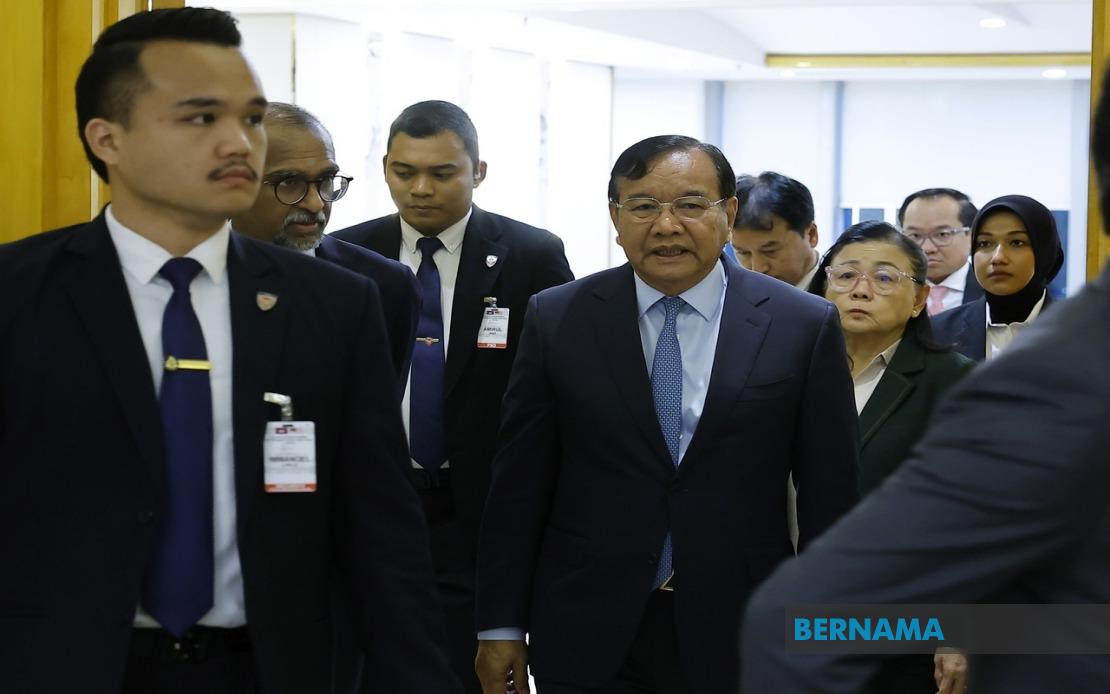
Cambodian Deputy Prime Minister and Foreign Affairs Minister Prak Sokhonn wrapped up his two-day official visit to Malaysia on Sunday, departing from Kuala Lumpur International Airport's Terminal 1 bound for Phnom Penh. The departure at 4.45 pm concluded a visit that underscored the strengthening partnership between the two Southeast Asian nations at a time when regional cooperation and economic integration are increasingly vital to the region's stability and prosperity.
Sokhonn's arrival in Malaysia on Monday was framed explicitly within the context of preparations for a significant diplomatic milestone: the 70th anniversary of formal relations between Kuala Lumpur and Phnom Penh, due to be celebrated in 2027. This forward-looking orientation signals that both governments are intent on leveraging their historical partnership as a foundation for deeper, more comprehensive engagement across multiple sectors. The timing of such commemorative preparations reflects a broader Southeast Asian tendency to use anniversary celebrations as catalysts for renewed commitment and structural reform within bilateral relationships.
A centrepiece of the visit occurred yesterday when Sokhonn made a courtesy call on Prime Minister Datuk Seri Anwar Ibrahim at the Prime Minister's Office. During this high-level engagement, both leaders discussed the trajectory of their bilateral relationship and identified priority areas for future cooperation. Their conversation encompassed digital economy transformation, artificial intelligence deployment, the rapidly expanding halal industry, food security challenges facing the region, and human capital development initiatives. These thematic areas reflect contemporary regional preoccupations: Southeast Asia's race to harness digital technologies and AI capabilities while maintaining food supply resilience in an uncertain global environment.
A particularly notable institutional achievement during the visit was the co-chaired 3rd Malaysia-Cambodia Joint Commission for Bilateral Cooperation (JCBC) Meeting, which Sokhonn conducted jointly with Malaysian Foreign Minister Datuk Seri Mohamad Hasan in Kuala Lumpur. The significance of this meeting extends beyond its formal agenda: the JCBC mechanism had lain dormant for two decades before this resurrection. This 20-year hiatus underscores how bilateral relationships can atrophy without sustained institutional engagement, and its resumption signals a deliberate effort by both governments to rebuild and formalize their cooperative structures. For Malaysia, the restoration of such mechanisms is strategically important, given the country's central role within ASEAN and its economic interests throughout Southeast Asia.
The economic dimensions of the Malaysia-Cambodia relationship have demonstrated remarkable momentum. In 2025, bilateral trade between the two countries surged 27.4 per cent year-on-year, reaching RM5 billion, equivalent to USD1.17 billion. This substantial growth trajectory indicates robust demand for Malaysian goods and services in Cambodia and suggests successful diversification of trade items beyond traditional sectors. Malaysian exports to Cambodia totalled RM4.13 billion (USD970 million), while Cambodian exports to Malaysia reached RM880 million (USD200 million), reflecting Malaysia's larger export footprint but also evidence of reciprocal trade flows.
Beyond trade, Malaysia's investment presence in Cambodia remains substantial and strategically important. As of 2024, Malaysia's cumulative foreign direct investment stock in Cambodia amounted to USD3.20 billion, encompassing 162 registered projects across various economic sectors. This investment position places Malaysia as Cambodia's third-largest foreign investor, a ranking that speaks to the confidence Malaysian companies maintain regarding Cambodia's investment climate and market opportunities. For Malaysian investors, Cambodia represents a lower-cost production base, access to ASEAN trade networks, and a growing consumer market, while Cambodia benefits from Malaysian capital, technology transfer, and management expertise.
The scale and composition of Malaysian investments in Cambodia reflect both the maturity of their economic relationship and the opportunities that remain underexploited. With 162 registered projects, Malaysian investors have diversified their presence across agriculture, manufacturing, tourism, telecommunications, and financial services sectors. This diversification provides some resilience against sector-specific downturns and allows both economies to develop complementary strengths. The resumption of the JCBC mechanism is likely to facilitate clearer policy frameworks for future investment and reduce bureaucratic friction for Malaysian firms operating in Cambodia.
From a regional perspective, the strengthening of Malaysia-Cambodia ties contributes to broader ASEAN cohesion at a time when the bloc faces external pressures and internal coordination challenges. The visit demonstrated that foundational bilateral relationships between ASEAN members continue to deepen, providing ballast against centrifugal forces that occasionally threaten regional unity. For Malaysia specifically, maintaining robust ties with all ASEAN partners, including Cambodia, reinforces its claim to regional leadership and ensures its voice carries weight in collective ASEAN deliberations on matters ranging from trade negotiations to security concerns.
The timing of the visit also carries implications for broader geopolitical alignments in Southeast Asia. Cambodia, while maintaining its historical relationships with China and Vietnam, has shown increasing interest in diversifying its international partnerships. Malaysia's engagement represents a non-great-power alternative for Cambodian policymakers, offering access to ASEAN platforms, Malaysian technical expertise, and investment opportunities without the strategic complications that sometimes accompany relationships with larger powers. Similarly, Malaysia's active outreach to all ASEAN neighbours reinforces its commitment to a rules-based, inclusive regional order.
Looking ahead to 2027 and the 70th anniversary of diplomatic relations, both governments appear committed to leveraging this milestone as a launching point for enhanced cooperation. The reinvigoration of the JCBC mechanism suggests that bilateral structures will become more active in coordinating policy, facilitating trade, and identifying new cooperation opportunities. Trade figures and investment statistics indicate that the relationship has substantial economic underpinnings that can support more ambitious collaborative initiatives. For Malaysian readers and businesses, the implications are clear: Cambodia represents an increasingly important market and investment destination, with government-level commitment to removing barriers and facilitating mutual prosperity.

