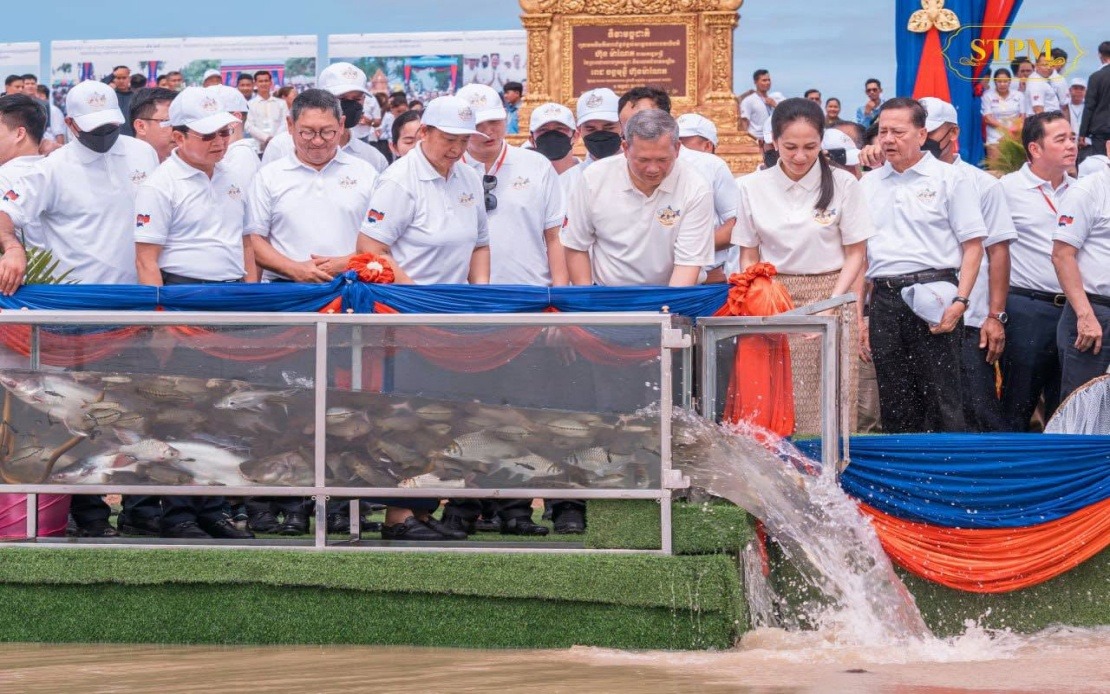
Prime Minister Hun Manet of Cambodia has instructed local authorities and military units to intensify operations against illegal fishing activities in crucial fish spawning zones, marking a significant shift in the government's approach to marine resource management. The directive came during the National Fish Day celebration held in Svay Rieng Province on Wednesday, underscoring the administration's commitment to tackling what it views as a critical threat to the nation's aquatic ecosystems and food security frameworks.
The Cambodian leader emphasised that protecting marine and freshwater resources during breeding seasons is essential for maintaining long-term sustainability of fish stocks. This concern extends beyond immediate conservation goals, touching upon the economic security of thousands of fishing communities scattered throughout the Kingdom whose survival depends directly on viable fish populations. Hun Manet framed the intervention as a necessity to prevent the collapse of a sector that underpins rural livelihoods across Cambodia.
In his remarks, Hun Manet revealed that military units deployed around the Tonle Sap lake have been engaged in combating natural resource crimes for the past two years, operating across both terrestrial and maritime domains. The Prime Minister acknowledged that this reliance on armed forces represents a temporary measure stemming from institutional gaps within Cambodia's law enforcement infrastructure. He articulated a longer-term vision in which specialised civilian agencies would gradually assume these responsibilities, reducing the military's involvement in what are fundamentally police functions.
The government's struggle to establish adequate natural resource enforcement capacity reflects broader challenges facing Southeast Asian nations grappling with organised resource theft and transnational environmental crime. Cambodia's resort to military deployment, while pragmatic in the short term, highlights the persistence of human and institutional resource constraints that many developing economies in the region face. Hun Manet's acknowledgment of this limitation suggests a forthcoming effort to build dedicated fisheries enforcement bodies, though timelines remain unclear.
Among the specific concerns flagged by the Prime Minister was the destructive practice of large-scale clam dredging, which he characterised as directly harming fishing communities by degrading marine habitats and reducing fish productivity. The government issued an immediate prohibition on such activities, demonstrating willingness to take action against commercially-driven extraction methods that prioritise short-term gains over ecosystem integrity. This reflects growing recognition across Southeast Asia of the connection between habitat destruction and fisheries collapse.
Hun Manet articulated a comprehensive vision for Cambodia's rural economy in which agriculture and fisheries operate as complementary pillars supporting national food security and nutritional adequacy. He described agriculture as the nation's stomach—a metaphor emphasising its role in providing calories and bulk sustenance—while positioning fisheries as the crucial protein source for Cambodia's predominantly rural population. This dual-sector framing acknowledges how heavily the Cambodian economy and food systems depend on primary industries vulnerable to both environmental degradation and criminal exploitation.
The symbolic aspect of the National Fish Day celebration included the release of 1.5 million fish and assorted aquatic species into the Vai Ko River in Svay Rieng Province. Such restocking initiatives serve multiple purposes: they represent tangible government action visible to local communities, demonstrate commitment to resource replenishment, and signal to fishing populations that authorities recognise their sector's importance. These releases, while modest relative to natural reproduction, carry political significance in territories where fishing remains a dominant livelihood.
For Malaysian and broader Southeast Asian observers, Cambodia's struggle against illegal fishing carries clear parallels and cautionary lessons. The region's shared waterways, including maritime boundaries and transnational rivers, create complex enforcement challenges that no single nation can address unilaterally. Cambodian fisheries crimes often involve actors from neighbouring countries, pointing toward the need for coordinated regional responses that remain underdeveloped across Southeast Asia.
The timing of Hun Manet's intervention reflects mounting international pressure on Southeast Asian governments to demonstrate environmental stewardship and sustainable resource management. Global seafood supply chains increasingly require certification that products derive from legal, sustainable sources, creating economic incentives for governments to combat illegal fishing. Cambodia's move, therefore, represents not purely domestic conservation interest but also positioning within international trade regimes that increasingly penalise nations unable to control their resource extraction.
The institutional challenges Hun Manet identified—inadequate specialised law enforcement—persist across much of Southeast Asia despite growing awareness of their consequences. Building capable, corruption-resistant fisheries enforcement agencies demands sustained investment, training, and political commitment that many regional governments struggle to maintain. Cambodia's frank acknowledgment of these gaps, combined with stated intention to overcome them, offers both a realistic assessment and a roadmap that other nations facing similar obstacles might consider.
Looking forward, the success of Hun Manet's enforcement initiative will depend upon consistent implementation, resource allocation, and willingness to confront powerful interests potentially benefiting from illegal fishing operations. Past environmental crackdowns across the region have frequently faltered when facing entrenched smuggling networks or politically-connected fishing operators. Whether Cambodia can sustain this campaign beyond the symbolic gestures and initial enforcement sweeps will ultimately determine whether its aquatic resources genuinely stabilise or continue deteriorating under pressure from illegal and unsustainable extraction.

