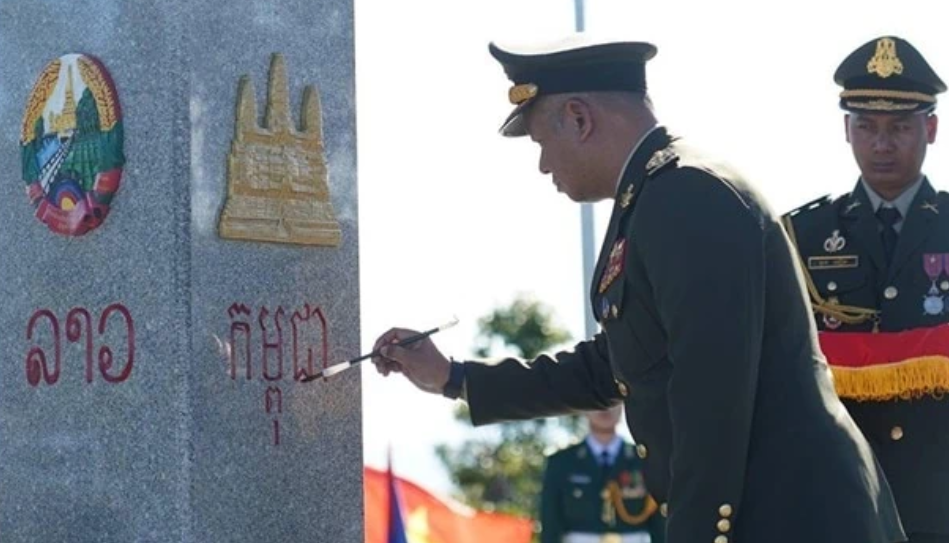
Cambodian Prime Minister Hun Manet has doubled down on plans to construct a direct road connection through Cambodian territory to the Dragon's Tail, a remote and strategically significant area where Cambodia, Laos and Vietnam converge at their shared borders. Speaking in Stung Treng province this week, Manet dismissed concerns about terrain difficulties and reaffirmed the government's commitment to linking the tri-border point directly to Cambodia's road network, arguing that geographical challenges cannot be used as justification for leaving the area isolated from the rest of the kingdom.
The initiative centres on the planned Route 78½, a proposed thoroughfare that would extend from Banlung in Ratanakiri province towards Cambodia's remote northeastern extremity. Currently, residents of the Dragon's Tail region face significant logistical barriers when attempting to travel within their own country, with many journeys requiring passage through Vietnamese territory due to Cambodia's lack of adequate road infrastructure in the area. Manet's insistence on establishing a purely Cambodian access route reflects broader concerns about territorial access and control, positioning the infrastructure project as more than merely a development initiative.
The prime minister employed vivid metaphors to illustrate his vision for northeastern Cambodia's future, likening roads to blood vessels that nourish and energize previously dormant regions. In his framing, connectivity serves multiple interlocking purposes simultaneously: enabling economic activity, attracting settlement and investment, opening isolated territories to broader development, and—crucially—strengthening the state's capacity to exercise effective authority over its border regions. This multifunctional understanding of infrastructure reveals how Cambodia views the project as integral to reasserting governmental presence and control in areas that have historically remained marginal to national economic and administrative systems.
The northeastern provinces targeted by this development push—Stung Treng, Ratanakiri, Mondulkiri and Kratie—have long been among Cambodia's most economically underdeveloped regions, their remoteness compounded by the legacy of civil conflict that devastated the country through 1998. For decades, these territories have struggled with inadequate connectivity to core markets and administrative centres, a condition that Manet's infrastructure agenda seeks to remedy. The symbolic resonance of the Dragon's Tail project extends beyond practical transportation concerns; it represents an attempt to demonstrate that Cambodia can and will exercise full sovereignty over every inch of its territory, a message with particular relevance given regional geopolitical sensitivities.
Manet's intervention on this issue arrives amid the aftermath of Cambodia's formal withdrawal from the Cambodia-Laos-Vietnam Development Triangle Area (CLV-DTA) in September 2024, a trilateral cooperation framework that had operated since 1999. The CLV-DTA originally encompassed 13 provinces across the three nations—four in Cambodia, four in Laos and five in Vietnam—and was designed to foster integrated development, improve cross-border trade, and raise living standards in remote border communities. Cambodia's exit from this arrangement followed intense public controversy and street protests, with critics arguing that participation in the framework posed risks to Cambodian territorial integrity and raised concerns about the country's relationship with its larger Vietnamese neighbour.
Government officials, including Manet himself, had repeatedly and forcefully rejected allegations that CLV-DTA participation threatened Cambodia's sovereignty or territorial holdings. Nevertheless, public anxiety about the framework persisted, reflecting deeper historical concerns about Cambodia's vulnerability to stronger neighbours and traditional anxieties about Vietnamese influence in the border regions. By revisiting these controversies during his recent speech, Manet sought to reframe the debate around northeastern development, arguing that the imperative to improve the four provinces remains regardless of the CLV-DTA's existence or non-existence. In this narrative, Cambodia's withdrawal from the trilateral mechanism represents not a retreat from development but rather a reassertion of independent agency in deciding how and when to pursue regional progress.
The timing of Manet's infrastructure pronouncements carries strategic weight. By emphasizing unilateral road-building initiatives, the prime minister demonstrates that Cambodia possesses both the political will and practical capacity to develop its border regions according to its own vision and timeline, without requiring multilateral frameworks or foreign cooperation. This positioning reinforces nationalist sentiment while simultaneously signalling to domestic audiences and regional observers that the government takes territorial sovereignty and administrative control seriously. For Malaysia and other Southeast Asian nations monitoring developments in the Mekong region, Cambodia's emphasis on independent infrastructure development suggests a recalibration of relationships and priorities within the broader subregional framework.
The concept of using infrastructure to establish territorial presence reflects a well-established principle in geopolitics whereby states use physical development projects to affirm and consolidate control over peripheral and border regions. Roads, in particular, facilitate not only commerce but also governmental authority, enabling tax collection, military deployment, administrative reach and security surveillance. Manet's metaphorical comparison of roads to blood vessels that bring nourishment and life to previously isolated areas masks a more fundamental reality: that improved access allows the central state to extend its administrative and coercive apparatus into regions that might otherwise enjoy considerable autonomy or vulnerability to external influence. In Cambodia's context, where border areas have historically been subject to competing interests and complex cross-border relationships, this project represents an attempt to entrench national sovereignty through physical infrastructure.
The broader development agenda for Cambodia's northeast also reflects economic calculations. The region possesses significant natural resources, including timber and minerals, and offers potential for agricultural expansion and ecotourism development. By improving road access, the government can facilitate resource extraction, enable private investment, and integrate these provinces more fully into national and regional supply chains. This economic dimension complements the sovereignty concerns, suggesting that Manet's government views northeastern development as simultaneously serving national assertion, state capacity-building and material prosperity objectives. For Myanmar, Thailand, Laos and Vietnam as well as Malaysia, Cambodia's infrastructural push in border regions may signal broader aspirations to become a more economically integrated and territorially consolidated nation-state.
The Dragon's Tail road project, though primarily a Cambodian initiative, carries implications for regional infrastructure connectivity and cross-border cooperation. If completed, Route 78½ would enhance transportation networks in Southeast Asia's most remote tripoint area, potentially facilitating not only Cambodian development but also regional trade and movement. However, the project's framing—as a sovereign reassertion rather than a collaborative initiative—suggests that Cambodia may be pursuing a more nationalist and independent development trajectory than during earlier periods of regional multilateral cooperation. This shift reflects both the CLV-DTA withdrawal and broader regional dynamics in which individual nation-states increasingly prioritize autonomous development paths over integrated frameworks.
Looking forward, the success or failure of the Route 78½ project will test Cambodia's institutional capacity and financial resources. Major infrastructure in remote, difficult terrain requires substantial investment, technical expertise and sustained political commitment. Whether Manet's government can mobilize the necessary resources and maintain momentum over multiple budget cycles remains uncertain. Nevertheless, the symbolic importance of the initiative extends beyond its immediate economic impact; it represents Cambodia's determination to exercise full territorial sovereignty and to ensure that no part of its national territory remains inaccessible or dependent on foreign passage. For regional observers, including policymakers in Malaysia, the project serves as a telling indicator of how Cambodia balances development aspirations with sovereignty concerns in a complex geopolitical environment.

