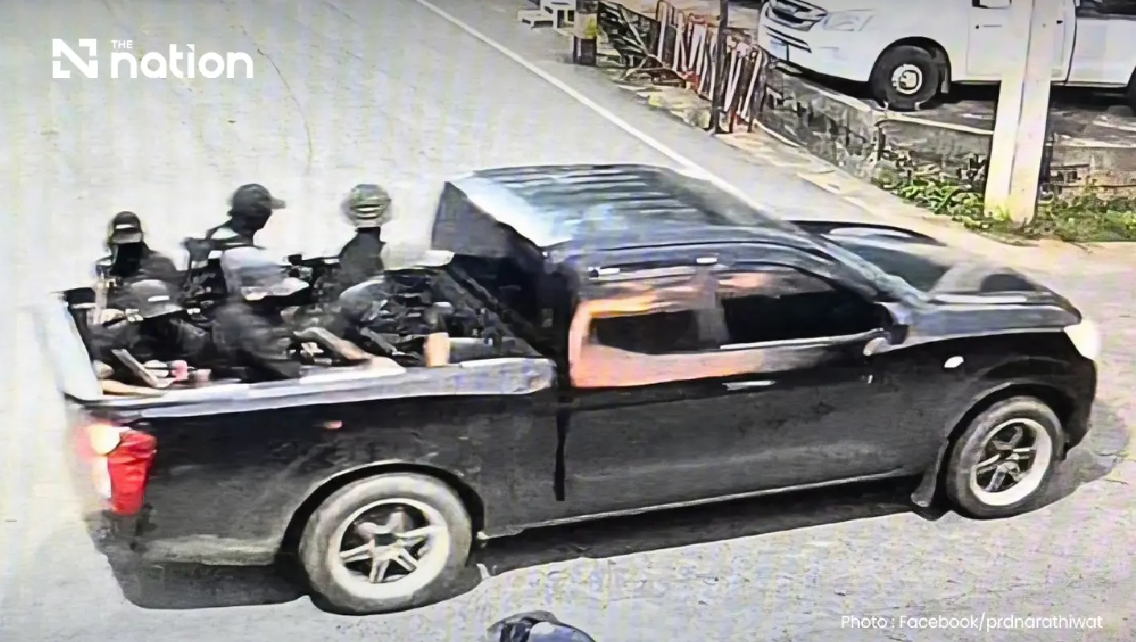
Security camera footage has provided a detailed account of how nine attackers executed a meticulously coordinated assault on the Bukeh Sami checkpoint in Narathiwat's Ra-ngae district, resulting in the deaths of five paramilitary rangers and injuries to six civilians. The incident unfolded in roughly 90 seconds on the evening of Wednesday, July 22, at approximately 6.45pm at the facility in Village 7 of Tanyong Mat subdistrict, which was staffed by members of the 4509th Ranger Company under the 45th Ranger Regiment Task Force.
Initial investigations suggested that six individuals were responsible for the strike, but video evidence from multiple cameras positioned around and across from the checkpoint later revealed the true scale of the operation. The assault involved two distinct teams functioning in coordinated fashion, demonstrating a level of planning and organization that distinguished this attack from spontaneous security incidents. The primary assault force consisted of seven heavily armed personnel travelling in a black Nissan pickup truck bearing a Songkhla registration plate numbered ผน 6866. The vehicle's occupants wore black clothing styled to resemble paramilitary fatigues and broad-brimmed hats that obscured much of their faces from surveillance equipment.
The secondary element of the attack force travelled on a red-and-white Honda Wave motorcycle, which served as rear security and fire support during the operation. The motorcycle's registration plate was obscured in the footage, complicating identification efforts. The rider wore conventional civilian attire including a white shirt and helmet, but carried an 11mm pistol, while his passenger adopted a distinctive disguise—a black women's hijab—while handling an AK-type rifle. This two-pronged approach allowed the attackers to maximize their firepower while the motorcycle provided tactical flexibility and escape route security as the convoy approached from the direction of Tanyong Mat market.
The assault itself commenced when the pickup slowed as it neared the checkpoint's perimeter. Three rangers stationed at the roadside guard post immediately became the first targets. Gunfire erupted from the vehicle's cargo area, with the attackers deploying M16 and AK-type rifles in a concentrated volley that fatally wounded all three officers at the initial position. Following this opening salvo, several assault team members dismounted from the pickup and maintained aggressive fire towards the main checkpoint structure and its fortified bunker, where two additional ranger personnel were sheltering. This two-stage approach—initial perimeter elimination followed by suppressive fire against hardened positions—reflected a tactical sophistication that suggested professional military or insurgent training.
Once the checkpoint had been overwhelmed, the assault team systematically searched the facility and its surroundings, taking weapons, ammunition, and equipment before withdrawing. As the group retreated toward their vehicles, one attacker hurled a pipe bomb toward an elevated structure positioned near a bridge adjacent to the checkpoint, inflicting additional damage and potentially attempting to hamper pursuit efforts. The coordinated withdrawal proceeded rapidly, with the pickup truck and supporting motorcycle departing the scene in the direction of Dusongyo subdistrict, also within Ra-ngae district. All five rangers—identified as Sergeant Major First Class Theerayut Somakerd, ranger volunteers Sakiriya Jena, Wimon Dabthong, Nattasit Kaewsena, and Salahuding Pi—were pronounced dead at the scene.
The civilian casualties comprised six individuals, including a child of approximately ten years old, all of whom required medical treatment at regional hospitals. Early reporting proved inconsistent regarding civilian injury figures, initially ranging from two to five before the final confirmed total of six emerged. This discrepancy underscored the chaos and confusion in the immediate aftermath of such operations and the challenges faced by security forces in rapidly assembling accurate information during active incidents.
The investigation that followed represented a significant coordinated effort among Thailand's security apparatus. Narathiwat Governor Boonchuay Homyamyen oversaw the scene examination alongside senior representatives from the Provincial Police Region 9 office, which was headed by commissioner Pol Lt Gen Piyawat Chalermsri. Narathiwat's provincial police chief Pol Maj Gen Prayong Khot Sakha and Col Witthaya Sariya, commander of the 45th Ranger Regiment Task Force, coordinated the comprehensive overnight forensic operation. Specialized teams including bomb-disposal experts, tactical police units, and forensic personnel worked through the night collecting and cataloging evidence.
The physical evidence recovered at the scene painted a picture of an operation involving sustained and intensive gunfire. Over one hundred spent cartridge cases were scattered across the road surface, originating from M16 rifles, AK-variant weapons, and an 11mm pistol—correlating directly with the weapons identified in the surveillance footage. Investigators also discovered ammunition casings that appeared to result from the attackers clearing weapon malfunctions during the assault, a revealing detail suggesting that despite their apparent training, the assault team encountered mechanical difficulties during combat. The bunker structure bore extensive bullet scarring across its walls and protective surfaces, testimony to the volume and concentration of fire directed at that position.
The attackers secured an arsenal of weapons and protective equipment during their raid. Four AK-type rifles featuring folding stocks were removed from the checkpoint, along with a single 11mm pistol and four ammunition magazines. Four bulletproof vests also disappeared during the looting phase of the operation. Authorities found the task of reconstructing a complete inventory challenging, as initial reports from checkpoint personnel contained conflicting information about both quantities and specific weapon classifications, a circumstance not uncommon in the immediate aftermath of violent incidents when survivors provide accounts under severe stress.
The suspected getaway vehicle—the black Nissan pickup truck—was later discovered abandoned and extensively burned, indicating a deliberate attempt to destroy forensic evidence and eliminate the vehicle's identificational trail. This destruction of the primary transport asset suggested that the attackers possessed sufficient resources and planning to arrange alternative extraction methods, or that they anticipated apprehension and chose to eliminate one avenue of investigation. Security forces responded by establishing checkpoints and roadblocks along probable escape corridors throughout the region immediately following the assault, though the timing and scale of this response determined whether the attackers could exploit their initial advantage and escape before perimeter security consolidated.
The attack underscores the persistent security challenges facing Thailand's troubled southern border region, where insurgent and militant groups continue to demonstrate capability for planning and executing complex operations against military and paramilitary targets. The coordination between ground assault teams and supporting elements, the apparent operational training evident in tactical approach and withdrawal procedures, and the sophistication of disguise and cover arrangements all suggest an adversary capable of sophisticated planning. For regional observers including Malaysia and other Southeast Asian nations, such incidents illustrate the transnational security implications of unresolved conflict in southern Thailand and the potential for militant networks to maintain operational capacity despite ongoing military and police operations.

