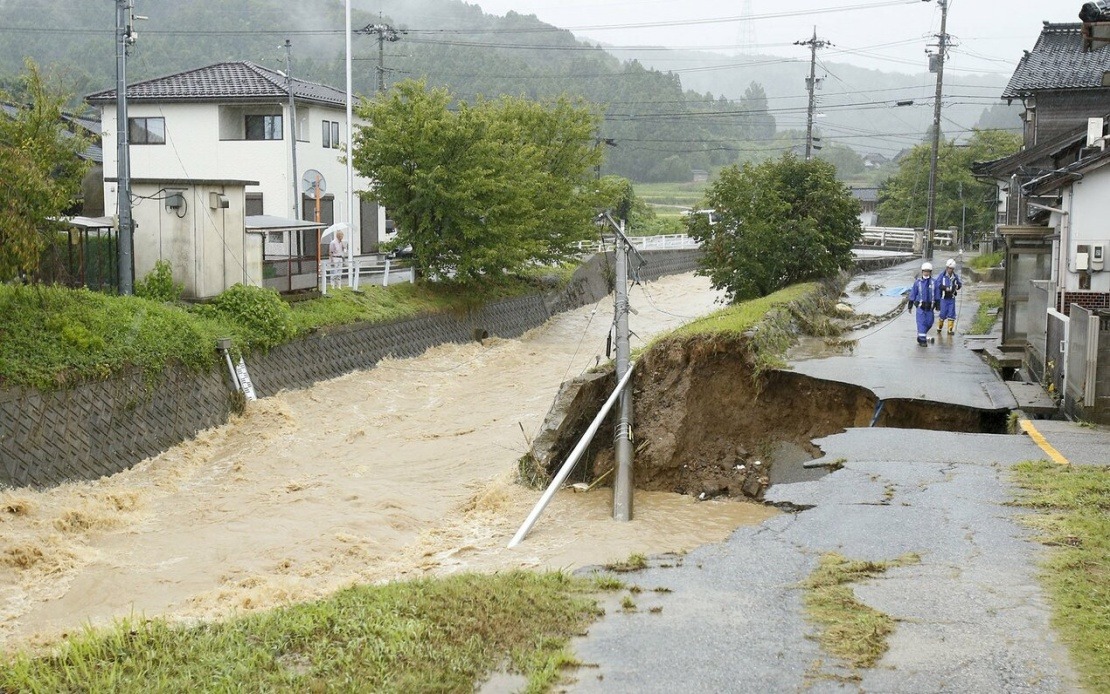
Central Japan experienced a severe weather catastrophe on Thursday as intense rainfall triggered the nation's most critical alert level, prompting widespread evacuation orders and rescue operations across multiple municipalities. The Japan Meteorological Agency deployed Level 5 warnings—its most severe classification indicating that disaster has either already struck or is imminent—to several areas in Ishikawa and Toyama prefectures as conditions deteriorated rapidly throughout the day.
The affected regions included Himi in Toyama Prefecture and the municipalities of Hakui, Shika, Hodatsushimizu and Nakanoto in Ishikawa Prefecture, where approximately 180,000 residents faced evacuation directives. Local authorities implemented immediate safety protocols to protect populations from life-threatening conditions, including mandatory evacuation notices and guidance to remain alert for potential landslides. The scale of the displacement underscores the severity of the meteorological threat engulfing these communities.
Rainfall intensity reached unprecedented levels in several areas within a twelve-hour window ending at 7:20 am, with Himi and Hakui recording over 300 millimetres, exceeding their historical records. Hodatsushimizu similarly experienced record-breaking precipitation exceeding 200 millimetres. These extraordinary measurements reflected atmospheric conditions of exceptional instability created by the convergence of a cold-air mass and a trough of low pressure, conditions the meteorological agency warned would persist throughout the region.
Physical devastation manifested immediately as the rainfall persisted. A firefighter in his 50s, stationed in Himi, reported to Kyodo News that rivers had breached their banks, with multiple vehicles submerged in floodwaters. Emergency responders fielded repeated distress calls from stranded motorists, though the Ishikawa prefectural government reported no confirmed fatalities as of Thursday evening, suggesting that evacuation measures and emergency response operations had prevented loss of life.
The meteorological front responsible for the catastrophic rainfall extended from the Sea of Japan eastward through northern and eastern Japan, with forecasters projecting its southward movement through Friday as conditions remained unstable. The Japan Meteorological Agency anticipated continued precipitation of up to 200 millimetres across the Hokuriku region and up to 150 millimetres in both the Kanto-Koshin and Tokai regions over the following twenty-four hours, suggesting that relief from the weather system would arrive gradually.
Neighbouring Niigata Prefecture also faced significant rainfall, placing additional strain on regional emergency management infrastructure already stretched by response operations in Toyama and Ishikawa. The concentration of extreme weather across such a densely populated corridor of central Japan challenged the capacity of local authorities to coordinate relief efforts and maintain public safety.
This disaster follows a similarly catastrophic weather event earlier in August when Level 5 warnings were issued in municipalities within Chiba Prefecture east of Tokyo. That episode resulted in thirteen fatalities and created scenes of urban flooding that immobilised approximately 2,500 vehicles at peak conditions, demonstrating the escalating frequency and intensity of extreme weather events confronting Japan. The recurrence of such severe conditions within a single month signals potential shifts in atmospheric patterns and raises concerns about climate resilience in densely populated regions.
For Malaysian and Southeast Asian observers, Japan's experience illuminates the mounting dangers posed by increasingly volatile weather systems across the broader Asia-Pacific region. Similar patterns of extreme precipitation have impacted Southeast Asia with growing regularity, overwhelming drainage infrastructure in urban centres and triggering devastating floods across multiple countries. Japan's sophisticated early warning systems and established evacuation protocols have prevented higher casualty figures, yet the unprecedented rainfall records and the necessity for mass displacement underscore the inadequacy of existing preparations even in technologically advanced nations.
The implications extend beyond immediate disaster response to longer-term urban planning and climate adaptation strategies. As extreme rainfall events become more frequent across East and Southeast Asia, authorities in Malaysia and neighbouring countries face urgent imperatives to strengthen meteorological monitoring capabilities, upgrade flood management infrastructure, and develop more robust evacuation frameworks. The Japanese experience demonstrates that even well-resourced nations struggle to fully mitigate such hazards, suggesting that Southeast Asian governments must substantially accelerate investment in resilience-building measures to protect their own vulnerable populations.

