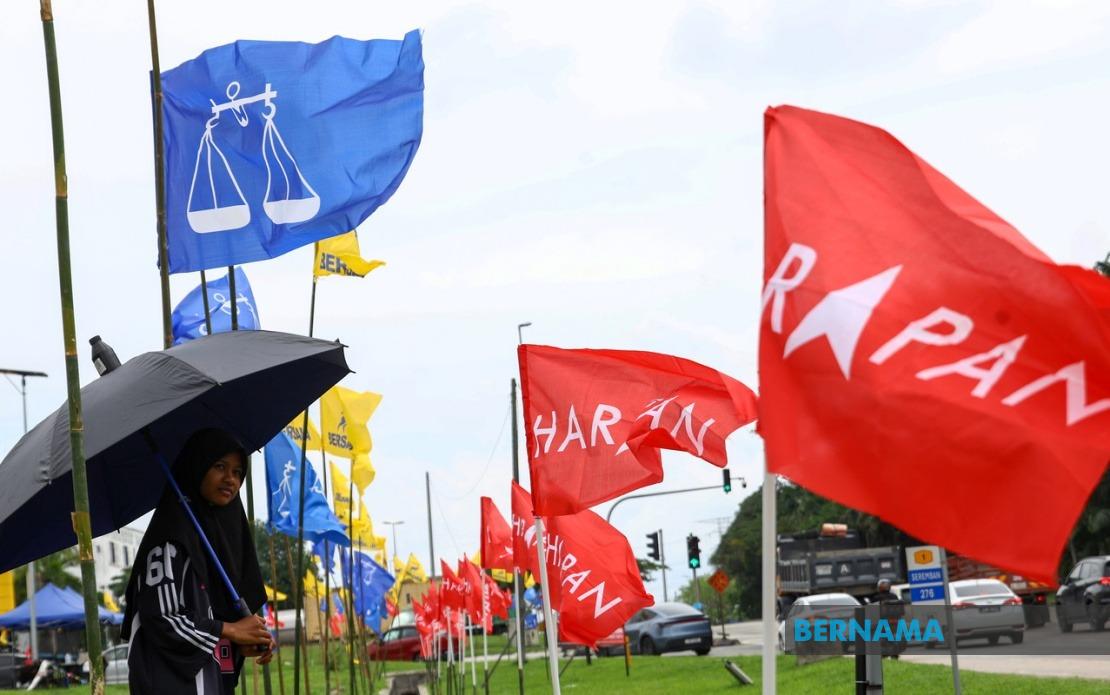
Pakatan Harapan's push for competitive representation in Johor hinges on a fundamental argument about democratic governance: that divided power ultimately strengthens institutional oversight and administrative accountability. At a DAP gathering in Kluang, Anthony Loke, the coalition's secretary-general, articulated this vision as PH enters the imminent state election with an ambitious slate of candidates spanning all 56 assembly seats. His remarks underscore a recurring anxiety among opposition-aligned figures that concentrated political control erodes the mechanisms through which citizens can hold governments responsible.
The framing of electoral competition as a safeguard against authoritarianism reflects broader debates across Malaysia's political landscape about what constitutes healthy democratic practice. Loke's contention—that governing coalitions without meaningful parliamentary opposition face diminished incentive to remain transparent or responsive—resonates with international scholarship on separation of powers and legislative effectiveness. When a single party or bloc commands overwhelming majorities, backbench dissent becomes muted, committee scrutiny weakens, and executive overreach becomes less costly politically. In Johor's context, where the Barisan Nasional-aligned Umno has historically maintained strong dominance, the notion of pluralistic competition carries particular weight.
PH's decision to contest every available seat represents a significant tactical commitment ahead of the July 11 polling date, with early voting scheduled for July 7. The coalition, which encompasses PKR, DAP, and Amanah, is effectively signalling confidence in its organizational capacity and popular appeal across diverse constituencies. This comprehensive approach differs markedly from strategies that focus resources on marginal or historically receptive areas. By distributing candidates uniformly across the state, PH simultaneously expands its narrative reach and generates baseline presence in even traditionally hostile terrain—a calculation that suggests faith in residual voter appetite for alternative governance.
The electoral landscape itself reflects Malaysia's gradual transition toward more competitive state-level contests. The Johor poll will see 172 candidates vying for 56 seats, indicating that multiple parties beyond the primary PH-BN axis are mounting campaigns. This fragmentation creates both opportunities and risks for opposition aspirations. While divided anti-establishment votes can inadvertently benefit ruling coalitions, robust multi-candidate races also force parties to articulate distinct policy platforms and engage more substantively with constituent concerns. The density of competition may paradoxically strengthen electoral legitimacy even if incumbent coalitions prevail.
For Malaysian observers tracking longer-term political trajectories, Johor represents a critical proving ground for several dynamics simultaneously. The state remains demographically and economically pivotal, and its electoral results carry symbolic weight for subsequent national calculations. A stronger-than-expected PH performance would vindicate grassroots organizing efforts in traditionally challenging terrain, whilst indicating shifting voter sentiment on governance priorities. Conversely, reinforced BN dominance would suggest that concerns about political concentration, while rhetorically potent, have not yet translated into decisive voter behavior in key states.
Loke's emphasis on preventing single-coalition dominance also implicitly addresses governance legitimacy concerns that have animated Malaysian political discourse since the 2018 general election. The argument proceeds from the premise that rotation in power, or at minimum substantial opposition presence, forces governments to maintain higher standards of conduct. Without external oversight pressure, administrations may accumulate unexamined practices, patronage networks, and institutional stagnation. This rationale underpins much opposition advocacy across Asia's electoral democracies, where competitive contestation is framed not merely as a matter of voter preference but as a structural prerequisite for functional governance.
The gathering in Kluang, attended by senior DAP figures including deputy national chairman Nga Kor Ming and deputy secretary-general Steven Sim Chee Keong, functioned as both campaign mobilization and ideological consolidation. By anchoring the electoral push to abstract principles of democratic health rather than merely to factional advantage, party leadership attempted to elevate campaign discourse above personality-driven or communal-interest framing. This rhetorical strategy acknowledges that Malaysian voters increasingly evaluate parties on institutional performance metrics alongside traditional bases of support.
For Southeast Asian observers, the Johor contest illustrates how subnational elections in federal systems become laboratories for testing opposition resilience and voter appetite for political diversification. The region's authoritarian and hybrid-regime states often feature dominant parties with superficially competitive elections, making genuinely contested state-level races increasingly valuable as indicators of underlying political sentiment. Johor's relative openness, within Malaysia's broader context of electoral fairness, permits clearer reading of voter preferences than many neighbouring jurisdictions allow.
The path to Johor's July 11 election will likely feature intensive grassroots canvassing and media contestation over governance narratives. PH's assertion that checks-and-balances require competitive representation provides intellectual scaffolding for its campaign messaging, distinguishing its push from purely anti-incumbent sentiment. Whether this framework resonates sufficiently with voters to translate into seat gains remains the fundamental question animating the state's political calendar. The comprehensiveness of PH's candidate deployment suggests organizational conviction, even if electoral outcomes remain contingent on voter turnout, campaign effectiveness, and demographic shifts.
Ultimately, Loke's comments reflect a governance philosophy increasingly common among Asian opposition movements: that electoral competition itself constitutes a public good, independently of which party prevails. This reasoning inverts traditional zero-sum perspectives on elections as mere instruments of factional advancement. Instead, it positions competitive contestation as protective infrastructure for democratic health, a framework that elevates the stakes of Johor's forthcoming poll beyond state-level patronage and into questions about Malaysia's longer-term political trajectory.

