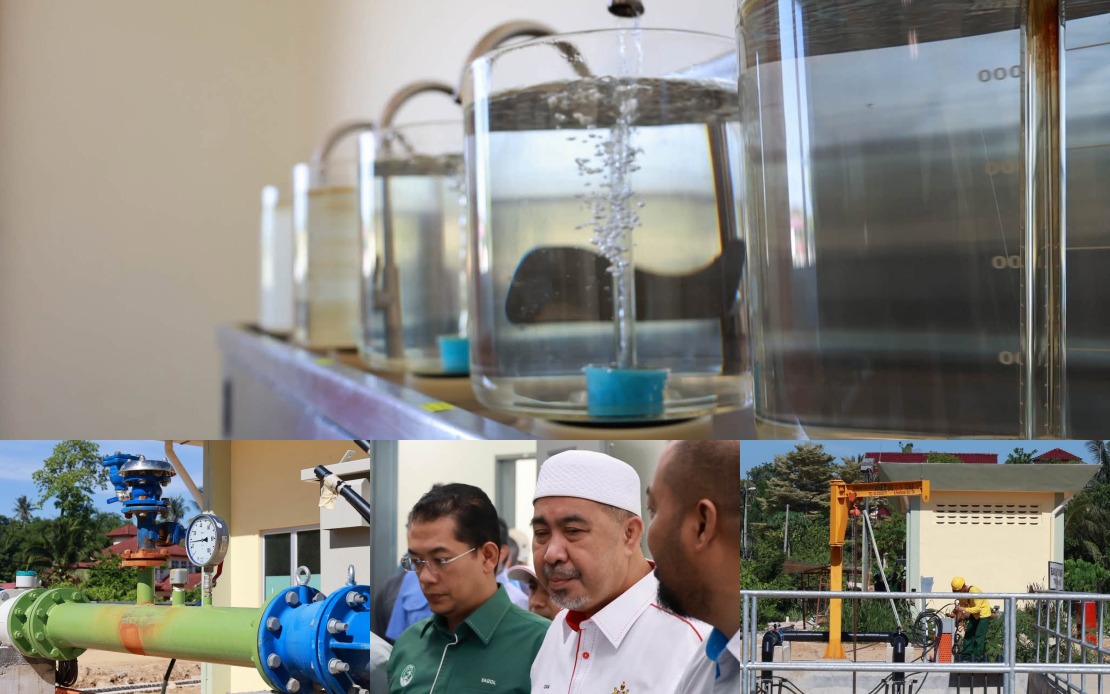
Kelantan's water infrastructure is about to receive a significant boost with the imminent opening of the Chicha 2 Water Treatment Plant in Pasir Hor, which is anticipated to commence operations in September and serve over 13,000 consumers across the region. The RM54.98 million facility, which broke ground in 2024, has reached 97 per cent completion according to Datuk Dr Izani Husin, chairman of the State Public Works, Infrastructure, Water and Rural Development Committee, who visited the construction site and spoke with reporters about the project's advancement.
The water treatment facility will be designed to handle a substantial daily production volume of 20 million litres, positioning it as a significant infrastructure asset for the state. Its service area encompasses five communities: Pasir Hor, Telipot, Kota Seribong, Mulong and Tunjong, each of which has experienced chronic water supply challenges typical of many rural and semi-rural regions across Malaysia. The plant's strategic location and capacity indicate that state authorities have invested considerable resources to address long-standing water accessibility concerns in this part of Kelantan.
A particularly noteworthy aspect of the Chicha 2 facility is its approach to water sourcing and treatment. The installation harnesses groundwater extracted from depths of up to 100 metres through a specialised excavation operation, which is then processed using an aeration system. This methodology ensures that water reaching consumer taps meets quality standards required for safe household and commercial use. The 1.84-hectare facility represents a modern approach to water management that taps into subsurface reserves rather than relying solely on surface water sources that may be subject to seasonal fluctuations or contamination.
One of the most significant impacts of the plant's opening will be the reactivation of approximately 10,000 consumer accounts that have remained inactive throughout the service areas. These dormant connections likely represent households and businesses that had disconnected from the water supply system due to inadequate service provision or prolonged interruptions. Once the Chicha 2 facility becomes operational, these accounts can be brought back online, dramatically expanding access to treated water and fundamentally altering the daily lives of thousands of residents who have previously struggled with water scarcity.
The aeration-based treatment technology deployed at Chicha 2 holds additional significance for Kelantan and potentially the broader region. Datuk Dr Izani highlighted that this method represents the first implementation of its kind within the state, suggesting that it offers advantages over conventional treatment approaches currently employed elsewhere in Kelantan. The successful operation of this facility could establish a template for future water treatment infrastructure projects, potentially reducing capital and operational costs while improving outcomes across multiple installations. This knowledge-transfer aspect of the project extends its value beyond the immediate service area.
However, the completion of Chicha 2 alone will not fully resolve Kelantan's persistent water supply difficulties. State authorities have articulated an ambitious timeline to comprehensively address water challenges by 2030 through a coordinated programme of infrastructure development and the establishment of additional treatment facilities. This phased approach acknowledges that water supply deficits in Kelantan are systemic and require sustained investment beyond any single project. The timeline signals a realistic assessment of the scale and complexity of infrastructure modernisation required across the state's water distribution networks.
Understanding the scale of Kelantan's water challenges requires examining the non-revenue water problem that currently plagues the system. The state currently experiences water loss rates exceeding 50 per cent, meaning that more than half of treated water never reaches paying consumers but is lost through various inefficiencies. This extraordinarily high loss rate, far exceeding levels considered acceptable in developed water systems, stems from multiple converging problems. Ageing pipe networks with significant leakage, sudden pipe ruptures occurring underground, and defective water meters that fail to register consumption all contribute to these losses, creating a vicious cycle where limited treatment capacity is further constrained by wastage.
The underlying infrastructure crisis reflects decades of deferred maintenance and inadequate investment in water system renewal. Many pipes serving Kelantan's communities date back several decades and were never designed to handle current demand levels or to operate in contemporary environmental conditions. Replacing this aging network requires not only substantial financial resources but also careful planning to minimise service disruptions during rehabilitation work. The phased approach outlined by state authorities reflects this complexity, as simultaneous replacement of all aging pipes would create widespread outages that would further frustrate residents already accustomed to water supply instability.
Reducing non-revenue water from its current catastrophic levels to internationally acceptable benchmarks of around 15 per cent would require comprehensive intervention across multiple fronts. Pipeline replacement programmes must proceed in parallel with meter modernisation and systematic leak detection programmes that locate and repair breaks before they become major ruptures. Chicha 2 and its companion projects represent essential components of this broader strategy, but cannot succeed without concurrent efforts to minimise wastage throughout the distribution network. The state's 2030 target implicitly acknowledges that this transformation will require sustained effort and investment over the next several years.
For Malaysian consumers across other states facing similar water supply challenges, Kelantan's experience and the Chicha 2 project offer both cautionary lessons and potential solutions. The state's difficulties underscore how water security cannot be assumed even in regions with reasonable rainfall, as systemic infrastructure failures can create artificial scarcity. Conversely, the commitment to expanding treatment capacity and modernising distribution networks demonstrates that water challenges, however severe, can be addressed through sustained investment and strategic planning. The aeration technology being pioneered at Chicha 2 may offer cost-effective alternatives to more complex treatment methods, potentially benefiting other states with similar groundwater-dependent systems.
State authorities have appealed for public patience as the phased implementation of water infrastructure improvements unfolds across Kelantan. This plea reflects acknowledgment that improvements will not be instantaneous and that residents will continue experiencing occasional supply constraints during the transition period. However, the September opening of Chicha 2 represents tangible progress toward comprehensive resolution of challenges that have affected water security for countless Kelantan residents. The project's near-completion and the state's broader infrastructure vision suggest that the decades of chronic water supply problems that have characterised the region may finally be entering a period of sustained improvement.

