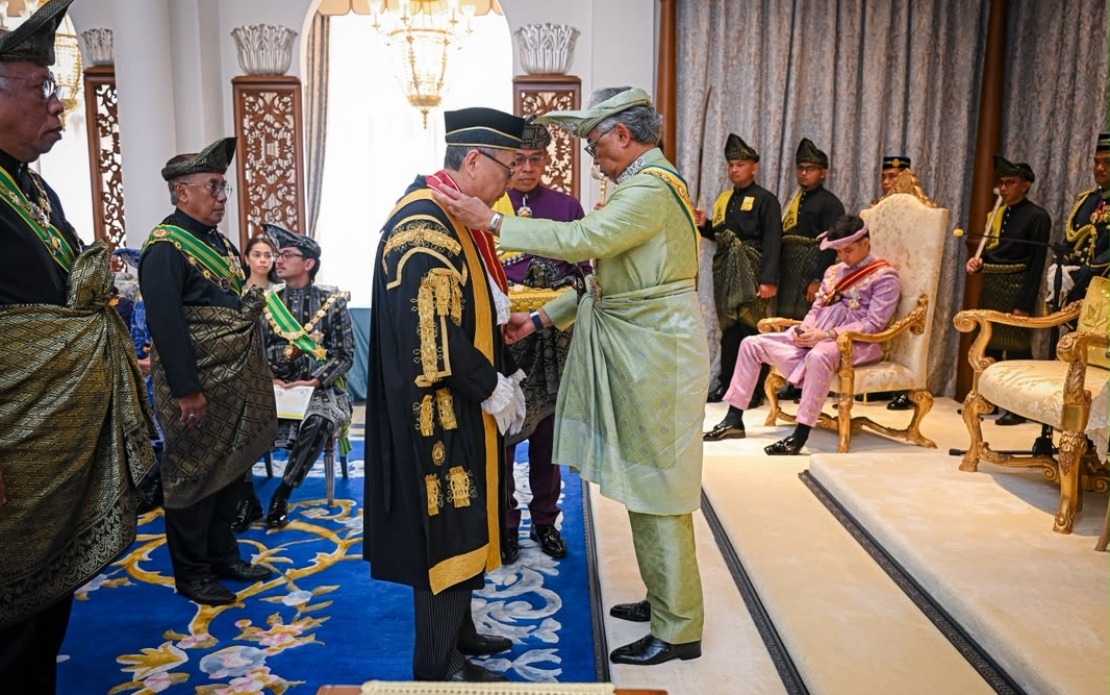
Fifty-two individuals, ranging from top judicial officers to military commanders and cultural figures, were recognised for their contributions to Pahang at a state investiture ceremony held in Kuantan on Thursday. Chief Justice Tun Wan Ahmad Farid Wan Salleh topped the honours list, receiving the Sri Setia Al-Sultan Abdullah Ahmad Shah Pahang award and the title of Datuk Seri Setia. The ceremony, held at Balai Mahkota within Istana Abdulaziz, coincided with the 67th birthday celebration of Sultan Pahang Al-Sultan Abdullah Ri'ayatuddin Al-Mustafa Billah Shah, who personally presented the accolades to the recipients.
The investiture ceremony drew a distinguished gathering of state dignitaries, including the Tengku Ampuan of Pahang, Tunku Azizah Aminah Maimunah Iskandariah, and the Tengku Mahkota of Pahang, Tengku Hassanal Ibrahim Alam Shah. Pahang Menteri Besar Datuk Seri Wan Rosdy Wan Ismail and other senior state government officials were present to witness the proceedings. The ceremony reflected the constitutional monarchy's role in recognising public service and achievement within the state framework, a significant tradition within Malaysia's federal structure where each state maintains its own honours system.
The second-highest tier of awards, the Sri Sultan Ahmad Shah Pahang honour carrying the title of Datuk Seri, was conferred on 16 recipients who represent diverse sectors of national and state governance. Notable recipients in this category included Works Minister Datuk Seri Alexander Nanta Linggi and Dewan Rakyat Deputy Speaker Datuk Dr Ramli Mohd Nor, the Member of Parliament for Cameron Highlands. The inclusion of federal ministers and parliamentary officials alongside state figures demonstrates how Pahang's honours system recognises contributions that extend beyond state boundaries into national affairs.
Among other Datuk Seri recipients were key government functionaries such as Deputy Minister of Economy Datuk Mohd Shahar Abdullah, who also represents Paya Besar in Parliament, and Pahang Local Government, Housing, Environment and Green Technology Committee chairman Datuk Mohammad Fakhruddin Mohd Ariff. The distribution across economic and administrative portfolios reflects the state's recognition of institutional performance in critical governance areas. Such honours typically acknowledge not merely individual achievement but also the effectiveness of departments and agencies in serving public interests.
The honours ceremony prominently featured military and security sector recognition, underscoring the armed forces' significance to national stability. Army Chief General Tan Sri Azhan Md Othman received the Datuk Seri rank, as did Armed Forces Joint Forces Commander Lieutenant-General Datuk Tengku Muhammad Fauzi Tengku Ibrahim and Deputy Air Force Chief Lieutenant General Datuk Nur Hafis Abdul Karim. Air Education and Training Commander Lieutenant General Datuk Muhammad Tarminzi Mustapha also received recognition, alongside Royal Malaysian Customs Department Director-General Datuk Amran Ahmad. These recognitions span operational and strategic military echelons, suggesting state acknowledgement of defence sector contributions to national security.
Educational and religious institutions were similarly honoured through their senior leaders. International Islamic University Malaysia Rector Professor Emeritus Datuk Dr Osman Bakar and Universiti Tun Abdul Razak Chancellor Datuk Mohamed Nizam Abdul Razak received the Datuk Seri award, reflecting the state's valuation of higher education contributions. Pahang's Syariah Chief Judge Datuk Abdul Walid Abu Hassan was conferred the Datuk Indera title, representing judicial recognition within the Islamic legal framework. These appointments highlight how state honours extend recognition across secular and religious institutional domains.
Cultural and artistic contributions were acknowledged through the recognition of singer Datuk Sheila Majid, who received the Datuk Seri honour. Her inclusion among government officials and military officers underscores Malaysian cultural diplomacy's standing within state ceremonial frameworks. Entertainment and music figures receiving formal state recognition have historically played roles in cultural diplomacy and international representation, positioning such honours as recognition of soft power contributions beyond traditional governance metrics.
Commerce and trade sector recipients included Malaysia External Trade Development Corporation Chief Executive Officer Datuk Abu Bakar Yusof and Koperasi Serbausha Makmur Berhad Chairman Datuk Zamri Mohamed, both receiving the Sri Indera Mahkota Pahang honour with Datuk Indera titles. These recognitions acknowledge the state's economic development agenda and the role of trade promotion agencies in advancing business competitiveness. The inclusion of cooperative sector leadership reflects Malaysian emphasis on socioeconomic structures serving small and medium enterprises.
Emerging and specialist sectors received recognition through several recipients. Equestrian athlete and MFDM Holdings director Mohd Qabil Ambak Mahamad Fathil and national silat exponent Mohd Al-Jufferi Jamari both received the Darjah Indera Mahkota Pahang award. These recognitions span traditional Malaysian martial arts to contemporary equestrian sports, demonstrating state honours' capacity to recognise excellence across conventional and modern competitive domains. Fire and Rescue Department operations leadership also featured prominently, with Deputy Director-General Nordin Pauzi receiving formal recognition.
Administrative and public service contributions were extensively acknowledged across education, utilities, and local government sectors. Pahang Education Director Ahmad Zamri Md Isa and Tenaga Nasional Berhad Pahang General Manager Affendi Abdul Rahman received Darjah Indera Mahkota Pahang awards, recognising their roles in essential service delivery. Such recognitions reflect state government emphasis on institutional stability and the critical infrastructure supporting economic and social development within Pahang's jurisdiction.
The ceremony's structure, proceeding through hierarchically ranked awards from the highest Sri Setia honour downward through Datuk Seri, Datuk Indera, and Datuk categories, represents established Malaysian state honours protocols. Lower tiers including Setia Ahmad Shah Pahang, Setia Mahkota Pahang, and Ahli Ahmad Shah Pahang awards completed the recognition across five recipients in aggregate. This tiered approach reflects meritocratic principles within monarchical systems, where formal recognition quantity and prestige correlate with assessed contributions to state interests.
For Malaysian readers and Southeast Asian observers, Pahang's honours ceremony exemplifies how Malaysian states maintain institutional autonomy in recognising public contributions while remaining integrated within federal governance frameworks. The inclusion of federal appointees alongside state officials demonstrates federalism's operational reality, where state and national governance domains overlap substantially. Pahang, as one of Malaysia's larger and economically significant states, utilises honours ceremonies as mechanisms for reinforcing institutional coherence and acknowledging service contributions across defence, education, commerce, and culture sectors essential to contemporary state function.

