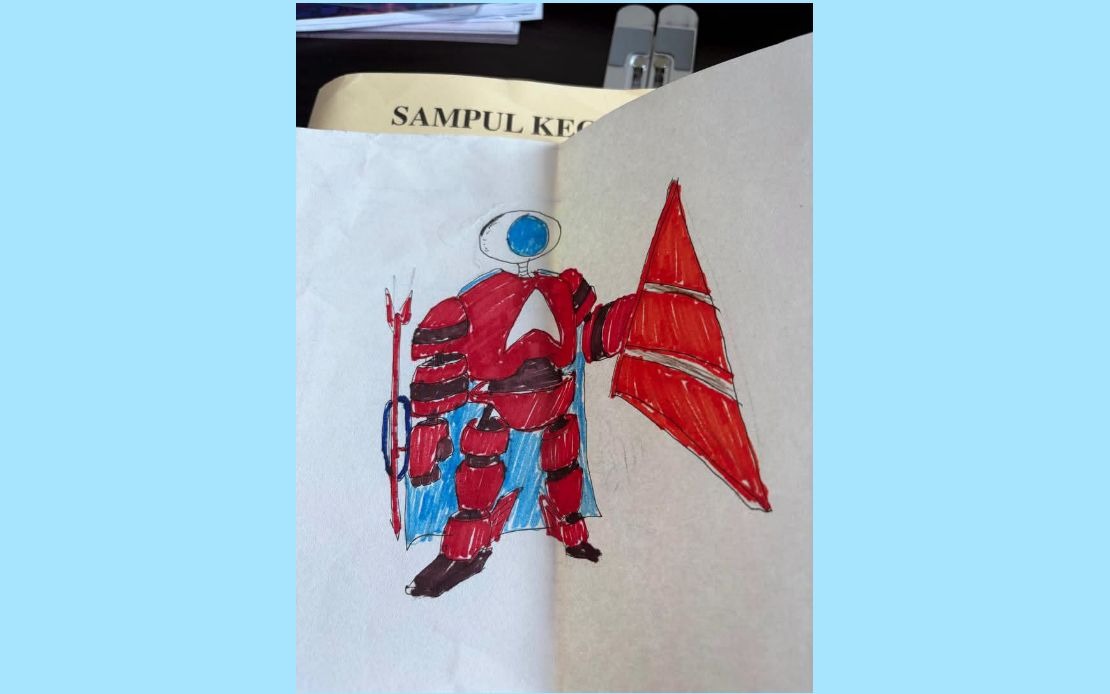
Prime Minister Datuk Seri Anwar Ibrahim has shared a touching moment from his recent community engagement in Negeri Sembilan, where a child with special needs presented him with a hand-drawn artwork that has since become a cherished memento. Taking to Facebook to express his gratitude, Anwar reflected on the significance of the gift, emphasizing how the encounter left a lasting impression on him and underscoring the value he places on direct interactions with Malaysians from all segments of society.
The artwork itself depicts a robot character rendered in red and blue armor, wielding what appears to be a staff-like implement in its left hand. While simple in execution, the drawing carries profound meaning for Anwar, who noted the circumstances under which it was presented—the child was being carried by his father during the Temu Anwar programme. This detail adds an additional layer of intimacy to the exchange, suggesting a moment of genuine human connection that transcended the formal nature of political engagement.
Temu Anwar represents a cornerstone initiative within the Prime Minister's broader strategy to maintain accessibility and foster dialogue with the Malaysian public. Conceived as a direct communication platform between the nation's leader and citizens spanning diverse demographics and backgrounds, these programmes aim to bridge the gap between government and rakyat through face-to-face encounters. The initiative reflects a commitment to grassroots engagement, allowing ordinary Malaysians—including families with children facing developmental challenges—to interact with the highest office in the land.
The posting of this personal moment on social media carries additional significance in contemporary politics. By publicly acknowledging the gift and expressing deep appreciation, Anwar humanizes his role as Prime Minister while simultaneously highlighting issues surrounding inclusion and representation of children with special needs. The gesture sends an implicit message about the government's recognition and respect for all citizens, regardless of ability status, and their rightful place within national discourse and community life.
For families navigating the complexities of raising children with special needs in Malaysia, such public acknowledgment can prove symbolically important. It validates their experiences and their children's inherent worth and capacity to contribute meaningfully to society, even through simple gestures like presenting a drawing. In a nation working progressively toward greater inclusivity, these moments of visible recognition from political leadership carry weight beyond the immediate interaction.
The Negeri Sembilan engagement that produced this memorable exchange forms part of a broader pattern of Anwar's public positioning since assuming office. His administration has increasingly emphasized direct engagement with constituents, seeking to cultivate an image of accessibility and responsiveness to public concerns. These Temu Anwar sessions have become regular fixtures, rotating through different states and drawing participants from varied socioeconomic backgrounds and age groups.
Anwar's decision to preserve and publicly commemorate this particular gift suggests his awareness of the symbolic power embedded in such interactions. In an era where political leadership is often criticized for distance from ordinary citizens' lived experiences, moments of genuine human connection—particularly involving vulnerable populations such as children with special needs—carry considerable political and social resonance. The artwork thus transcends its literal form to become a representation of inclusivity and human dignity.
The incident also illuminates the role of creative expression in child development, particularly among children with special needs. Art can serve as a powerful medium through which children communicate emotion, creativity, and connection when verbal expression may present challenges. That this child's artistic offering was recognized and valued by the nation's leader sends a message to parents, educators, and society more broadly about the legitimacy and importance of fostering creative outlets for all children.
Within the context of Southeast Asian politics, where hierarchical structures and formality often characterize interactions between political leadership and the public, Anwar's public embrace of this moment demonstrates a willingness to engage in behavior that prioritizes human connection over protocol. This approach may reflect broader generational shifts in how political leaders position themselves in relation to their constituencies, particularly in democracies where authenticity and relatability increasingly influence public perception.
The preservation of this drawing also raises implicit questions about how governments acknowledge and support families managing special needs care in Malaysia. While the symbolic gesture is meaningful, substantive questions about educational resources, healthcare accessibility, and social support systems remain pressing concerns for this demographic. Nevertheless, such visibility contributes to ongoing conversations about disability rights and inclusion policy within the country's political sphere.

