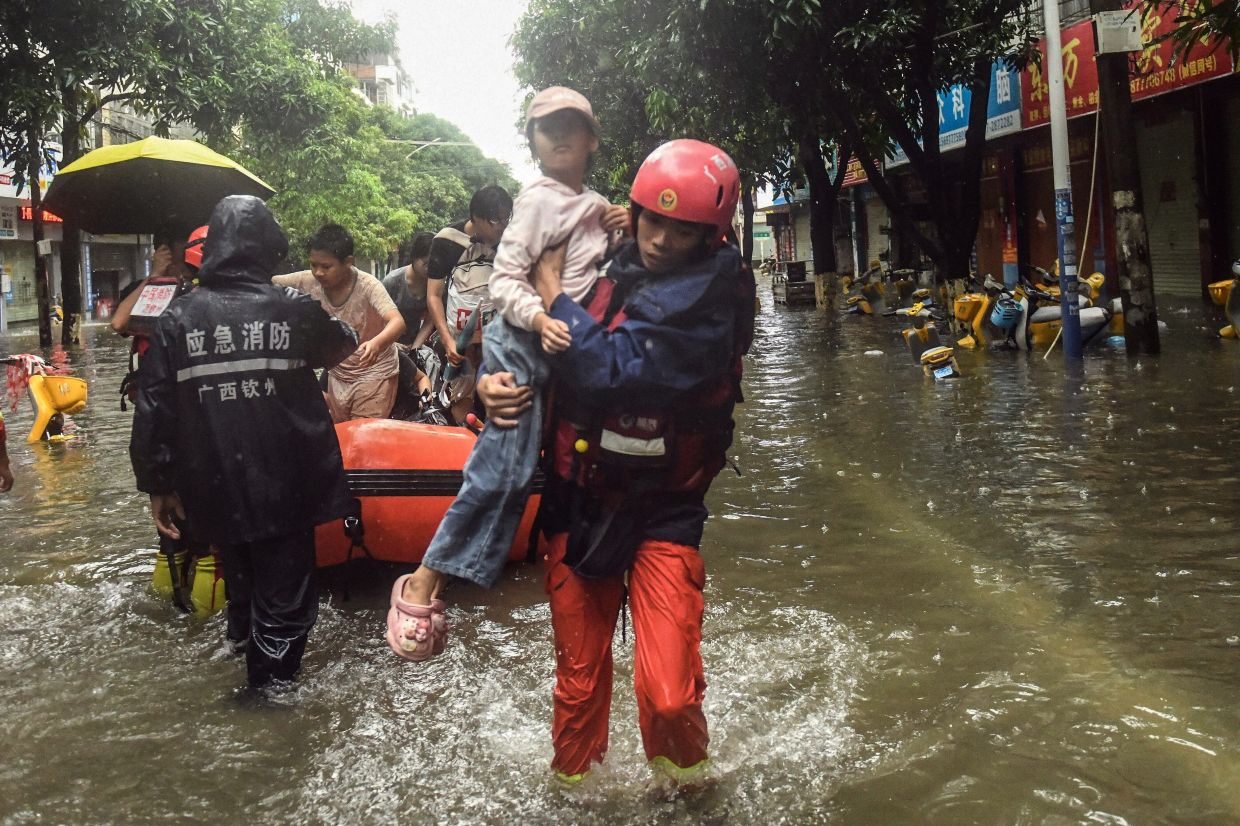
China's monsoon season has turned catastrophic, as a succession of natural disasters spanning several provinces has claimed at least 49 lives and displaced more than 100,000 people. The deadliest incident occurred in the southern Guangxi region, where Typhoon Maysak delivered torrential downpours that overwhelmed infrastructure and killed six people. State authorities mobilised one of their highest emergency response levels in the region, signalling the severity of the unfolding crisis. The situation remains fluid, with meteorological services forecasting continued heavy rainfall through Wednesday and beyond, raising the prospect of further casualties and displacement in coming days.
The flooding in Guangxi has exposed the vulnerability of critical water infrastructure in the face of intensifying storms. A major reservoir dam burst under the weight of unprecedented water volume, its concrete walls crumbling under pressure captured in footage broadcast by state media. The burst unleashed torrents that cascaded downstream, inundating agricultural lands across nearly 13,000 acres. Officials at the State Flood Control and Drought Relief Headquarters maintained the second-highest alert level for the region, reflecting deep concerns about secondary hazards including embankment failures and further dam breaches. Engineers warned that flood peaks exceeding warning levels by more than six metres were expected at the Wuzhou Hydrological Station early Thursday, intensifying pressure on already strained water management systems.
Water Resources Minister Li Guoying issued stark warnings about the compounding dangers posed by prolonged rainfall and sustained high water levels. The combination threatens the structural integrity of reservoirs and embankments across the affected zone, he cautioned, as water saturation weakens earth barriers and concrete structures face relentless pressure. This assessment underscores a growing challenge facing China's water infrastructure: climate patterns are shifting toward more extreme rainfall events in concentrated periods, testing systems designed for historical precipitation norms. The minister's remarks suggest authorities anticipate further crises in the coming days as floodwaters continue their slow progression downriver.
The scale of human displacement has been staggering, with authorities evacuating at least 130,000 people from danger zones in Guangxi and neighbouring Guangdong province. The evacuation effort required mobilising substantial logistics capabilities, as rescue workers deployed inflatable boats and life vests to extract residents from flooded communities. State authorities dispatched additional relief supplies including food, raincoats, and rubber boats to affected regions, though the ongoing rainfall is hampering distribution efforts. For those evacuated, return timelines remain uncertain, as water levels must recede and infrastructure must be assessed for safety before communities can be repopulated. The evacuation has underscored the region's exposure to catastrophic flooding, a risk that persists annually during the summer monsoon season.
The Guangxi flooding was not the only deadly meteorological event unleashing chaos across the country. Separate thunderstorms and gale-force winds devastated Hubei province in central China, killing 11 people and injuring 331 others. The province documented extensive structural damage, with 4,800 houses sustaining harm and 22 buildings collapsing entirely. One person remained missing in Hubei as rescue operations continued. Tornadoes were separately reported in other localities late Monday, though comprehensive damage assessments were still being compiled. The concentration of violent weather phenomena across multiple regions within a 24-hour window suggests a broader atmospheric disturbance rather than isolated weather systems, amplifying the overall scale of national disaster response requirements.
Northwestern Gansu province faced a distinct but equally devastating crisis, as a catastrophic landslide in Dangchang County buried residents and claimed 21 lives. The landslide struck Rencang village at approximately 6:56 am Tuesday, initially burying 33 people before rescue teams excavated the debris. As rescue operations concluded Wednesday, authorities confirmed the final death toll at 21, though investigators have yet to determine whether the landslide was triggered by heavy rainfall, geological instability, or human activity. The incident, occurring hundreds of kilometres from the main flood zone, demonstrated that China's disaster challenges extended beyond water management into terrain destabilisation. Provincial authorities responded by committing 30 million yuan in reconstruction funding, acknowledging both immediate humanitarian needs and long-term recovery requirements.
China's exposure to multiple concurrent disasters reflects geographical and climatological realities that seasonal patterns have made increasingly severe. Summer across Chinese provinces oscillates between extreme phenomena: some regions experience torrential rainfall and devastating floods, while others endure scorching heat and drought. This summer has proven particularly punishing, compressing multiple major disasters into days rather than months. The geographic scatter of incidents—from southern Guangxi to central Hubei to northwestern Gansu—illustrates that no region enjoys immunity from extreme weather. Authorities have acknowledged that natural disasters are endemic to the Chinese calendar, yet the intensity and frequency of recent events suggest that baseline planning assumptions may require upward revision.
President Xi Jinping issued instructions for rescue coordinators to mobilise resources and personnel with maximum urgency, signalling top-level government concern about the crisis trajectory. His directive to rescuers to "go all out" in emergency operations reflected anxiety that ongoing rainfall could produce additional casualties beyond the already substantial toll. The presidential intervention suggested concerns that frontline authorities required political backing to justify extraordinary resource deployment, a signal that disaster costs might strain provincial budgets. Xi's public engagement also served to demonstrate centralised authority's responsiveness to humanitarian catastrophe, a significant element of governance legitimacy in China.
For Malaysia and Southeast Asia, China's experience offers sobering implications. The region shares monsoon weather patterns and similar physiographic hazards, including vulnerable river systems and steep terrain prone to landslides. As climate patterns shift toward more intense precipitation events, Southeast Asian nations face analogous infrastructure vulnerabilities. China's disaster response—despite significant state capacity and resources—has struggled to prevent substantial casualties, raising questions about whether regional governments are adequately prepared for intensifying extremes. The Guangxi dam breach, in particular, merits attention from Malaysian water resource managers overseeing comparable structures. China's current crisis represents a preview of challenges that may intensify across Asia in coming decades as global temperatures continue rising.

